China’s embassy in Washington has posted a satirical music video that mocks American anxiety over Beijing’s economic rise, the meme diplomacy coming as policy circles warn of a “China Shock 2.0”.
The short clip, shared on the embassy’s official X (formerly Twitter) handle on Wednesday night, replaces stern diplomatic language with bright animation, internet humour and catchy rap.
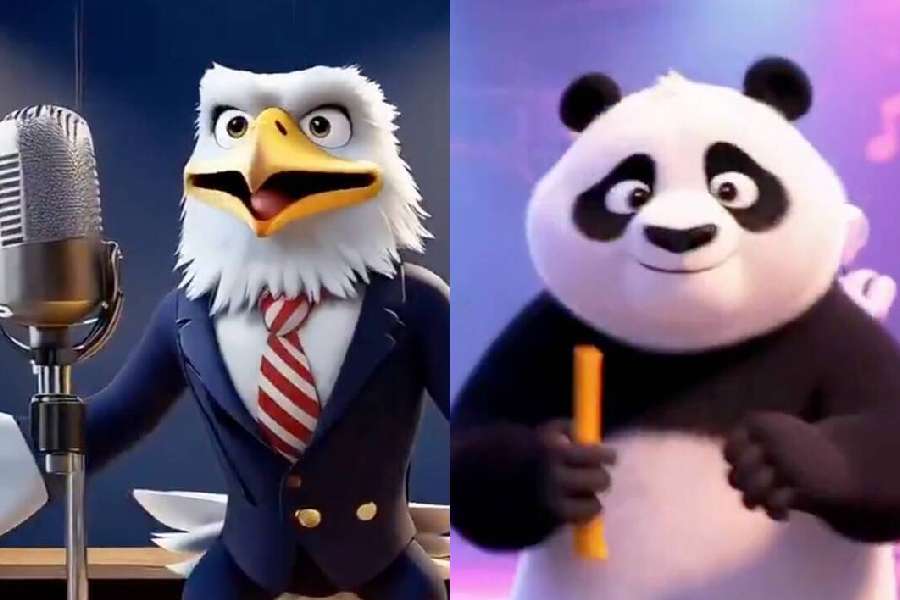
A cartoon bald eagle, the stereotypical stand-in for the US, frets into a microphone about China’s growing clout, lamenting that America “panics every time they reach the top”.
In less than a minute, the video skewers what Beijing sees as a double standard in western economic thinking. When the US leads in technology or industry, the lyrics sing, it is hailed as progress. When China does the same, it is branded “overcapacity” or a looming “shock”.
The animation is slick and polished, reminiscent of content produced by China Global Television Network.
Set in a dramatic news studio, it features flashing headlines such as “Bracing for China Shock 2.0” and “Overcapacity”, while a panda – symbolising China – is shown industriously coding, building solar panels and launching rockets against backdrops of fireworks and futuristic skylines.
Delivered in English with Chinese subtitles, the rap-style lyrics revolve around the theme that China builds “better, cheaper, faster”, and that is what really unsettles Washington.
The online reaction was swift and divided. Some praised the clip as sharp-edged trolling and a savvy piece of digital diplomacy. Others saw it as another sign of how openly combative the relationship between the world’s two largest economies has become, with even embassies now trading barbs in meme form.
The phrase “China Shock” entered economic debate to describe the upheaval triggered by China’s rise as a manufacturing powerhouse in the late 1990s and early 2000s, when western companies shifted production to Chinese factories.
That first wave helped make China the world’s leading exporter, but it also hollowed out parts of the industrial heartlands of the US and Europe.
Now, economists and policymakers warn of a possible “China Shock 2.0”. This time, the concern is not mass offshoring, but China’s push up the value chain into electric vehicles, batteries, clean energy, AI and advanced manufacturing, even as the US and its allies tighten tariffs, subsidies and investment controls.
It is that anxiety the Chinese embassy’s video seeks to puncture. Rather than issuing a formal rebuttal to American policy debates, Beijing has opted for humour and spectacle, using a format more at home on TikTok and X than in traditional statecraft.
The subtext is familiar. China wants to project confidence and portray attempts to contain its rise as panicked, hypocritical and ultimately futile.
The timing is also telling. Relations between Washington and Beijing remain strained, with trade policy, technology controls and supply chains firmly in the crosshairs.
The move also mirrors a broader trend in US political communication. Meme-style messaging has gained traction in American officialdom too.
Earlier this month, after the capture of Venezuelan leader Nicolás Maduro, the White House’s official social media accounts posted a series of viral meme videos celebrating his downfall.
Within hours of Maduro being flown to New York to face federal charges, posts featuring internet slang and patriotic imagery wrapped in humour spread rapidly online.
Against that backdrop, China’s embassy rap looks less like an outlier and more like part of a widening information contest, where trade disputes, military actions and diplomatic rivalries are increasingly packaged for viral consumption.