The handover of two JF-17 fighter jet simulators from Pakistan to Bangladesh earlier this week was a small event in material terms.
Simulators do not alter the military balance of South Asia. Yet the symbolism was very much there.
For the first time in decades, Bangladesh and Pakistan appear to be moving towards a more “structured defence relationship”, one that extends beyond ceremonial military exchanges and into procurement and strategic coordination.
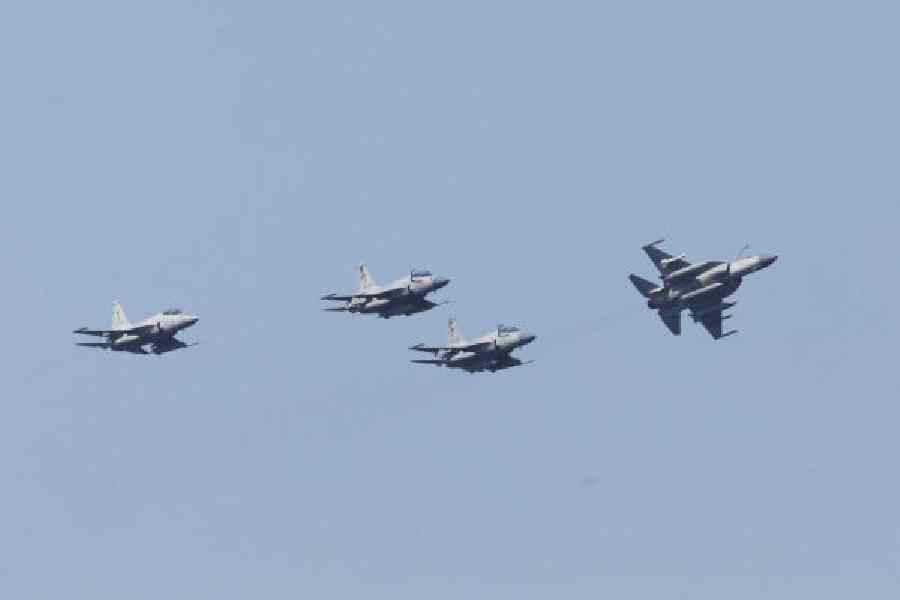
The simulators, delivered for the Bangladesh Air Force’s training infrastructure, were linked to discussions surrounding Pakistan’s JF-17 Thunder fighter aircraft, jointly developed by Pakistan and China.
According to a report in the Daily Asian Age of Bangladesh, Pakistani officials described the transfer as part of “broader defence cooperation between the two countries”.
Defence Security Asia reported that the systems were intended to “familiarise Bangladeshi personnel with the aircraft’s operational environment”, fuelling speculation that Dhaka could eventually procure the fighter itself.
That possibility has acquired greater significance since the political transition in Bangladesh following August 5, 2024, when the fall of the Awami League government and the installation of an interim administration reshaped Dhaka’s foreign-policy calculations.
Under ousted Prime Minister Sheikh Hasina, Bangladesh maintained unusually close security and political ties with India while relations with Pakistan remained constrained by historical distrust rooted in the 1971 war.
The interim government has not soured ties with India, but it has adopted a more visibly diversified diplomatic posture, reopening channels with Islamabad that had long remained politically sensitive.
Military engagement has become one of the clearest indicators of this shift. Reuters reported in January 2026 that Pakistan was seeking a formal defence pact with Bangladesh and was discussing the potential sale of JF-17 fighter jets.
Pakistani officials told Reuters that military cooperation had accelerated after the political transition in Dhaka and now included high-level exchanges, defence-industrial talks and training initiatives.
The report noted that the two countries were exploring broader defence collaboration after years of limited engagement. The warming ties have unfolded in stages.
In recent months, military delegations have travelled more frequently between the two countries. Bangladeshi officers have reportedly participated in Pakistani military programmes and exercises at a higher rate than before. Pakistan has also signalled interest in supplying military hardware ranging from trainer aircraft to more advanced systems.
The Print reported that Bangladesh and Pakistan were discussing expanded defence procurement ties, including Dhaka’s interest in the JF-17 Block III variant, Pakistan’s most advanced version of the aircraft. The report cited Pakistani and Bangladeshi officials indicating that the fighter was being presented as a lower-cost alternative to Western combat aircraft.
The JF-17 itself occupies an unusual place in Asian defence markets. Developed by Pakistan Aeronautical Complex and China’s Chengdu Aircraft Corporation, the aircraft was originally conceived as an affordable multirole platform for states unable or unwilling to buy expensive Western fighters. Pakistan has promoted it aggressively across the Global South.
According to Al Jazeera, Islamabad sees Bangladesh as a strategically important prospective customer because a successful sale would bolster the aircraft’s credibility and extend Pakistan’s defence-industrial reach beyond its traditional partners.
The Block III variant includes an active electronically scanned array radar, improved avionics and compatibility with long-range air-to-air missiles. Pakistan portrays it as a “4.5-generation” fighter, though Western analysts generally classify it below advanced Western and Chinese fifth-generation platforms.
Its principal advantage is cost. Analysts quoted by Reuters and Al Jazeera noted that the aircraft is significantly cheaper than alternatives such as the French Rafale or the American F-16.
Yet Bangladesh’s fighter modernisation plans appear to point more decisively towards China than Pakistan. Anadolu Agency reported that Dhaka plans to purchase 20 Chinese fighter aircraft worth approximately $2.2 billion.
Bangladeshi officials cited in the report did not specify the exact platform, though discussions have centred on modern Chinese fighters capable of replacing ageing aircraft in the Bangladesh Air Force inventory.
This matters because Pakistan’s defence role in Bangladesh may ultimately function less as an independent strategic axis and more as a conduit into China’s military ecosystem. The JF-17 programme itself is deeply intertwined with Chinese technology, logistics and financing.
Any Bangladeshi acquisition would therefore increase Dhaka’s dependence on Chinese defence supply chains, regardless of whether the aircraft is formally purchased from Pakistan.
That dynamic is especially relevant given Bangladesh’s broader military procurement history. China has long been Bangladesh’s principal arms supplier. According to Stockholm International Peace Research Institute data frequently cited by regional analysts, most major Bangladeshi defence acquisitions over the past two decades have originated from China, including submarines, frigates, tanks and missile systems.
In that sense, Pakistan’s “growing defence role” in Bangladesh may represent not a strategic realignment away from China but rather an extension of Chinese influence through a politically less sensitive intermediary.
Still, the optics are geopolitically potent because of South Asia’s history. Relations between Bangladesh and Pakistan have remained burdened by unresolved questions surrounding the 1971 liberation war, including wartime atrocities and demands for an official apology from Islamabad.
For decades, Bangladeshi political leaders calibrated relations with Pakistan carefully to avoid domestic backlash. The recent military cooperation, therefore, carries symbolic weight disproportionate to its operational scale.
Strategic commentators from India have responded with visible concern. Middle East Eye reported that India’s security establishment increasingly views Pakistan’s growing presence in Bangladesh as strategically troubling.
Indian analysts quoted in the report argued that Islamabad was exploiting the political transition in Dhaka to regain influence in a country New Delhi had long regarded as part of its immediate strategic sphere.
The anxiety is partly geographical. Bangladesh occupies a crucial position along India’s eastern flank, bordering several sensitive northeastern states connected to the Indian mainland through the narrow Siliguri Corridor.
Any increase in Pakistani military or intelligence influence in Bangladesh inevitably resonates strongly within Indian strategic thinking because of the region’s insurgency history and longstanding India-Pakistan rivalry.
Indian media coverage has often framed the developments in alarmist terms. Reports in Indian outlets have described an “expanding Pakistani footprint” in Bangladesh and warned of a possible erosion of India’s regional influence.
Some commentary has linked the defence cooperation to broader fears about China’s encirclement strategy in South Asia. Yet much of this analysis risks overstating the immediacy of the shift.
The evidence so far suggests that Bangladesh is pursuing diversification rather than alignment. The interim government, as well as the new government of the Bangladesh Nationalist Party (BNP), seem determined to demonstrate greater foreign-policy autonomy after years of being perceived by critics as excessively close to India under Hasina’s regime.
Re-engagement with Pakistan serves that political objective while also broadening Bangladesh’s bargaining leverage with larger powers.
Nor has Dhaka abandoned security cooperation with New Delhi. Intelligence coordination, border management and economic ties between Bangladesh and India remain extensive.
India is also deeply integrated into Bangladesh’s infrastructure, energy and trade networks in ways Pakistan cannot realistically match. The expansion of defence contacts with Islamabad, therefore, reflects a recalibration.
At the same time, Pakistan clearly sees opportunity. Islamabad has struggled for years with diplomatic isolation in parts of South Asia and limited success in exporting defence equipment. Bangladesh offers both strategic and commercial potential.
A successful JF-17 sale would provide Pakistan with a major export breakthrough while signalling that it can compete in regional defence markets despite economic constraints at home.
Now, whether this cooperation between Bangladesh and Pakistan matures into a lasting strategic partnership remains uncertain.
Historical mistrust between the two societies remains substantial, and Bangladesh’s military procurement decisions are ultimately driven more by capability requirements and Chinese financing than by ideological affinity with Pakistan. Moreover, any overtly anti-Indian posture would carry serious economic and geopolitical risks for Dhaka.