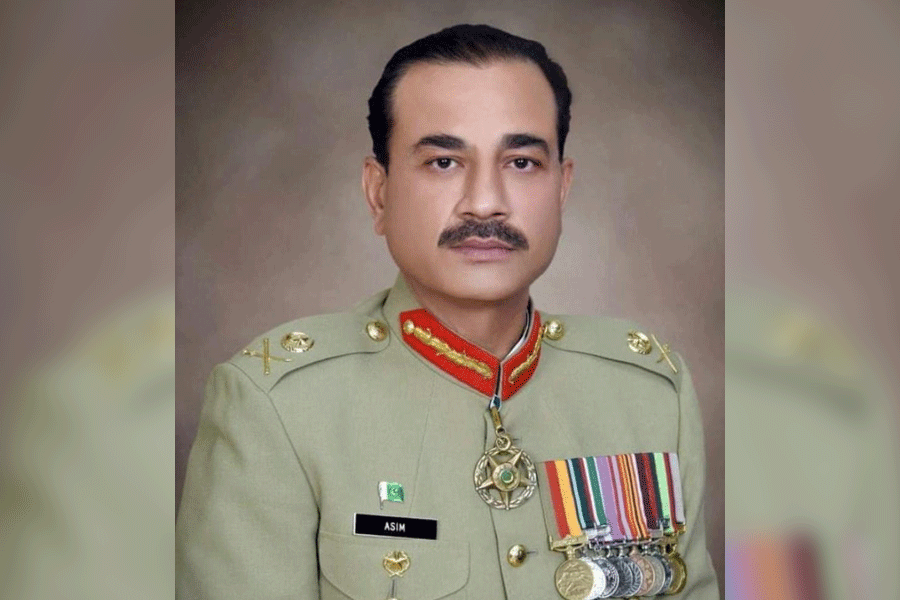
Pakistan's Chief of Defence Forces (CDF) Field Marshal Asim Munir on Thursday said the fight against terrorism would continue until enduring peace and stability are achieved across the country.
He made the remarks while addressing a ceremony at the General Headquarters (GHQ) in Rawalpindi, where military awards were conferred on officers and soldiers of the armed forces, the Pakistan Army said in a statement.
The decorations included 50 Sitara-i-Imtiaz (Military) and 12 Tamgha-i-Basalat awards.
Commending the operational preparedness and resolve of the Pakistan Army and law enforcement agencies, Munir lauded their sustained efforts against terrorists.
He “reaffirmed that the fight against terrorism will continue with full national resolve until enduring peace and stability are achieved across the country”, the statement said.
Munir is also set to travel to Tehran on Thursday as part of Pakistan’s mediation efforts and consultations between Tehran and Washington over the Iran war, Iran’s ISNA news agency reported.
India raises Afghan civilian deaths, 1971 East Pakistan crackdown at UN
India sharply criticised Pakistan at the UN Security Council on Wednesday, highlighting Afghan civilian deaths and injuries caused by cross-border violence by Pakistani military forces and saying such “heinous acts” should not come as a surprise from a country that “bombs its own people and conducts systematic genocide”.
In a strong retort during the UNSC Open Debate on ‘Protection of civilians in armed conflict’, India’s Permanent Representative to the UN Ambassador Harish Parvathaneni called out Pakistan’s “long-tainted record” of genocidal acts after Islamabad’s envoy, Ambassador Asim Iftikhar Ahmad, raised the issue of Jammu and Kashmir during the debate held under China’s presidency of the Council for May.
“It is ironic that Pakistan, with its long-tainted record of genocidal acts, has chosen to refer to issues that are strictly internal to India,” Parvathaneni said, referring to United Nations Assistance Mission in Afghanistan (UNAMA) estimates that documented 750 civilian deaths and injuries in Afghanistan in the first three months of 2026 due to cross-border armed violence by Pakistani military forces, most of them resulting from air strikes.
According to UNAMA, 94 of the 95 incidents involving civilian casualties were attributed to Pakistani security forces.
Parvathaneni further alleged that Pakistan carried out a “barbaric airstrike” on the Omid Addiction Treatment Hospital in Kabul during Ramzan in March.
Citing UNAMA estimates, Parvathaneni said the strike killed 269 civilians and injured 122 others at the facility, which “by no means can be justified as a military target”.
Calling it hypocritical to espouse international law while targeting innocent civilians, the Indian envoy noted that the strikes were carried out after tarawih evening prayers, when several patients were leaving the mosque.
He further pointed to UNAMA estimates that more than 94,000 people had been displaced due to cross-border armed violence against Afghan civilians.
“But such heinous acts of aggression by Pakistan should not come as a surprise from a country that bombs its own people and conducts systematic genocide,” he remarked, recalling Operation Searchlight in 1971, when Islamabad had sanctioned a “systematic” campaign of genocidal mass rape in former East Pakistan, now Bangladesh.
Parvathaneni said such conduct reflected Pakistan’s repeated attempts to externalise internal failures through violence both within and beyond its borders, adding that “the world can see through Pakistan’s propaganda”.
He also accused Pakistan of ignoring UN Secretary General Antonio Guterres’ call urging member states to uphold international obligations related to civilian protection, including the principle of non-refoulement in the context of Afghanistan.
India further voiced concern over the persistent threat posed by cross-border terrorism, which it said continues to undermine regional peace, stability and international security.
“India has been a victim of such form of terrorism for decades. States that sponsor, shelter or support terrorism must be held accountable,” Parvathaneni said in an apparent reference to Pakistan.
He stressed that terrorism in all its forms remains one of the gravest threats to civilians worldwide and asserted that no cause or grievance can justify deliberate attacks against civilians.
Parvathaneni also warned that the use of missiles, bombs and other explosive weapons in cities and populated areas continues to cause large-scale civilian harm.
“The growing trend of use of drones to deploy explosive weapons in urban areas is especially concerning,” he said.
He added that the use of emerging technologies, including artificial intelligence and autonomous systems in conflict, must conform to international law and humanitarian principles, stressing that safeguards should be in place to prevent misuse and unintended harm to civilians.
“Protection of civilians cannot be achieved through humanitarian responses alone. The targeted use of violence against civilians to achieve political objectives, including terrorism, must be addressed comprehensively,” Parvathaneni said.