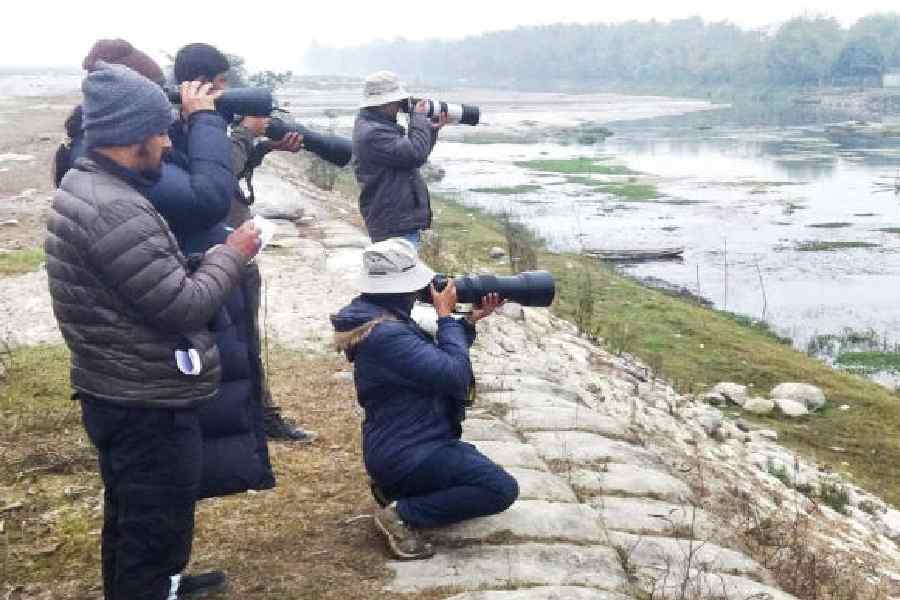
The month-long annual waterfowl count (AWC) began in north Bengal on Sunday, with preliminary data suggesting a decline in the number of migratory birds visiting the region from Central Asia and Siberia this winter.
The survey, conducted by the NGO Himalayan Nature and Adventure Foundation (HNAF), commenced at the confluence of the Teesta and Karala rivers on the outskirts of Jalpaiguri.
The total count will be made public at the end of the month-long survey, which will cover major wetlands and riverine stretches across Cooch Behar, Alipurduar and Jalpaiguri.
Animesh Bose, veteran environmentalist and programme coordinator of HNAF, said the inaugural day’s count was not encouraging.
“We had apprehended earlier that the massive amount of silt deposited in wetlands across Jalpaiguri and Cooch Behar districts during the floods of October 2025 would badly affect their flora and fauna. On the first day of this year’s AWC, we observed a decline in bird turnout at the Teesta–Karala confluence compared to last year,” Bose said.
In the previous season, the NGO recorded 319 birds at the same location.
Every winter, migratory birds like the Brown Shrike, Bar-headed Goose, Northern Pintail, Gadwall and Common Teal, along with herons and storks like the Asian Openbill, arrive in north Bengal from Central Asia and Siberia in search of food and warmer climates.
The October floods have devastated large parts of Alipurduar, Jalpaiguri and Cooch Behar districts, washing debris and silt into wetlands that annually attract thousands of such birds.
According to Bose, an eight-member HNAF team participated in the inaugural day of the waterfowl count with foresters from the Jalpaiguri forest division.
Survey sites include Gajoldoba, Fulbari, Jaldapara National Park, Gorumara National Park, Nararthali Beel, Rasikbil, Noukabehar — the confluence of the Murti, Jaldhaka and Diana rivers — Domohani, Gosaihat, the Gholani river stretch and the Teesta–Nandikhola area across the three districts.
“Our next count will be conducted at Rasikbil in Cooch Behar on Monday,” Bose said.
Once the AWC is completed, the findings will be forwarded to the International Wetlands Bureau through the state biodiversity board to update its database.