 |
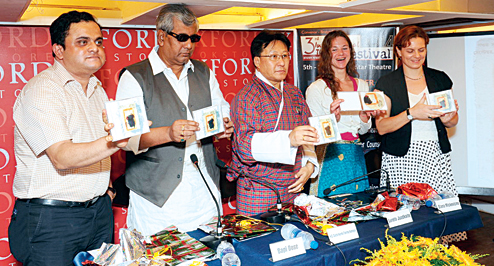
| The digital version of the Bratyajon magazine being released by (from left in picture by Sanjoy Chattopadhyaya) Bratya Basu, Bapi Bose and others at Oxford Bookstore and (below) a scene from Zindagi aur Jonk, one of the plays at the festival |
Masked dancers from Bhutan seemed to fly through the air in a swirl of colours, Grigore Lese and Carmen Vasile presented the unique mono operas Old Romanian Tales and Nala Damayanti Soul Birds and Soda Model group from Thailand staged regional versions of Indian epics through myriad folk forms. All at the third Bratyajon International Theatre Festival.
At a press conference to announce the festival, Bratya Basu, the founder director of Kalindi Bratyajon, had urged the city audience to sample plays from beyond Bengal because “theatre has its own language”.
But Star theatre, the venue for the plays, did not fill up to capacity on all days, prompting Basu to voice his disappointment at the closing ceremony. Calcutta, he rued, had missed out on “some rare and very important world-famous performances”.
 |
The festival included 11 performances by groups from Lithuania, Thailand, Bhutan and Romania as well as plays in Hindi and Bengali.
“Since ultimately this is done for the audience we may have to change the venue to make this festival more accessible to people,” he said.
The highlights of the festival included Zindagi aur Jonk, a play by Bansi Kaul. Performed by Rang Vidushak of Bhopal, the play had a striking stage design. Based on a work of Amarnath, the plot revolves around a mentally unsound beggar, Rajua Sala.
“The irony is that society is unwilling to acknowledge such people, they see them as freeloaders. But it is the mohulla (neighbourhood) that is the parasite. So life makes jonks of us all,” Kaul told Metro.
Bapi Bose, a Delhi-based director presented a Hindi play, Seventeenth July, on the use of communal sentiments to instigate political disturbances.
The fare from the city included Kharir Teer (Chalk Arrow) with Arpita Ghosh in the lead and Ballygunge Swapnasuchona’s Kanyadaan.
Kharir Teer takes off from the discovery of a chalk arrow mark on the door of a lady who is a central minister and a former theatre artist. “The play is written by a young member of Naihati Somoy which I found very relevant,” said Ghosh, who has also directed the play.
She also acted in a play written by Basu and directed by Debesh Chattopadhyay, Apatoto Ei Bhabe Dujoner Dekha Hoye Thake.
Kanyadaan, a Bengali adaptation of Vijay Tendulkar’s 1983 play, is directed by Basu, who also acts in it along with Meghnad Bhattacharya, Swatilekha Sengupta and Sohini Sengupta.
Hosts Kalindi Bratyajon staged K?, a pseudo-thriller featuring Ritwick Chakraborty, and Cinemar Moto, both written and directed by Basu.
The festival also saw the release of the latest issue of the Bratyajon magazine in a CD version. “We have always tried to keep up with the times and reach out to the largest number of people. The involvement of the young is urgently needed,” said Basu, explaining the need to go digital.