 |
 |
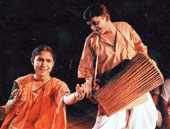
| Moments from Chandali (top) and Phera |
On her recent visit to the city, writer Ketaki Kushari Dyson had complained that women?s problems, ?especially the smaller issues of daily living?, rarely made it to the Calcutta stage. What do women directors and writers have to say? Is it because some like Saoli Mitra believe that the problems of men and women cannot be seen separately, or is it because the ?male-dominated? society refuses to allow the real woman to emerge as Taslima Nasreen maintains?
?This is a patriarchal society and men like to see women in docile roles. She should be attractive but shy. Play perfect lover and housewife. Even if she should revolt, the revolt has to be within limits. Above all, hers should be a side role,? feels Taslima Nasreen who is currently having two of her books dramatised and staged.
Phera, which debuted in Calcutta about four years ago, returned recently at the 25th anniversary of Aitijhyo Natyapith at Madhusudan Mancha. The play was directed by Himangshu Das and dramatised by Krishna Kumar Ghosh.
Lajja, Nasreen?s second novel to be dramatised, this time by Swaroop Sarkar of Suchandra Natya Sangstha, will be staged at Bally on February 12. Phera will be put up again at Rajarhat by Aitijhyo this month-end.
?Neither Lajja nor Phera are plays dealing exclusively with women?s issues. There is a lot more? the partition, the violence and the pain. But yes, women occupy central positions,? says Nasreen.
Phera centres around Kalyani (played by Runa Mukherjee) and her yearning to return to her childhood home in Bangladesh. But beyond the effervescent nostalgia, the kaleidoscope of changing relationships and religious tension, one sees in this play poignant glimpses into the lives of urban middle class women.
The toll the Partition has taken on Kalyani ? from being assaulted at her aunt?s home to seeking security in marriage, trying to relive her lost childhood and crossing the border only to find everything mutilated and twisted.
Nasreen feels people hesitate to approach bold statements, as in her works Farashi Premik and Shodh, which she remembers had scared away some film producers with its ?startling ending where an abused housewife takes violent revenge on her husband?.
Also playing in the city is Pancham Vaidik?s latest production Chandali. Director actress Saoli Mitra chose to adapt this earlier version of Tagore?s dance drama Chandalika as it ?spoke eloquently of human ambition?.
The play focuses on two women and their individual journeys. Though it ends with death, there is hope and self-realisation.
?Even Ibsen?s plays are not only about women?s emancipation,? says Saoli, who has recently returned from Norway with the prestigious Ibsen Award for Putul Khela, the Bengali stage adaptation of A Doll?s House.
?The fact that Nora (A Doll?s House) leaves her home is just as important as the fact that she is going on a quest for truth. The social pressure is visible equally on Nora and her husband. To address women?s problem?s only would be a simplification,? stresses Saoli.