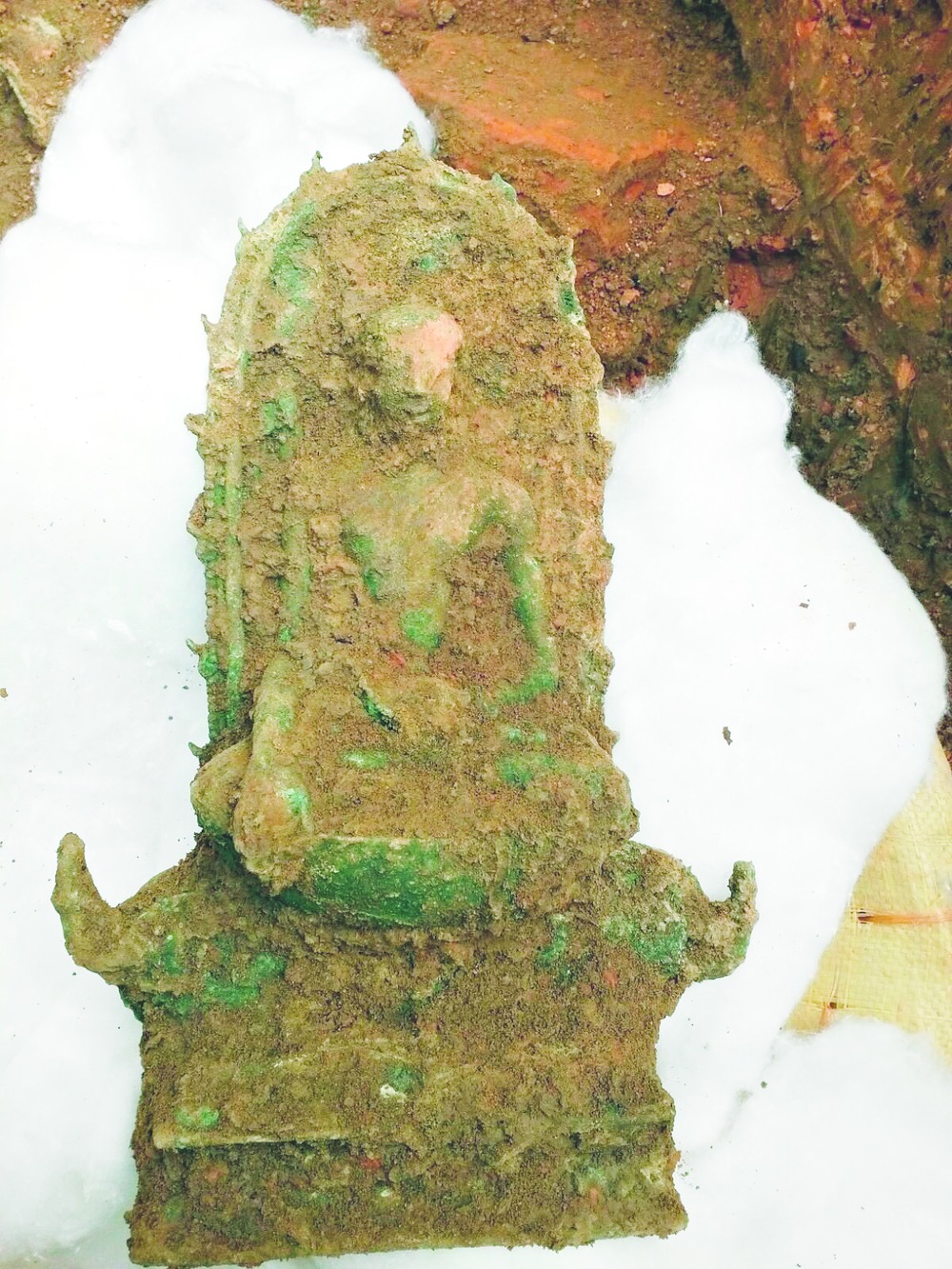


Ninety-one bronze statues of Buddhist deities have been unearthed from the Sakhisen mound at Moghalmari, in Danton in West Midnapore, establishing it as the site of a 6th century Buddhist vihara (shrine).
The statues were found in a trench 1 metre long and 50cm wide, at a depth of 1.6m, during an excavation by the state archaeology department.
"We now have irrefutable proof that this was a Buddhist vihara of importance," said Prakash Chandra Maiti of the archaeology department, who is leading the excavation.
"Finding such a hoard of sculptures is very rare. It seems the sculptures had been deliberately stashed out of sight to protect them from the marauding Huns or other foreign attackers. These seem to be from the reign of Samachardeva, a strong independent ruler from the little-known post-Gupta era."
The fragile statues will be transported to Calcutta for cleaning and preservation. Once the soil is removed and salinity neutralised, the finds will undergo chemical treatment.
Maiti said the Buddhist deities found in the mound were of all kinds. "As far as I can make out, there are Avalokiteshvara, Tara, Saraswati, Hariti and many others. One has the lambakarna Buddha in a bhumisparsa mudra on a lotus with prabhavali (decorative arch like a halo) and ushnisa (crown of hair)."
The sculptures and a small votive stupa were found in the second of the three phases of constructions noticed in the mound. Digging in the first phase this season has yielded the wheel of a toy clay cart, fragments of a basalt sculpture, a clay lamp, decorative stucco fragments, terracotta pottery, hopscotch, iron nails, shell bangles and beads of terracotta and stone.
Maity feels the stone sculpture fragments found on the upper layer seem to indicate mutilation and destruction by humans.