
Calcutta: The Victoria Memorial Hall galleries will be redesigned as part of a Rs 60 crore modernisation and upgrade plan sanctioned by the Centre in 2014.
This is the first major intervention at the nearly century-old monument since its inception. The modernisation programme presented the museum guardians with an opportunity to carry out a comprehensive overhaul of the ageing display system that often clashes with the grand interiors.
The gallery display will be reorganised by city-based architect Abin Chaudhuri, in consultation with the Victoria Memorial curator, Jayanta Sengupta, and a committee of technical experts.
"A tender was floated two months ago and eight architects were shortlisted. We had to make a presentation on Victoria Memorial - Modernisation in front of a jury," said Chaudhuri , whose studio won the Rs 18-crore project.
The artefacts could be displayed chronologically, following a broad timeline from the late 16th century to 20th century, starting with the late Mughal period to the East India Company, Sepoy Mutiny, the British Empire and then on to nationalism.
"The collection could be reoriented according to this timeline though it is not adequate to cover the entire timeline," Sengupta said. "We are thinking about how to do it."
British and European art that represent the Western visualisation of India, including the works of Thomas and William Daniel, Johann Zoffany, Tilly Kettle and William Hodges, will be on the ground floor. The swadeshi art of Abanindranath and Gaganendranath Tagore will be on the first floor.
"There is a need to rethink the curation of the gallery. After 71 years of Independence, the museum cannot just showcase the pageantry of the Empire. We need to retell the history and imperial art will, of course, be a big part of it," Sengupta said.
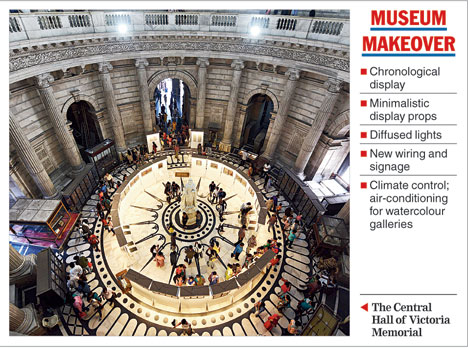
The display system would be overhauled to expose the red sandstone architecture inside. "All the box-type partitions, false ceilings and running plywood will go. The display props will be minimalistic to highlight the interiors and exhibits," the curator said.
The old display cabinets could be retro-fitted and reused. There will be new wiring, new signage and climate control. Lighting will be diffused. "It will not be possible to air-condition the whole monument as that would be prohibitively expensive. Air-conditioning will be limited to galleries, particularly those which house the water-colours on paper and textiles. Oil paintings adapt to weather," he said. Ventilators will keep the air in circulation.
Architect Chaudhuri's presentation was aimed at "exemplifying the intrinsic grandeur" of the Victoria Memorial. "The most striking architectural aspect of the Victoria Memorial is its symmetry," he said. "The well-defined strong axis along the main public entrance highlights this symmetry. Minor axes run along the gardens and water bodies. The public entrance and circulation is planned along the axis and heighten this experience to inspire awe and grandeur."
Chaudhuri's approach to redesigning the display at Victoria Memorial is derived from these key concepts of symmetry, strong axes and circulation. His suggestions include low-height displays, pedestals created to emphasise objects of importance and niches used for customised display of important objects relevant to the gallery theme.
Visual storage is another concept that could be introduced at Victoria for the first time in the country. "Only 10 to 12 per cent of the collection is displayed. And 90 per cent of the collection is in storage. Ideally, we should have a four-year cycle of rotation. But we often cannot do that," Sengupta said. So Chaudhuri has proposed Leica file cabinets to showcase the stored paintings.
Chaudhuri's ideas are being discussed in detail by Sengupta and his team of experts.