 |
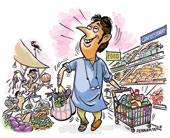
Bhajaharibabu just needed to stare at the tomatowala. His face would darken. His eyes would narrow, his nostrils would flare. The other market-goers would collect around him. Bhajababu would remain still. The tomatowala would stretch his hand: Bhajababu carried his own scales and weights. “Bajar koratao ekta art (Going to the market is an art too),” Bhajababu would say finally.
The impassioned bajar-goer from Shirshendu Mukhopadhyay’s Manojder Odbhut Bari (Manoj and His Strange Family) is a Bengali institution — the man for whom going to the marketplace is an incurable addiction. It is where he finds his objects of desire: he marvels at the perfect shape, the glistening skin and the delightful colour of the potol. When he reaches out, his touch is almost a caress.
The marketplace is also where he finds his social standing, towering over the vegetable seller, telling him a thing or two about what he thinks about the bandhakopi in particular and the world in general. “Koto nebe (What’s the price)?” he asks. “Arey babu, apni choice korun, daam niye bhabchhen keno (Make your choice, why are you worrying about the price)?” pleads the vanquished vendor.
Foodies in thought
It has been a way of life. “Bengalis are not just foodies, they start enjoying their meal right from buying the raw materials,” says Rakhi Purnima Dasgupta of Kewpie’s. She says that many customers at her restaurant, which specialises in Bengali cuisine, ask her from where the ilish or beckti is. “I tell them I haven’t caught it, so I really don’t know,” laughs Dasgupta.
But Bhajaharibabu faces a challenge now. The world, including Calcutta, is divided into those who goes to the bajar and those who go to the retail store, to buy vegetables and grocery off the shelf. The latter is the new Calcuttan.
He doesn’t like the mud, the slush and the fish smells of the marketplace. He likes to push a glass door instead. Though traditional markets thrive, more and more Calcuttans are making the switch from the market to the swanky retail outlet.
As these stores become more popular, the traditional bajar looks set to change its character.
Many of the retail stores are one-stop-shops for “everything that you will need throughout the week”. Many of the store-goers are the rushed, “no-time-for-anything” professionals. Shikha Sharma, a young Phoolbagan resident, visits the Food Bazaar at Pantaloons Kankurgachhi. “I don’t have time for shopping daily. I usually stock up on groceries and vegetables on Saturdays for the entire week. I don’t need to visit many shops. It’s so much cleaner than the local market,” says the software professional.
One of the first outlets in the staples and fresh produce sector was the Food Bazaar on VIP Road, which opened in 2002. Over the next seven years, 12 more Food Bazaars opened shop in the city.
“Our business is growing at 30 to 35 per cent in Calcutta annually,” said Sandeep Marwaha, the head of operations (east) of Pantaloon Retail, which owns Food Bazaar. It’s the same story for Spencer’s Retail of the RPG Group. Spencer’s set up shop in Calcutta in March 2007 with a small store in Alipore. Today they have 20 outlets and are counting.
In terms of floorspace, Spencer’s Retail has grown from 4,000sq ft to 1.5 lakh sq ft in two years in Calcutta. That’s big business. And worth the initial hiccups such as the resistance from Left-wing labour unions as faced by the Metro Cash and Carry wholesale outlet on the Bypass or the ire of hawkers that scuttled the grand opening of the Spencer’s store on Rashbehari Avenue.
The steady footfall of a certain section of shoppers has helped the retail stores overcome the hurdles. Working couples, short of time and lacking their parents’ market acumen, prefer to shop at branded outlets in air-conditioned comfort.
The Sanyals of Salt Lake EC Block do their weekly shopping at C3 at City Centre. It’s easier to shop at such stores if you have kids in tow. “My boys would run riot at the local market. At C3, they behave themselves as they know our next stop would be Pizza Hut or KFC,” smiles the young mother.
Subhanil Roy, 30, says he prefers retail stores as the market “intimidates” him. “I accompanied my father to Gariahat market recently and was repulsed by the filth and the haggling. I would never know if the fishmonger was giving me good fish or whether he was ripping me off! I’d rather go to a retail outlet — they may charge a little more but at least I wouldn’t be taken for a ride,” he says.
Shopping abroad
Gairik Das, the head of the department of retail management at IISWBM, attributes the growing popularity of retail to the changing socio-economic dynamics. “Customers are more sophisticated. Many have been abroad and have seen the quality of products and the service at department stores there. When they return home, they want to shop in comfort and style too, never mind a few extra bucks.”
Das says he was recently appalled to see someone buying daab at a Spencer’s outlet. “But it’s a new experience for some people and they enjoy shopping for everyday items at a plush store,” he says.
Retail outlets give the customer standard prices, particularly in case of open-ended products that do not have an MRP (maximum retail price), stresses Marwaha of Food Bazaar.
“The price of staples like rice, dal or sugar and fresh produce keep fluctuating. Most customers don’t have the time to track such variations. When they buy from us, they are assured of getting the benefit of any price slash,” he says.
Not too machh
Retail stores are winning over members of Bhajababu’s tribe too. Das cites the example of a retail chain’s outlet in Uttarpara, which is thronged by the same people who would jostle at the local market till the other day. “In fact, the chain’s store in Uttarpara, on the city outskirts, is more successful than their outlet in Kankurgachhi,” he said.
But Bhajababu could flaunt the variety of fish he’s bought. Retail stores are yet to match the market when it comes to range of products.
“Take tangra fish. While one can pick from big, medium or small tangra at Gariahat market, retail outlets usually stock only one kind of tangra, that too in limited quantity,” says Rakhi Purnima Dasgupta.
The retail food stores in the city are a far cry from their counterparts in the West, where the shopper can choose from a wide range of meat and dairy products and farm produce. Fresh produce constitutes only 3 to 4 per cent of the stocks at Food Bazaar.
“We stock fresh produce (fruits, vegetables and dairy products) to give the customer a complete shopping experience,” says Marwaha, who adds that he sees customers moving from buying loose staples to packaged products.
Spencer’s offers a wide range of loose products, which are a little cheaper than packaged ones.
But if retail stores cannot match a market’s range, they will say they sell even 50g cumin seeds, with the weight correct — and, which impresses a shopper in the country most — the weight and the price on a printed slip! Plus there are the “exotic and foreign” foods: bell peppers, yellow and red, cabbage, purple, broccoli, parsley, button and oyster mushroom. Marinated pomfret or stuffed duck....
No harm in this, for the average Bengali’s dinner table is also changing. For not only does he have a “lunch” and “dinner” now, instead of the “dupurer” and “rattirer” khaoa of yore, he has also got hooked to the taste of mushroom and babycorn, which often appear in home-cooked delicacies along with chitol machher muithya and potoler dolma.
So is the bajar changing too to keep up with the trend?
“I get delightfully fresh and white mushrooms at AE Market,” says Salt Lake resident Chandni Bhattacharya.
It seems to be happening to an extent.
In some cases, the bajar will embrace the store, as in Lake Mall, the future avatar of Lake Market. The decaying municipal market is being transformed into a multi-storeyed mixed format mall, at an estimated cost of Rs 70 crore. There will be a multiplex, a 40,000sq ft Big Bazaar, apparel showrooms as well as shops selling fresh produce. Two hundred and fifty shopkeepers from the former market will be accommodated on the ground floor of the mall in a “cleaner, formatted ambience”.
Mall model
Six markets were slated for repair and renovation in Salt Lake — AB-AC, AE, CA, CK, EC and BD. The Bidhannagar municipality wants to demolish the old structures, dilapidated and dangerous, and build multi-storeyed malls in partnership with private players, though the shopkeepers are opposed to the idea. Only BD market’s makeover into a mall had made some headway, but even that was stalled over relocating the shops to BD Park, which the block residents opposed.
The College Street Market will transform into the country’s first integrated book mall, Varnaparichay. The ground and first floors of the 1.2 million-sq-ft mall will rehabilitate the 950-odd tenants of the market, who have now been shifted to Marcus Square. It’s inspired by the Ibn Battuta Mall in Dubai, says an official of the Bengal Shelter Housing Development Ltd. VIP Market is slated to get a makeover soon.
In any case, there will be more retail stores.
A Reliance official says that since organised retail penetration in Calcutta is minuscule compared to cities like Hyderabad or Chennai, retail players are bullish on Calcutta and the city will see many more retail outlets in coming days. The Spencer’s outlet at South City Mall sees the largest footfall in any Spencer’s store across India — around 2.5 lakh customers monthly. Buoyed by the response in Calcutta, Spencer’s is readying to launch an outlet dedicated to fish and meat products at Sodepur.
The bajar thrives, but there’s no denying that rows of neatly stacked vegetables and frozen fish and meat will denote bajar for many more Bengalis in the days to come.
So what about Bhajababu?
An official at Reliance Fresh put things in perspective. “The local market and retail outlets are not in an either/or relationship — there is space for both formats in Calcutta. It’s not a static market — the same customer may visit the sabzi mandi one day and the retail store on another.”
Maybe Bhajababu will wander into a retail store one day, if only to scoff at it.