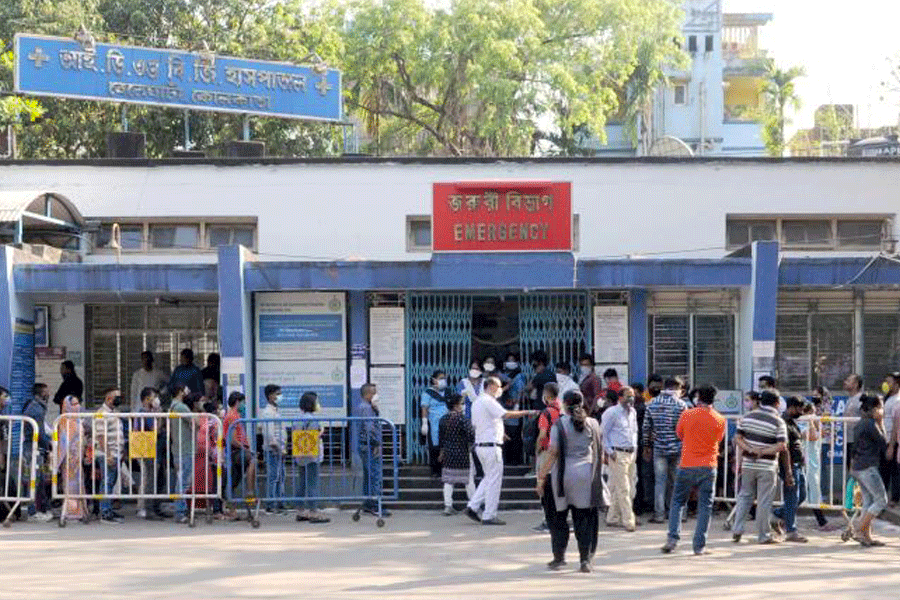
Two nurses who tested positive for the Nipah virus have been admitted to the Beliaghata Infectious Diseases (ID) Hospital in Kolkata, with their condition described as extremely critical, a senior state health department official said on Wednesday.
Both health workers tested positive for the virus on Monday. One of them was brought to the Beliaghata ID Hospital on Tuesday night, while the other, a house staff member, was shifted early Wednesday from Burdwan Medical College and Hospital, the official said.
“The health condition of both of them remains extremely critical. They are still in a coma and admitted to the ICCU,” the official of the health department told PTI.
Incidentally, a resident medical officer (RMO) at Barasat hospital, who had been in contact with the infected nurses, also showed symptoms of Nipah, he said.
“The RMO has been placed under isolation, though tests conducted at the Virus Research and Diagnostic Laboratory (VRDL) at Kalyani AIIMS, including nasal swab, blood, urine, and throat swab, came back negative,” he added.
According to state health department sources, one of the nurses had recently returned from her hometown in Katwa in Purba Bardhaman district, where she fell ill and was initially admitted to a local hospital on December 31.
“As her condition worsened, she was transferred to the Bardhaman Medical College, and then by a special ambulance to the Barasat hospital before being moved to Beliaghata ID Hospital,” an official said.
A source said the other nurse had a history of travelling to Ghugragachi in Nadia district, located near the India-Bangladesh border.
Meanwhile, an anti-viral drug widely used during the Covid-19 pandemic is being administered to the two nurses, who work at the same Barasat hospital where they are currently admitted.
Remdesivir could not initially be sourced by the private hospital, but the state health department procured and supplied the drug, sources said.
Samples of the two nurses, sent to the National Institute of Virology (NIV) in Pune, tested positive for Nipah, state government officials confirmed on Tuesday. The health department has also issued a treatment guideline to the private hospital.
“While one of the nurses is in a coma, the condition of the other has improved slightly, but remains very critical. Remdesivir is now being administered to both patients,” said a state government official. The drug will be given for five to nine days, depending on the patients’ response.
Alongside remdesivir, another anti-viral drug, ribavirin, is also being administered, sources said. “Ribavirin is given twice a day. However, there is uncertainty about its effectiveness against Nipah,” an official said. A third anti-viral drug, favipiravir, is also under consideration, according to health department sources. “However, favipiravir is not available at present,” the sources said.
In addition to anti-viral medication, the nurses are receiving supportive care. “They are suffering from severe respiratory distress, and respiratory support is being provided,” a source said.
“Remdesivir has been used for Nipah virus on a compassionate-use basis, particularly during outbreaks in Kerala,” an official said.
Experts, however, cautioned that there is no proven anti-viral treatment for Nipah virus infection, although some drugs have been tried during earlier outbreaks.
“A Lancet article published in 2025 identified remdesivir as a candidate drug that could be evaluated in trials for the treatment of Nipah virus,” said Chandramouli Bhattacharya, an infectious diseases expert based in Calcutta. “Remdesivir was also used in the treatment of Ebola, though without success,” he added.
Bhattacharya said ribavirin is approved globally for the treatment of Hepatitis C and has seen experimental use in diseases such as measles and respiratory syncytial virus. “There are also reports of its use during Nipah outbreaks,” he said.
He underlined that healthcare workers face the highest risk of infection during Nipah outbreaks. “It is very important that those working in medical facilities have proper awareness,” he said.
Favipiravir, currently unavailable, is an anti-viral drug developed in Japan and primarily approved for treating influenza. Experts said it has also been used on an emergency basis for other viral infections, including Ebola and Covid-19, and has previously been administered on a compassionate basis during Nipah outbreaks in Kerala.
Nipah virus is a notifiable disease, requiring immediate reporting to the central government.