 |
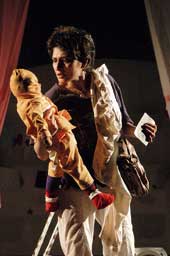
| Roopa Ganguly in Suprabhat at Sujata Sadan. Picture by Aranya Sen |
I was so afraid, I was so afraid I would forget the lines,? gushed screen star Roopa Ganguly in the corridor leading to the green room.
Her debut stage appearance had, however, gone off without a hitch. In fact she had left many spellbound as the harried working mother in Suprabhat, one of the two plays premiered on the second day of the Swapnasandhani theatre festival at Sujata Sadan.
There were five plays for the four-day festival, all directed by Koushik Sen and all of them dealing with the tense tussle between the individual and a changing and (at times) hostile society.
Franca Rame (wife of Dario Fo) had written Waking Up (translated as Suprabhat by Jaya Mitra) to keep their group going through bleak times. It therefore calls for a minimum of characters, props and scene changes.
Roopa was accompanied on stage by only a rag doll and an actor whose job was to sleep through the entire play. Though it isn?t clear why the play was not adapted to the Indian milieu or why the rag doll had to be used, Roopa carried off her role with aplomb.
Startled out of sleep by a nightmare ? significantly, of hostile factory workers ? Lisa (played by Roopa) realises she is late for work. As she proceeds to ready her baby for the creche and herself for another hard day at the factory, she talks or rather rants and rages at her fate. Sketches emerge of the husband, another ?puppet? in an oppressive mechanical regime.
Lisa was a name Roopa adopted for herself. In the original no names are given to the two characters, perhaps to allow everyone to identify with this couple that badly needs time to spend together and whose home is reduced to a momentary stopover in a constant race with time and commitments.
There are hilarious moments when Lisa finds that the bottles of cheese and talcum powder have got switched. But in the background there is always the sense of time ticking away. Lisa is late so she must find the door key she has misplaced and get the baby ready. Midway the two get interchanged and Lisa hallucinates she is desperately looking for her baby instead of the key.
The play ends with Lisa untying three curtains hanging across the backdrop inscribed with the word that signals an almost magical release from the grind. There is a genuine feeling of relaxation as Lisa laughs and jokes with her child, but there is also the realisation that this too is momentary. Other mornings are only waiting their cue.
In Samudrer Mauno, singer-lyricist Kabir Suman excelled as an ageing gentleman (again identified only as Uncle) in Nazi-overtaken France. This multi-layered play was written secretly by someone with the pen name Vevcor during World War II, and translated by Bishnu De.
There are many poignant moments like the one where German officer Verner Von Ebrenkar picks up a ball of red wool dropped by his French niece (played by Reshmi Sen) who refuses to speak a single word to him throughout the play as a sign of protest. But as the officer horrified by the behaviour of his colleagues finds himself isolated the hint of a relationship dawns between him and the niece. Koushik and Reshmi are able to carry off their complex roles with much needed subtlety.
Of the two plays in which Riddhi Sen (Koushik and Reshmi?s six-year old son) played the lead, Banku Babur Bondhu was certainly more memorable mainly because everything from the script (an adaptation of Satyajit Ray?s story), props, light and sound effect were perfectly balanced. Bhalo Rakkhosher Galpo, with its large cast of youngsters and a powerful performance by Chitra Sen, remained ungainly even in its 48th presentation.
The lasting image of Malloban (adapted from a novel by Jibanananda Das) was of the central prop: a maze-like structure of stairs.
While all the other characters race up and down, Malloban (played by Koushik), a lower middle class idealist, stumbles and flounders even if it is only to reach his caustic-tongued ambitious wife (played by Reshmi).