 |
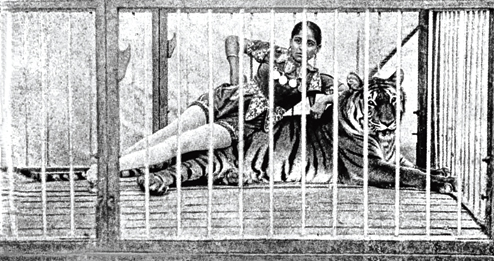
| Fearless Sushila Sundari, one of the stars of Priyanath Bose’s circus, reclines on the back of a Bengal tiger for her photograph to be taken |
It was a Barnum & Bailey world indeed. And although it was indisputably close to reality, the travels and adventures of Professor Priyanath Bose’s Grand Circus held surprises enough to be dubbed “phoney”. This is a new edition of the diaries of a man who owned a circus which pitched its tent all over the undivided sub-continent and south-east Asia in late 19th and early 20th centuries.
Justifiably titled Professor Boser Apurba Bhraman-Brittanta or The Wonderful Travelogue of Professor Bose, the diaries saw the light of day 110 years ago. The diaries prove that Priyanath Bose (1865-1920) was not just a great and intrepid entrepreneur, who brought together a huge team of talented artistes and performers under the big top, but also an engaging writer with a journalist’s eye.
He had a good sense of humour, poking fun at himself when the situation demanded. For example, he could not help laughing at his own stentorian voice when he was moved to sing in the paradisiacal Shalimar Bag in Lahore. But he is also moved to tears at the suffering of the people in a famine-stricken region of Rajasthan.
In this new edition published by Karigar, urban historian Debasis Bose has appended to the text a longish account of the other Bengali entrepreneurs, performers and artistes who either joined circuses or formed ones themselves. Bose recounts in detail the life and times of the dauntless Priyanath Bose, who like many of his ilk, would roll in it one day and be reduced to penury the next. Debasis Bose paints a lively picture of the social milieu in which these circus owners and performers often operated together, but would end up squabbling and bickering amongst themselves. This would prove to be the undoing of the circus company itself. Such a fate had befallen Priyanath and his elder brother Motilal who had partnered but would fall out frequently. Debasis Bose also throws light on the scandals in which these men separated for long periods from their wives would get entangled in. Motilal became infatuated with a pre-teen girl, a trapeze artiste in his company. Their union never received social sanction, but their daughter, Indubala Debi, became one of the greatest singers of those times.
In his diaries, Priyanath Bose left behind not only a heart-rending report of a famine, but also of a battle — Pathan War — in Waziristan in the tribal areas of what is now Pakistan. Although he never saw action, he left behind a vivid document of the massive arrangements made for war. Priyanath Bose had mastered the art of story-telling, and geography comes alive in the diaries. Apart from picturesque descriptions of the terrain through which the circus travelled and their travails, there is an intriguing ghost story as well. He had a lively prose style and he effortlessly switched from Sanskritised Bengali to the lingo of the underclasses in the same breath. This adds to the delight and excitement of reading the episodic diaries. This at a time when the convention was to pen accounts of journeys to pilgrimage centres.
This is not a facsimile edition but the publisher has taken care to retain most of the original illustrations and the invaluable black-and-white photographs of the dare-devil performers who defied gravity and the fear of big cats.