 |
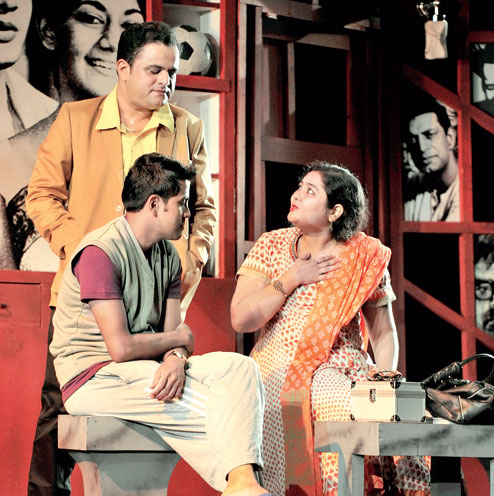
| Scenes from a stage rehearsal of Cinemar Mato at Madhusudan Mancha. (Anindya Shankar Ray) |
In the 100th year of Indian cinema, Kalindi Bratyajon’s latest production traces the fascinating trajectory of the film industry closest to home.
Cinemar Mato, written and directed by minister Bratya Basu, takes viewers on a tour of Tollywood’s glorious past, pauses to scrutinise current trends and comments on the direction of our celluloid dreams.
Cinema is the protagonist here and like cinema elsewhere, split into categories like mainstream and parallel.
“The play attempts to capture the entire spectrum of Bengali cinema — from the ‘four decades of evolution’ to mainstream cinema with its canvas of past-present-future, from noticeable changes in film-making at the turn of the century to new-age cinema that holds the future for movie-lovers,” said Basu, whose last play was Ruddhasangeet.
 |
The characters in the play develop into iconic symbols. Three male characters — Dipayan, Prithwijit and Avijit, played by Pijush Ganguly, Krishnendu Dewanji and Basu — represent parallel Bengali cinema, films of the future and the current mainstream.
The two female characters — Jayanti and Maitreyee, played by Anashua Majumdar and Poulami Basu — embody the evolution of acting in Bengali films over the years.
The plot unfolds in the flat of Jayanti Bhadra, a senior actress with a chequered past, where all the characters face each other and come to terms with their convictions and prejudices.
The end, like that of a typical Bangla boi, has a twist that makes the viewer wonder whether “all is well” with the future of our favourite pastime.
Bengali film songs from the last four decades provide the musical backdrop to the scenes.
“Through this play I have tried to present a theatrical utterance of love for and resistance to celluloid which strongly identifies with the Bengali language and communities of eastern India,” said Basu.
The first public performance of Cinemar Mato will be at the Academy of Fine Arts at 6.30pm on Wednesday.