 |
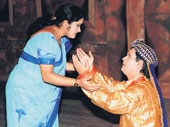
| Ballabhpurer Rupkatha in progress |
Finding scarce information on stage productions, three theatre lovers have got together to float the first-of-its-kind audio-visual magazine on the live act in Bengal. Natuya Katha, conceived by Debasish Chakraborty, Satya Bhaduri and Sunetra Ghatak, will feature news, views and profiles of veterans on the stage circuit.
?The aim is to focus on the work and times of theatre veterans,? says Debabrata Chakraborty, who is directing the programme. Sunetra Ghatak and Satya Bhaduri are helping him out with the planning and execution. Natuya Katha goes on air from July 8 on Tara Newz.
The special attraction of the 22-minute weekly programme is the slot on theatre personalities, old and young. The profiles ready to roll include Gyanesh Mukherjee, Mohit Chattopadhyay, Arun Mukherjee, Rudraprasad Sengupta and Usha Ganguli, interviewed by actor Pijush Ganguly.
?The profile on Gyanesh Mukherjee will track his journey? How he got involved with amateur theatre before joining group theatre, forming his own troupe and then his contribution to commercial theatre. There is scarcely any material on theatre and so Gyaneshda has helped us with some rare photographs from his personal collection,? adds Chakraborty. The interviews, which are extensive, will each be telecast over three or more episodes.
Theatre students will specifically benefit from the programme on theatre games, to be aired once in two weeks. It will have actor-director Goutam Halder discussing and demonstrating some of the techniques of stagecraft. ?Physique forms a vital part of stage acting and Goutam has shown this through a string of skits,? adds Chakraborty.
A separate section on theatre songs has been devised to revive the lost tunes of old productions alongside new ones.
Chhanda Chatterjee, Debojit and Riddhi Bandyopadhyay have rendered some of the songs, on stage with musical arrangements.
Yet another novelty of the magazine will be a chat on theatre, where veterans will pick a production and discuss its making, merits and weaknesses, along with its clips. To start off, the first panel discussion will feature Kalyani Natyacharcha Kendra?s Khowabnama, with the spotlight on district theatre and the production?s young director Kishore Sengupta.
A news bulletin will keep theatre lovers updated about the events in the circuit, showcasing all special events and productions. ?We will also cover Hindi and English theatre as much as possible,? Chakraborty promised.
Badal Sircar may have disowned his early proscenium comedies after blazing the new trail of open Third Theatre three decades ago, but they continue to regale Bengali audiences. He carved a special place for himself in Bengali drama during the 1950s and 1960s with his typical brand of humour, a sparkling irreverence that carried over into his Third Theatre work.
Ballabhpurer Rupkatha was one such comedy, written around the same time as his classic Evam Indrajit, in 1963. Sircar appears to have liked it enough to direct it himself in 1970, soon after forming his own group Satabdi, before he rejected regular auditoriums. Now revived by Nandipat, it is easy to understand why the play appealed to him. Beneath the fun and games ? and shades of Oscar Wilde?s story The Canterville Ghost ? lies an ironic look at the changing face of society that remains relevant.
Bhupati Ray of Ballabhpur has seen better days. His magnificent 400-year-old palace is on the point of collapse, and he has too many creditors. The only way out is to sell the mansion, but who will buy a crumbling edifice? That, too, with a resident ancestral ghost?
Luckily, a Calcutta businessman, Mr Haldar, expresses interest because he?s competing with his rival as to who can possess a more ancient building. Bhupati tries to lessen its age in order to raise the price, but Haldar?s ready to pay more the older it is.
He?s in seventh heaven to hear that it?s haunted, since his rival can?t top that. Meanwhile, the ghost (a spitting image of Bhupati, but possessed of a glad eye), flirts with Haldar?s daughter who doesn?t know of his spectral nature. The plot thickens.
Nandipat has frequently depended on guest directors like Bibhas Chakraborty in the past. Here one of its founder members, Prakash Bhattacharya, turns to direction and does a remarkable job in his very first effort, editing the lengthy text and pacing it well. He could perhaps add some effects to make the ghostly sequences more eerie.
Nandipat also has one of Bengali theatre?s best actors, Bimal Chakraborty, who dons a double lead role contrasting utter helplessness and suave aristocracy. Biplab Naha Biswas presents Haldar as a Westernised and nouveau riche gentleman, breaking into English at any opportunity.
The secondary characters, especially Bhupati?s cronies, also receive fine portrayals. And Sandip Suman Bhattacharya designs an artistic cutout backdrop to evoke the sandstone ruins.
In a city where dilapidated bungalows owned by impoverished gentility are being bought and torn down by profiteering promoters every day, Sircar?s play certainly resounds with echoes.