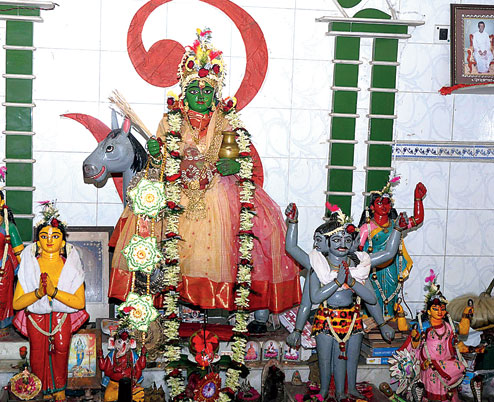

In the winding lanes of Halderpara, central Howrah, is a temple of the goddess of health. The goddess is the healer and protector of the people of Howrah. Devotees frequent the temple in the spring and summer months, when most children and also adults suffer from chicken pox, mumps or other seasonal diseases.
The temple premises is chock-a-block on Sitala Ashtami in the Bengali month of Phalgun, the day of the annual utsav of the deity. More than 2,000 people gather through the day to offer puja to the goddess. Some pray for rapid recovery of their loved ones while others come to show gratitude to the deity for curing someone by offering something they had pledged. Devotees believe that Sitala grants everyone’s wishes.

“I had come to this temple when my son had a severe bout of chicken pox when he was five years old. He was ill for a long time and I was afraid that he might not recover at all. I came to this temple and prayed for him. I believe that he started recovering after that,” said Sarbani Dutta, a resident of Kasundia, who visits the temple every year on Sitala Ashtami.
The Sitala temple is said to be 200 years old. Biswanath Pandit, a local purohit and an ayurvedic doctor, lived in this part of Howrah that was sparsely populated and was mostly jungle. There was an adjoining pond with his house and a cowshed. It is believed that Biswanath had found a kashthi pathar (touchstone) figure of Sitala at the cowshed and had also dreamt of the goddess. He started worshipping the goddess in a mud hut near his house which was later made into a concrete structure.
With a new temple, a cement idol of the goddess was also installed. Descendants of Biswanath took the responsibility of running the temple after him. However, it was as late as 2008 when Haradhan Pandit, Biswanath’s grandson, decided to renovate the temple. The present temple came up with funds collected from devotees and also from the family. “When we made the new temple, we ensured that the old structures were not destroyed. The sanctum sanctorum was kept intact and marble slabs were placed on top of the old concrete structure,” said Goutam Pandit, the present sevait of the temple.
Sitala is seen here in a green hue, with the characteristic broom in one hand and a vessel in another. On either side of the deity are a yellow-hued Hiravati and red-hued Raktavati. “They depict the forms of rash. The rash is usually red when it appears and later becomes white blisters,” said Goutam. In front of Sitala are idols of demons Jarasur, Ghantakarna, goddess Manasha. The small kashthi pathar idol can also be found in this temple. The temple is maintained by the family members themselves as there is no debuttor property. “We run all temple expenses ourselves and also with donations from devotees,” said Goutam. “Every 12 years the idol is cleaned and painted again,” said Goutam.
Sitala Ashtami is the annual puja of the deity when devotees gather at the temple for special puja and offerings. Five days prior to the puja, a traditional announcement is made in the neighbourhood where a drummer walks through announcing the day of the puja. Devotees bring offerings of their choice. “We usually do not ask for anything, but those who believe in it offer neem leaves, turmeric and a little oil to the deity, after their loved ones are cured of chicken pox,” said Goutam. In the evening, people gather to sing songs of Sitala, called sayelar gaan. Bhog is offered and distributed the next day. “We keep the bhog distribution for the next day to avoid chaos on the day of the puja,” said Goutam.