 |
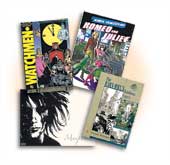
| From top left: The cover of Allan Moore’s Watchmen, a manga Romeo and Juliet; the cover of The Barn Owl’s Wondrous Capers; a Sandman cover |
Salman Rushdie wouldn’t mind writing one, it seems. Some of the world’s best literary talents are already into it. Scottish author Ian Rankin, one of the finest contemporary practitioners of crime fiction, has already written one featuring John Constantine from the Hellblazer series.
The graphic novel, the comic book in its more “serious” avatar, has opened up a whole new world. Or worlds, where superheroes encounter darker aspects of humanity, or embody them themselves.
Calcutta worships the graphic novel too. Its audience, or readership, is fit, though few, and the South City Mall Starmark outlet was overflowing with them when British graphic novel writer Tony Lee dropped in on Wednesday.
There is other evidence. Next day, Lee addressed a successful workshop on the graphic novel at Jadavpur University. But then there seems to be one every month in the city. The English department at Jadavpur even teaches a course on the graphic novel. Three months ago, the British Council library added a collection to its graphic novels which is currently in heavy demand.
“The 18-25 age group borrows most of the graphic novels,” says Aparna Bhattacharya, Manager, Young Audiences, British Council. Several classics are available in graphic form, such as Shakespeare’s plays, not to mention Agatha Christie mysteries.
“Classics do not come across as boring in this format,” says Bhattacharya.
On the face of it, the visuals do it. Graphic novels come with brilliant, striking, often stylised, visuals. Some graphic novel artists, such as Jill Thompson or Dave McKean, are stars in their own right.
There are many graphic novel styles. “I prefer reading manga (from Japan),” says Amrita Chakraborty, a student of Jadavpur University who likes the black and white visuals that tend to have a greater cartoon than realist side to them.
Her classmate Arnab Banerjee says the quality of graphics determines his reading preferences.
But there are more insidious reasons. The comic book now, or the graphic novel, is located in a realm of fantasy that is as satisfying as it is for the adult mind. That is not to say children don’t read comics any more, but fewer comics can be claimed to be juvenile.
The Sandman novels by Neil Gaiman (“Those who haven’t read it, buy it NOW,” said Lee), for example, has Morpheus, or Dream, or eponymously, the Sandman, “essentially the anthropomorphic personification of dreams”, as the central character of an epic series. But with the Sandman and his siblings, Gaiman succeeds in creating a new universe, quite literally, as also a powerful mythology of modern life. It is a rich, seductive, menacing, beautiful, and, perhaps most of all, mysterious world, not like our own, and very like our own.
“It is easier to connect with the narrative as the creators visualise their thoughts for us. But on a deeper critical level, there are many issues that remain only partly addressed and this ambiguity is the most challenging and interesting thing the novel has to offer,” says Sion Choudhury, an avid reader.
Things have moved from Archie and Jughead indeed. Allan Moore, often considered a pioneer in many ways in the graphic world (though Moore himself prefers the term “comic book”), would read like a novel if the visuals weren’t there, says Lee.
Amita Das was introduced to graphic novels recently by her grandchildren. “I had read Tintin and Asterix in my childhood but the graphic novels I now read appeal to me as they deal with something serious,” she said.
Sarnath Banerjee, the author of graphic novels Corridors and The Barn Owl’s Wondrous Capers, agrees too that the graphic novel is not only for a particular age-group. “Youngsters have a more sophisticated understanding of the graphic novel and are more open to it but this does not make it age-specific,” he says.
There are some complaints about the Indian graphic novel, though. Says Arnab: “Indian graphic novels lack in presentation skills. Sometimes writers also take on very ambitious projects that they are not able to execute with adequate skill.”
Abhijit Gupta, teacher of English at Jadavpur University and graphic novel aficionado, feels there is a need for a distinct style. “Though there is a restricted readership of graphic novels at present, a lot of work is being done and people are opening up to this form in a new way now,” he adds.
Meanwhile, Project C, an Indian English comics magazine, is going to be launched in 2010-11 as a forum for young artists to share their ideas before they get published. “There is a lot of talent all over the country but the main hurdle is lack of technical expertise,” says Rimi B. Chatterjee, who teaches English at Jadavpur University and is associated with Project C.