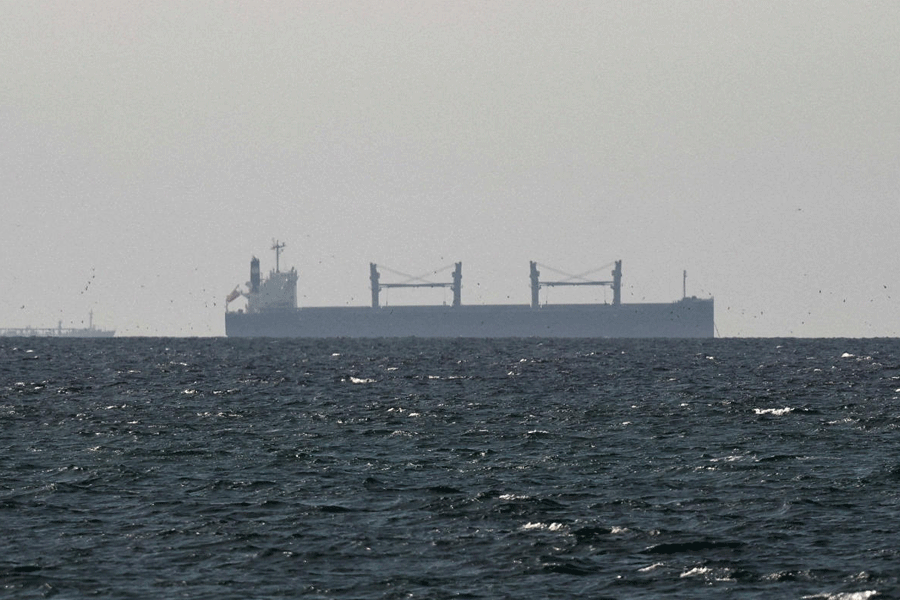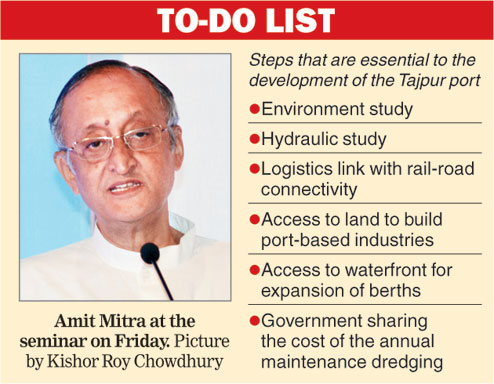

Calcutta, Aug. 26: Prospective investors said environmental clearance, access to land and dredging cost-sharing would hold the key to the development of the proposed port in Tajpur, on a day industries minister Amit Mitra announced that the Bengal government would float bids inviting private players to develop the facility.
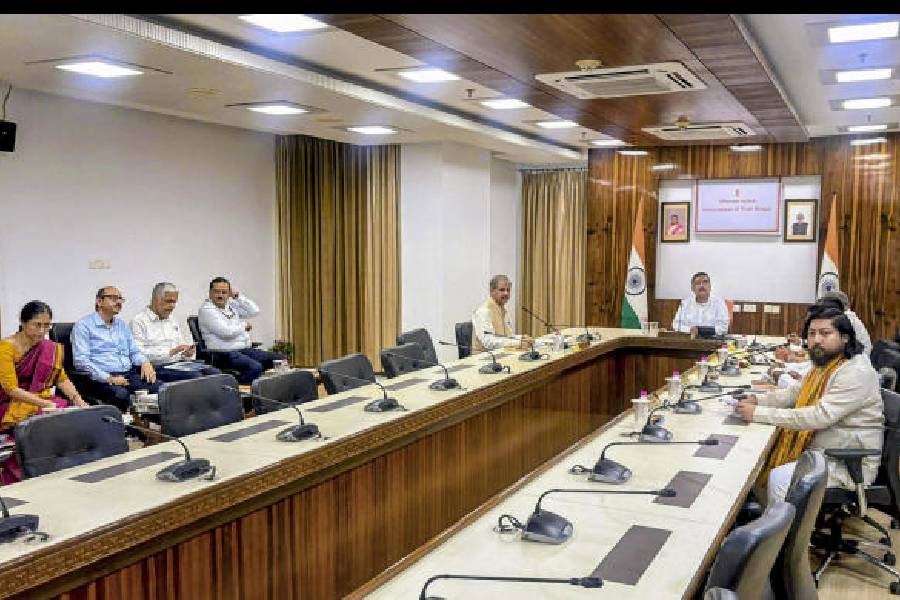
The government is keen to find a private partner for the project in East Midnapore and the bids would be floated in six months, Mitra, who is also the finance minister, said at a seminar on Opportunities in the Maritime Sector in West Bengal in the run-up to the Bengal Global Business Summit in January.
"The chief minister wants to create an industry hub around the port. Around 10,000 people will be employed at the port. Another 30,000-40,000 will get jobs in associated industries. The Bengal government will create allied infrastructure such as rail and road links for the port, which will be developed by a private party," Mitra said.
Some of the companies operating in the port and shipping sector, such as the Apeejay Surrendra Group, Adani Ports and Essar Ports, participated in the seminar.
The investment in the first phase will be around Rs 4,900 crore. In the second phase, another Rs 890 crore could be pumped in. The cost of dredging to create an 18km shipping channel to the port will be part of the investment.
Private players said they would look into the state's proposal and await further details before making a financial commitment. "We got to know about Tajpur today. We will have to evaluate available documents and take a call," said Jai Khurana, the vice-president and head of business development at Adani Ports.
Investors usually look for a detailed feasibility report incorporating aspects such as environment and hydraulic studies, access to land and waterfront, availability of land for port-based industries and sharing of the dredging cost with the government, among others issues.
Government officials said a detailed feasibility report had been prepared by CRISIL, appointed by the state as a consultant for the project,and an executive summery would be circulated when the initial bids are invited. "We have started environment and hydraulic studies. This may take six to nine months," an official said.
A government official said a committee of secretaries had been set up to decide on the concession model.
Calcutta Port Trust, which is under the Union shipping ministry, has expressed interest in participating in the Tajpur project. However, the CPT is yet to make a concrete proposal to the state. CPT chairman M.T. Krishna Babu recently expressed fears that the proposed port could eat into the pie of the harbours in Calcutta and Haldia unless a holistic approach was taken.
Speaking at the seminar, K.K. Sinha, the CEO and director of Essar Ports, highlighted the importance of an environment study. "It should be initiated soon because environment clearance takes time," he said.
Khurana of Adani Ports cited the example of the Mundra port the company developed in Gujarat. "We initially had no idea how many industries would come up when the port was built. As we had land to expand, many industries could come up. So there has to be a clear policy on land. The developer should know if the government is going to provide it. If the developer has to acquire (land), he has to know what kind of assistance it (the government) will provide," Khurana said.
Minister Mitra said no land acquisition was needed for the proposed Tajpur port. "There are around 1,500 acres of low-lying land, which can be utilised by dredging silt," he said. Apart from land for industry, access to the waterfront is also of crucial importance for future expansion.
Port and shipping experts said the government must spell out how much of the dredging cost it would shoulder. After the dredging to create the channel, dredging needs to be done every year to maintain navigability.
"A sea port on the eastern coast of India is more challenging than a similar facility on the western coast because the sea is turbulent here. We have to build a breakwater (a structure to protect a beach or a port) or a harbour to provide berthing facilities to ships," one of them said.
Several issues relating to ports may be resolved when Bengal comes out with its maritime policy. Karan Paul, the chairman of the Apeejay Surrendra Group, said his shipbuilding project in Kulpi, South 24-Parganas, would be launched after the policy was made public.