 |
 |
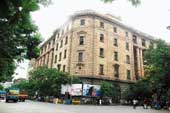
| EMPTIED OUT: The Mackinnon & Mackenzie building at Fairlie Place and (bottom) reconstruction work inside. Pictures by Bishwarup Dutta |
The abundance of architectural beauty — delicate, vulnerable, ephemeral — on Strand Road amidst the squalor, poverty and stink of urine concentrate is quite astounding. The collapse of the already gutted Strand warehouse at the Brabourne Road crossing underscores the vulnerability of the city’s built heritage, and one does not have to subscribe to any conspiracy theory to come to the conclusion that all heritage structures occupying real estate of immense value are defenceless against the nexus of developers in cahoots with politicians and other vested interests, and that includes government officers.
On any given morning, Strand Road running alongside the Hooghly and the circular rail running in between, looks cool and green owing to the abundance of peepul, frangipani and gulmohar on both sides of the road. One tree wears a small green noticeboard on its trunk that reads: Utkaliya Milita Mancha, indicating the presence of a huge labour force from Orissa.
If you start walking from Floatel, which claims to be India’s only floating hotel, the State Bank of India headquarters standing opposite it tells a story of mindless destruction of heritage. Dressed in stone and neo-classical ornaments, it is an ungainly and unlovely building that was constructed over the grave of the original building — majestic but on a smaller scale — of 1879 vintage.
Rubbing shoulders with it and in stark contrast with it is the New Secretariat building, the city’s first highrise structure designed by the MIT-returned architect Habibur Rahman, looking sad and grubby, its whitewash having peeled off. The “football” on top of it noticeable from miles away is actually a radar used for making weather forecasts.
 |
This city may be a little more than 300 years old, but for the past three centuries, history has not exactly been sitting on its hand. Its past has been eventful and colourful enough. Strand Road was not built in a day either. In 1852, Reverend James Long wrote that even 40 years earlier, nine fathoms of Hooghly water used to stand where the western railings of Metcalfe Hall are located.
In 1820, the question of constructing a road and a wharf along the western boundary of Calcutta was considered, and actual construction apparently began in 1828. The work was financed by public subscriptions.
In 1823 Strand Road was formed, but shipbuilders, who had docks in Clive Street, had to move to Salkia and Howrah. Well, the river used to flow past Prinsep Ghat, where many dignitaries used to disembark till the river shifted. The Prince of Wales, Albert Edward, was received at the Ghat during his visit in 1875-76.
 |
| All that remains of the Strand warehouse |
There is a tension and tussle between the past and present and that is quite visible here. As the city tries to break out of the grip of the past into an uncertain future, developers authorised by the heritage bodies of the state government as well as the Calcutta Municipal Corporation are being allowed to butcher landmark buildings. The Mackinnon & Mackenzie building at Fairlie Place opposite the fine Eastern Railway booking office is one such.
In my childhood I used to pass by the magnificent stone-clad Mackinnon & Mackenzie building every day on my way back from school, and I was told that it was earthquake-proof. Whether it was actually so or not I have not had occasion to find out, but all that the developer has left of it is its shell, with those rows of columns as hefty as oak trees trussed up with giant steel claws. The building is of 1927 vintage and after it was gutted in a fire it was abandoned for several years. This is a familiar ploy adopted by promoters to allow an old building to go to seed and look shaky enough to be declared unsafe or condemned.
In the case of Mackinnon & Mackenzie, after years of exposure to the elements a jungle had grown on the terrace. I remember walking up to it to be confronted with this greenery hemming in the crevasse — the immense gutted section — and the huge, desolate halls.
Now its innards have been scooped out, as in the case of Great Eastern Hotel, and only the façade remains, flimsy like a theatrical prop. Work has come to a standstill.
These old buildings seem to lead a life of their own and surrounded though they are by countless eateries for office-goers they seem to be unconcerned about how the other half lives. This feeling is heartily reciprocated by the thousands of people who live in the streets and pass by them unimpressed by their hauteur. The pavilion put up by the Nawab of Dacca to welcome the Prince of Wales when he visited Calcutta in 1875-76 has turned into the grubby clothesline-cum-kitchen of an eatery. The ghost of the vast Bengal Bonded Warehouse Association — shades of Carr, Tagore & Co, an enterprise started by Dwarkanath Tagore among others — has turned into an impromptu urinal.
On Netaji Subhas Road, a stone’s throw from here, is the tall multi-domed Chartered Bank building that has been abandoned for some years involved in litigation as it is. How certain developers must be licking their chops at the thought of pulling it down.
If one is walking towards Burrabazar down Strand Road, elbowing out the wretched new boxes of glass and concrete is a procession of fine old buildings. The Foreign Post Office building opposite the New Secretariat is painted bright pink, but its rear is a mouldering heap.
A few steps away is the high red wall of the Government of India Stationery Office but instead of the sprawling grounds within, one can only see the garbage dump outside it. To learn everything one wants to know about the aesthetics of disgust one needs only to take a walk down Strand Road. Rows of sheds belonging to Calcutta Port Trust with masses of beautiful cast iron still intact are turning into junk, while gentlemen happily relieve themselves on what is left of the pavement outside.
When Metcalfe Hall itself, at the corner of Hare Street, was falling apart, a mountain of garbage that used to stink to high heaven had accumulated outside it. Ever since it has been in the care of the Archaeological Survey of India, this building, whose principal west front is modelled on the Tower of Winds in Athens, it has been in reasonably good shape.
The circular rail noisily trundles by and for a few seconds it is visible through a gap in the wall, which is framed with creepers and weeds. A little urchin swings from the aerial roots of a peepul tree. A barber has opened shop on the pavement. The building in front has all the fixtures of antiquity. The signboards say it belongs to Albert Herbert (India) Ltd. It will be demolished soon.
Later I checked the Intach Calcutta heritage handbook and discovered it was built in 1868. There are many others of that vintage like the handsome Kettlewell Bullen & Co building and the magnificent port trust headquarters, which is better looked after than its other valuable properties like the warehouses.
As the road approaches Brabourne Road the human traffic becomes heavier and the pavement on the right hand side is crowded with tea stalls and those tiny shrines of Hanuman and Shiva.
Rows of warehouses of various heights line the other side till we reach the big four — Fairlie, which houses the maritime archives (How many of us know this?), Clive, Canning, that houses the Ganesh oil godown and sports a tower, and finally, Strand, which has turned into a mountain of debris.
Behind the Strand warehouse one is not surprised to discover that only three days after the last Saturday’s deaths, the eateries under its shadow still attract as many customers they did before, and trucks and three-wheelers and labourers still seek shelter from the afternoon sun under its ledges. Is it despair? Is it indifference? This is quintessential Calcutta.
Pyaasa to Parineeta
 |
| Vidya Balan rehearses for a Parineeta scene to be shot at Prinsep Ghat |
When the skirl of bagpipes played by the army used to greet visitors to Eden garden, and the Strand from Hastings up to Calcutta Swimming Club used to be a top favourite of all promenading Calcuttans, Prinsep Ghat used to be one of the most favoured shooting spots of film-makers of every shade. This Palladian porch with its forest of elegant columns used to be a haunt of real life lovers, anyway, and reel life followed suit. One of the most memorable sequences to be shot here was the picturisation of Geeta Dutt’s evergreen “jaane kya tune kahi...” in Guru Dutt’s Pyaasa, which in 2002 made it to the Sight & Sound critics’ and directors’ poll of all-time greatest films and in 2005 was rated as one of the 100 best films of all time by Time magazine. Guru Dutt, who played the role of a struggling poet, happily followed a coquettish Waheeda Rehman as she sashayed amid the enchantingly lit columns of Prinsep Ghat.
Through the 1950s and till the 70s, innumerable Bengali films, including Teen Bhubaner Pare and many Uttam Kumar and Ranjeet Mullick starrers, were shot along the Strand with the Gwalior Monument silhouetted against the Hooghly, and Prinsep Ghat as well. In those days two couchant lions used to sit outside the Ghat, till 1972 when preparation were being made for the construction of Vidyasagar Setu. General Jacob was posted in Calcutta then, and he had these two imperial beasts removed to Fort William. Now they sit outside the Mili tary Engineering Services guest house.
Films like Satyajit Ray’s Pratidwandi and Tapan Sinha’s Ekhoni had shots of the Strand and Prinsep Ghat. It is still much sought after. Saif Ali Khan played the piano and sang a duet here with Vidya Balan in Parineeta made in 2005. S.D.