
Calcutta: The Calcutta Municipal Corporation and the government seem to be at cross purposes when it comes to managing waste.
The government has stressed waste segregation at source but the civic body has said the practice in a few wards has so far proved futile.
"The results are not encouraging in the wards where we segregate waste at source," Debabrata Majumdar, mayoral council member, solid waste management, said at a recent meeting of an NGO, Concern for Calcutta.
"It doesn't seem to be financially viable.... I am a chartered accountant; so, I have to see the cost benefit. Not only is the recyclable waste proportion low, it also has a few takers."
The civic body is continuing with the system but it isn't beneficial, Majumdar said.
About the central directive on waste segregation at source, he said the waste would be segregated at the disposal site.
Subrata Gupta, state urban development and municipal affairs secretary, however, said managing waste would pose a challenge if left unsegregated at the household level. "Calcutta will generate 9,000 metric tonnes of waste every day by 2035."
Waste is now segregated at the household level in wards 33, 47, 64, 103, 110, 115 and 130. Contractual workers of the civic body regularly collect wet and dry waste separately.
The money given to contractors in these wards is far more than what the civic body receives by selling the recyclable waste, a civic official claimed.
About five tones of such waste is generated every day in these wards. But it is less than one-fourth of the expected amount.
"The fallibility of the method is inbuilt in the system. It is possible that the contractor's workers don't send the valuable dry waste to the civic body," Sasanka Deb, a waste expert who was present at the NGO's meeting. said.
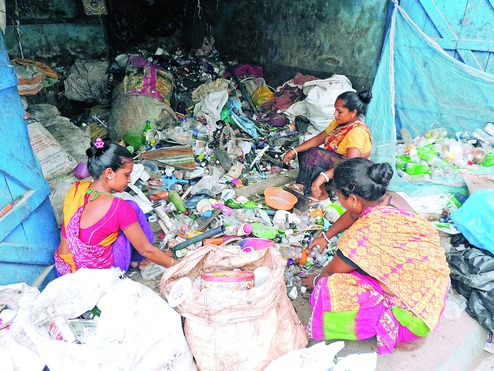
"Alternatively, the civic body could use ragpickers to collect dry waste," he said.
Bangalore, Pune, Mumbai, Chennai and Delhi have already implemented the system of waste segregation at source, Deb said. "And ragpickers play a major role."
The solid waste management rules makes not only segregation at source mandatory but also speaks of including ragpickers in the waste management process.