The Supreme Court on Monday refused to interfere with a Calcutta High Court judgment that had declined to quash the NIA probe into the violence at Beldanga in Murshidabad district in January under terror-related sections of the UAPA.
A bench of Chief Justice Surya Kant and Justice Joymalya Bagchi said it found no reason to interfere with the order passed by a high court division bench on February 26.
The Bengal government, which had challenged the high court order, had also questioned the direction of a sessions court in Calcutta to state police to transfer the case materials to the NIA.
Senior advocate Kalyan Banerjee, who represented the Bengal government, said in the Supreme Court that no material was available before the NIA or the high court that warranted the invocation of UAPA,1967. Yet, he argued, the high court upheld the NIA probe through the impugned order.
Senior advocate Sidharth Luthra, who appeared for the NIA, defended the probe by the National Investigation Agency.
The Supreme Court, however, said it found no reason to interfere with the high court order. Justice Bagchi said “the high court has passed a reasoned and balanced order” based on the material collected by the NIA, pointing out that the same had been done pursuant to the Supreme Court’s own February 11 order.
The bench said the high court had concluded that the incident warranted an NIA probe after examining the material placed before it.
“It is for the high court to decide whether or how the UAPA is made out,” the Supreme Court said.
On February 11, the Supreme Court had orally questioned the NIA rationale for invoking terror-related offences under the UAPA, 1967, in connection with the violence at Beldanga, saying “every emotional outburst cannot be packaged as a threat to economic security”.
The bench of Justice Kant and Justice Bagchi, however, in its earlier order, had asked a high court division bench to examine whether, prima facie, any terror-related offences were made out based on the NIA probe.
“Even without looking into the documents, you have said Section 15 is justified. The case diary was not placed before you. This is pre-decisional. Every emotional outburst cannot be packaged as a threat to economic security,” Justice Bagchi had orally told additional solicitor general S.V. Raju, who appeared for the NIA.
The top court had passed the earlier directions and observations while disposing of two appeals filed by the Bengal government challenging a high court’s direction to the Centre to “consider” the NIA probe and the subsequent January 28 notification issued by the Union government for the NIA probe.
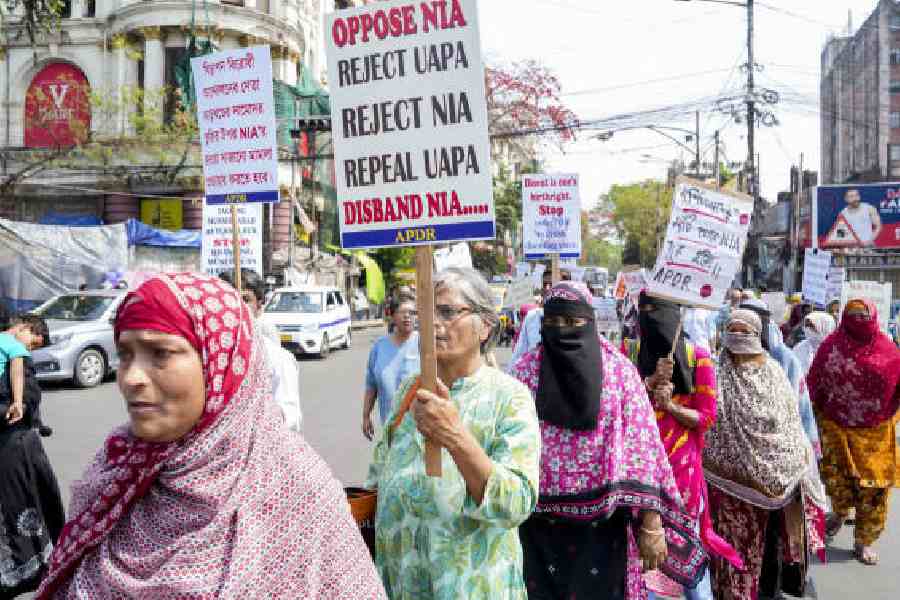
The high court had passed the directions on a plea from the leader of the Opposition, Suvendu Adhikari, for an independent probe into the large-scale violence that followed the killing of Alauddin Sheikh, a Beldanga youth, in Jharkhand. The protesters damaged public and private properties and blocked highways.