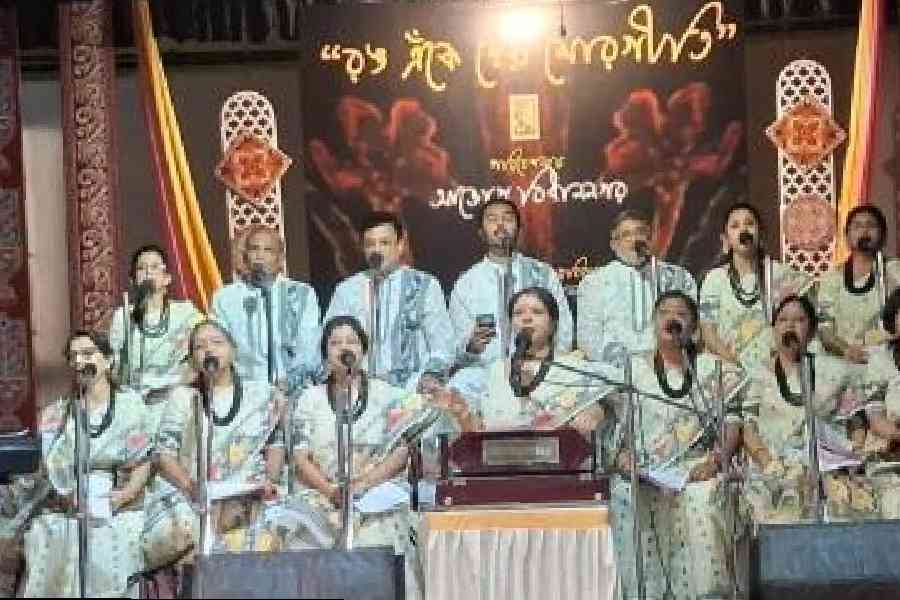
Township-based music group Abhog presented before a packed Laban Hrad Mancha a show that explored a lesser-known aspect of Tagore’s creative genius — the transformation of poems into songs and songs into poems
Titled Rang Eke Dei Mor Geeti, the show was scripted by Kanad Chowdhury, and combined Rabindrasangeet, recitation and narration. Nearly 20 songs were rendered in solo and chorus formats, and most of the works were drawn from Tagore's anthology of poems Sanai, composed in the final phase of his life in 1940.
The evening opened with a chorus rendition of Parobashi chole eso ghare, adapted from the poem Prabasi, published in the silver jubilee edition of the leading magazine of the time, Prabasi. This was followed by the poem Bodol and its musical counterpart. Composed in January 1925, while Tagore was travelling from South America to Italy, Tar hate chhilo hasir phuler har, sung by Anwesha Chakraborty, left a lasting impression.
Mamo dukkher sadhon, composed in 1939, was sung by Debjani Sarkar with remarkable restraint, coupled with Mouli Dasgupta’s narration.
Also presented was the poem Asa jaoa from the Sanai anthology, written on March 28, 1940. Eight days later, Tagore’s close friend, missionary and social worker Dinabandhu Andrews, passed away, and the bard transformed into the song Prem eshechhilo nishobdo charane on April 10, intertwining themes of love and death. The song was rendered by Anindya Pal alongside Tapas Roy’s narration.
Maniratna Roy performed Tumi kon bhangoner pothe ele, where the poem and song were composed on the same day, and Lopamudra De sang Ogo tumi panchadashi. Chorus renditions of Adhara madhuri and Ogo badhu sundari, composed on the occasion of the wedding of his brother Satyendranath Tagore's granddaughter, changed the ambiance.
Barnali Deogharia received applause for her rendition of the rarely performed Doibe tumi kokhon neshay peye, and the guitar-like strains produced on the synthesiser by Subrata Mukherjee towards the end of Amar priyar chhaya, sung by Saibal Sen, captivated listeners. The concluding solo by Parama Chatterjee also left an impression.
The event concluded with a recital of percussion by Aurobindo Pradhan, violin by Kanad Chowdhury and synthesiser by Subrata Mukherjee. However, the narration would have been smoother had the narration used either Bengali or English calendar years instead of mixing the two.
"Before the show, I was concerned about whether the singers would be able to do justice to these uncommon songs, and how the audience would receive them. But we received tremendous appreciation,” said programme director Debjani Sarkar.
Saswati Adhikari, secretary of Abhog, shared that their inspiration came from Shankha Ghosh’s album on the same subject, Ekti Raktim Morichika. “We wanted to present something fresh,” she said.
Guest of honour Swapan Som praised the organisers and noted that an almost full auditorium, as the show received, was a rare sight today.
Bharati Kanjilal