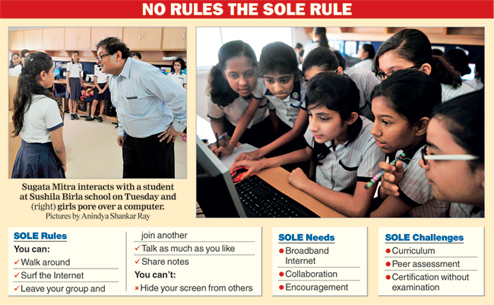

The only rule is that there are no rules, started off Sugata "Hole in the Wall" Mitra, winning over the students of Sushila Birla Girls' School, who were introduced to the TED prize-winning professor's model of learning on Tuesday.
Twenty-fours students of Class VII stood in attention in the computer room when Mitra walked in and immediately put them at ease despite his classic appearance of a professor in thick glasses.
"The rule is that there are no rules. You may talk to each other, use the Internet, share notes, change your groups.... Basically do anything to find your answers," Mitra told the girls as they broke into smiles, ready to embark on an "intellectual adventure".
Mitra had a set of rules for the teachers. "Please stay on one side of the room, don't talk too much and do not talk to the students at all," he grinned, adding: "It's what you probably tell your students at other times."
Next, it was time to vote for a student to be Mitra's assistant. "The assistant will have a superpower. Someone who I can talk to and who can talk to me." So Mahi Shah became assistant professor Mahi Shah and Mitra hollered: "You have 30 minutes.... Off you go!" The girls rushed to the nearest computer and began their search for an answer to Mitra's question: "Can trees think?"
Voices soared, chaos reigned. Just the way Mitra would like it. The students hopped from desk to desk, group to group, oblivious to the teachers standing around, their searches ranging from "Do plants have brains? Can they communicate with each other?" to scholarly articles on reactions in trees, tree allergies, plant archaeologists and trivia on people who can kill trees using curses.
At time out, Mitra convened what he called a conference with the students. "I will be the chairman but since the chairman is usually an old man who sleeps during meetings, I will appoint a co-chairman," he smiled, once again letting a student take charge.
Pleased with the answers the students came up with, he said: "I did this not to find out who's good or bad. That does not matter. Nor is it about one group competing with the other but to collect everyone's thoughts and come to a conclusion."
To the teachers, Mitra explained, "Drive the curriculum with a carefully crafted, good, fun, interesting question. Then instead of teaching first and then taking a test, invert it. Give them the question first and let them find the answers. Internet and mobiles are permitted."
Mitra who has conducted more than 30 SOLE (Self-Organised Learning Environment) sessions in schools in the UK, wanted teachers to see for themselves what the model was all about.
While teachers appeared upbeat about Mitra's novel method, some doubts crossed their mind. What about younger ones? What will happen to weak students? Is Internet a reliable source of information?
"It is not about making learning happen but letting learning happen," said Mitra. "Like in a regular school, some would gain a lot, some average and some might not get it but unlike in a standard classroom where negative reinforcement can make a student who is weak in one thing, weak in everything, that does not happen in SOLE."
Principal Sharmila Bose welcomed the idea. "There is a major shift in teaching, especially in senior classes and we can't have chalk-and-talk methods anymore. SOLE is an inspiring idea, many steps ahead and we are ready to take the big leap by trying to incorporate this in every class from now," she said.
And the students' verdict? "Group work is the best work!" they chorused.