 |
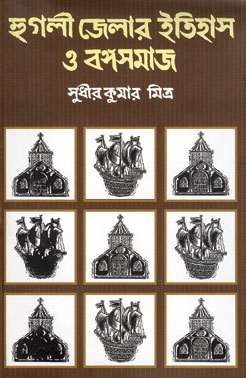
| The book cover |
Local historians — that is enthusiastic people without the requisite degrees who compile the history of the area or neighbourhood they live in and are not above including myths and hearsay in their work — are often given short shrift as their writing lacks academic rigour and are not tightly structured. However, their versions of histories often turn out to be most gripping, and occasionally they provide rare insights as they do not mind delving into material that a historian would not deign to touch. Sudhir Kumar Mitra (1909-1993), who had put together the originally three-volume history of Hooghly district, was one such chronicler.
His Hooghly Jelar Itihas O Banga- samaj has been recently published in two hefty volumes by Dey’s. Edited by Soumitra Sankar Sengupta and Pallab Mitra, this “birth centenary edition” includes a lot of fresh material, much of which was left behind by Sudhir Kumar himself, although in a haphazard manner. He was born in Jejur village in Hooghly, and later his family shifted to Masjidbari Street in Darjipara. But he never lost touch with his birthplace.
Jogendranath Gupta, who had written the history of Bikrampur, had urged him to write the history of Hooghly district but Sudhir Kumar never thought he would be up to the task. But he set out with a camera and took several photographs of Saptagram, Bangshabati or Bansberia and Tribeni, and followed it up by reading Reverend Long’s On the Banks of Bhagirathi, and writing two articles. This kindled his passion for unravelling the past which ultimately bore fruit. He wrote that Hooghly district had many firsts to its credit in India — the first printing press, first Bengali type, first printed book, first English-Bengali dictionary, first university, first paper mill, first jute mill, first newspaper, first ice machine, first high court judge, first periodical, first Christian, and the first railway.
The section on social mores is most interesting. Besides detailed accounts of several rituals, his account of the slave trade reveals how men and women and even children used to be abducted or bought for trafficking abroad. Dacoity was a menace in those days, and there are apparently real-life accounts of robberies and sensational getaways from the prison of the Andaman and Nicobar Islands.
Book II is all about the 24 towns, hamlets and villages of Hooghly district and their eminent residents. One wishes that the editors had used the blue pencil a little more strictly. They could have easily cut down on the redundant details in many chapters for better reading. But the volumes do present a rich collection of photographs of personages and important structures in Hooghly.
 |
| Nicki Tourigny (behind, in black) takes a break while Tyler Norman interacts with the audience at Earthcare Books store. Picture by Sayantan Ghosh |
Cross-pollination in art
Two “bees” were in the city recently to “cross-pollinate the grassroots” with their art and knowledge on global issues. Members of Beehive Design Collective — a US-based non-profit group of art activists (with a solid sense of humour, as their website claims) — organised a narrative art presentation of their sketch True Cost Of Coal at the Earthcare Books store in Middleton Row recently.
“We educate by creating images that deconstruct complex geo-political issues like colonialism, corporate globalisation and extreme resource extraction. The images are presented with a narrative,” said Nicki Tourigny, one of the two artists in town. The other was Tyler Norman.
True Cost Of Coal was about the complex history of coal mining in America. But the audience discussed other issues — from the Uttarakhand tragedy to bauxite mining in Odisha — in the process. “Extreme resource extraction is not just a problem in America but elsewhere too. It was also the cause of the recent natural disaster in Uttarakhand,” said Samar Bagchi, the founder-director of Birla Industrial and Technological Museum, who was in the audience.