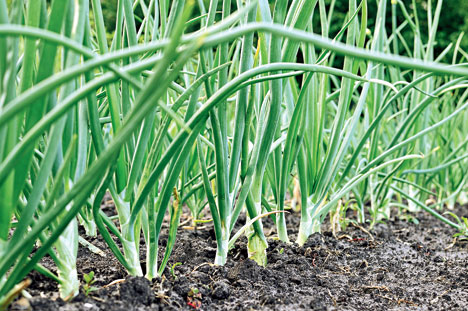


Onions are a crucial ingredient in many an Indian recipe and the herb grows well in the climate here too. Of course, Maharashtra is the largest Onion-producing state in India but it can be grown well in Bengal and particularly Salt Lake too.
In the last installment, we had gone over the varieties of Onions available as well as the method for its plantation. This week we shall learn more about it.
Manuring and fertilisation: Onions need a heavy dose of fertiliser for good yield. Fertiliser requirements depend on soil type. FYM 2-3kg per sq m may be mixed with the soil a month before transplanting.
About 75kg of nitrogen, 40kg phosphorus and 40kg potassium may be added in two equal parts, 30 to 45 days after the planting.
Irrigation: Kharif onions are grown in the rainy season. So irrigation will be required if there is a dry spell. In general, kharif crops need five to seven times of watering. Excess irrigation would be harmful. Drip irrigation is beneficial during kharif season.
In case of rabi Onions, the crop should be irrigated frequently throughout the growing season. In general, Onions need irrigation at the time of transplanting, three days after it and subsequently at seven to 10 days’ interval, depending on the moisture of the soil. Irrigation needs to be stopped when the crop attains maturity (10 to 15 days before harvest).
Weed management: The management of weeds is one of the most serious problems in Onion cultivation, as weeds limit the crop yield. In kharif Onion, the yield loss could be between 10 and 50 per cent. Some weedicides are available in the market and one may use them as per directions of the manufacturers. Generally these weedicides control weeds up to 30 to 35 days but thereafter, hand-weeding should be done.

Harvesting: Kharif Onions should be harvested after 50 per cent top fall. This is when the leaves droop to the ground. This is an indication of crop maturity. But in the kharif season, bulbs mature in 90 to 110 days but plants remain in active growth and there will not be any top fall. The bulb size, shape and colour are taken as an index of maturity during kharif season.
In this case, harvested bulbs may be left in the field for three days to dry (curing). This would make the bulbs firm and increase shelf life. But high humidity and cloudy weather would hamper curing and lead to rotting and unusual sprouting.
In case of rabi crops, harvest the bulbs when more than 50 per cent of the leaves are “top down”. Harvest along with leaves, pulling them out by hand. After three to four days of curing, the roots and tops get clipped, which makes bulbs firm and dry and helps increase shelf life.
The tops (drooping leaves) should be removed, leaving 2-2.5cm stalk above the bulbs. The bulbs should be cured for 10-12 days for better storage.
Sometimes grading is done according to bulb size of the onions. Class A bulb would be 8mm and above, Class B 50-80mm, Class C 30-50mm. But manual grading is a cumbersome and laborious process. Grading with machines is easier and more precise.

Uses: Onions not only add specific taste and flavour to food but also contribute to good health. It has medicinal value (mentioned in the last edition), and has antioxidants. It reduces bad cholesterol, which is chiefly responsible for heart attacks and stroke.
Onions also help in maintaining good cholesterol. Its consumption helps maintain healthy blood pressure by keeping the arteries elastic. It contains Vitamin C and sulpher compounds that act as a powerful anti-bacterial and anti-viral compound and boosts the immune system.
As onions are rich in sugar and other nutrients they can be processed into onion vinegar. Onions can also be processed into onion sauces and beverages. Onion powder may be prepared out of dehydrated flakes of onions. It is convenient to add powder onion for preparing of baked products like pizza and bread and also for spicing up different grilled items.
• To be continued