 |
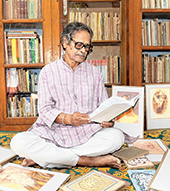
| Hariprasad Medda in his Kalipur home in Arambagh. (Anindya Shankar Ray) |
Hariprasad Medda was 21 when he ran away to Santiniketan during a college excursion in Burdwan to become an artist. Six decades later, Hariprasad, who was inducted into The Telegraph School Awards for Excellence 2011 Hall of Fame, is still listening to the diktats of his heart and trying to keep the idea of Santiniketan alive.
Hariprasad lost his father when he was one. He was brought up at his maternal uncle’s home in Kalipur village near Arambagh in Hooghly. Now 79, he still lives there.
Walk into the compound of the large building and you see a bit of Santiniketan on the walls — in the form of murals and paintings. Walk into the tiny room where he lives, and you see the walls covered with shelves happily weighed down by books and paintings.
But a home was never enough to make Hariprasad content. He had a habit of running away. The bright young boy, a good student, always strained against the rules of formal education.
“I was not interested in becoming a doctor or an engineer. I ran away when I was in college and went to Kala Bhavan. Mastermoshai (Nandalal Bose) changed my life,” says Hariprasad, sitting on a mora in his room. A smiling, robust man, he looks far younger than his years.
He fondly remembers his time in Santiniketan, when he was taught by Bose and Ramkinkar Beij.
Hariprasad did not just learn art. He learnt singing and dancing and played football — he was the best striker of the Visva-Bharati University team. In 1957 he received his diploma in art.
Back home, he was unhappy again. A few days later he ran away once more. This time he travelled across the country by trains, paying his way sketching for people.
“My family got in touch with Mastermoshai and he offered me a job at Vasanta College in Benaras to teach art in the girls’ college,” says Hariprasad.
Later he taught art in schools and colleges in Dhenkanal, Coimbatore and Chennai, choosing to work in institutions that encouraged alternative learning methods in tune with Tagore’s ideals.
“But Mastermoshai had asked me to go back to my village and spread the joy of learning art among the people there,” says Hariprasad.
In 1965 he left a lucrative job in Coimbatore and came back to Kalipur, where he has stayed since, teaching work education at the Ram Krishna Gobindapur Higher Secondary School till he retired. But his real contribution is in the way he has spread the word of Tagore, his notions of art and culture, in a place where dancing, theatre and painting were considered a waste of time.
“I had to initially dress men up to play female leads because they would not let women act together with men. Now my students all act together,” says Hariprasad.
He did not limit himself to teaching art. To those who did not have the skill for painting he taught billboard writing, book-binding, batik and handicrafts. He taught the women sewing and drawing alpana to help them earn.
“Now some of my students sell their art for much more than I do. I am very proud of them,” says Hariprasad.
His work is far from done. Hariprasad, who paints portraits of Tagore — as many portraits as the anniversary year; this year he painted 151 portraits — can still be seen cycling from village to village and fair to fair armed with a sketch book or assisting his students with their classes or plays.
“Singing, dancing, art should never be neglected. It should be as much a part of your life as academics,” says Hariprasad.
 |
| Amarendranath Adak in his Pursura home in Hooghly. (Anindya Shankar Ray) |
Amarendranath Adak from Champadanga, Hooghly, had a dream. He wanted to educate the people of his village. He took the first step towards fulfilling his dream in 1966 by establishing a primary school.
Forty five years, two schools and a college later, this 75-year-old teacher, who was inducted into The Telegraph School Awards for Excellence Hall of Fame on Saturday, is not content.
“I don’t think I have done badly but I haven’t fulfilled even a fraction of my dreams,” says Amarendranath at his home in Pursura village of Champadanga, Hooghly.
Amarendranath inherited his passion from his family. His great-grandfather, Maharendranath Adak, established a school in a neighbouring village in 1917. His father Subol Adak set up the Shyampur Munshi Khairat Ali Jubilee Institution and was instrumental in setting up other schools in the area. His uncle, Bishnu Adak, had built a school too.
Amarendranath completed his MA in Bengali from Calcutta University under illustrious teachers such as Pramathanath Bishi, Narayan Gangopadhyay and Asutosh Bhattacharya. His eyes crinkle with mirth as he remembers the daab seller under the mango tree who claimed that anyone who drank coconut water sold by him would pass the exam.
He wanted to stay back in the city; he had job offers. But that was not to be.
“My father reminded me how Rabindranath Tagore had wanted people to develop villages and requested me to do something for my village,” says Amarendranath, sitting with his back to the stunning view of the Damodar that can be seen in its splendour from the window of his study.
With Tagore in mind, he made his way back to Chiladangi, where he was born. In 1962 he joined Champadanga High School as an assistant teacher, where he taught for around nine months. Since then Amarendranath, also a staunch Gandhian, has taught in Kamarpukur Ramakrishna Sarada Mahavidyalay and Khanakul Raja Rammohan Ray Mahavidyalay.
Before he took up his first job, Amarendranath had become part of an effort to found a college in Champadanga as part of Tagore’s birth centenary celebrations. But making it a reality was tough.
“After the ’62 elections the Congress said no to the college but I kept trying. I managed to get 10 bighas from a relative, Nitai Charan Hazra, and Rs 20,000, and the process started,” says Amarendranath.
He calls it a college of the people of the village. Traders, workers, farmers — all contributed in building this college, brick by brick. Amarendranath even levied an unofficial tax of an anna for every transaction that happened in Champadanga and met with no resistance. That is how much of the college was funded.
But even that wasn’t enough. All work on the college was put to a halt till 1971, after the Congress lost the Assembly elections in 1967.
In the meantime he concentrated his efforts on starting a school in his village, Chiladangi. In 1966 he set up the Chiladangi Rabindra Bidya Bithi Primary School. Forty five years later, the school that started with a thatched roof and two rooms has become a high school with over 2,000 students. Amarendranath has been its secretary from inception.
In 1971, his dream of starting a college was finally realised and Champadanga Rabindra Mahavidyalay started as a commerce college with 33 students.
He moved away from the college a few years later because of some misunderstanding. He doesn’t want to talk about it. He was instrumental in setting up over 20 primary schools and five high schools in Hooghly district.
Now, the retired mastermoshai spends his free time writing, playing with his grandson and dreaming.
“I have not done everything I wanted to, but I am proud that now you can find a graduate farmer working in every field in our area,” says Amarendranath.