 |
I made up my mind to visit Chiria Mines after hearing about the place during a trip to Manoharpur in Jharkhand. The journey itself is the best part of the trip but mine began with the news that the goods train that heads to Chiria Mines through the hills and the Saranda forest would not ply that day.
Outside the Manoharpur station, villagers were waiting in the shade of a palm tree for trucks to take them the 30-odd kilometres to the mines. I joined them.
Soon, a car came down the road only to speed past us raising a cloud of dust. The road, as far as I could see, was pretty. It headed up through the hillocks underneath a canopy of trees.
A truck followed the car. But it, too, roared past without paying any attention to our frantic waving. I was thinking of putting off the trip by a day when another car pulled up near where I was standing. The man inside said he was going to Kiriburu and offered to take me to a point 8 km from Chiria Mines, where our routes diverged.
I jumped into the car but five minutes into the ride started to wonder if it was wise to travel with a stranger on a deserted hilly road. My fear was unfounded. My benefactor was a gentleman. A businessman, he had been staying in the area for 30 years. He, too, recommended a visit to Chiria Mines.
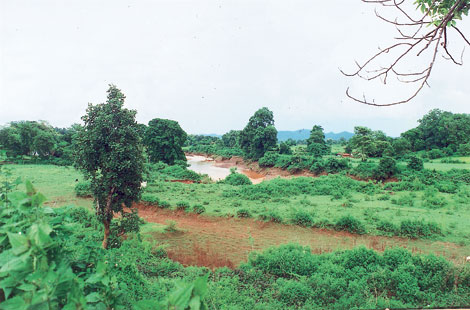
As the car left the outskirts of Manoharpur, the forest became denser and the slope steeper. The sunlight reached the ground only in patches through the leaves of sal, segun, kendu and akashmoni. My companion said the forest cover was rapidly thinning because of timber thieves.
The river Koel rumbled through boulders beside the road during the initial part of the journey, its waters coming down in swells from the cliffs. Tribals gathered firewood on the banks.
Further on, we saw glimpses of other rivers like Karo and Koena billowing and dashing to the plains. The turbulent Durduri also afforded us a look.
Surrounded by Kiriburu, Karampada, Tupadih Rangra and Rakshi, Chiria Mines lies to the south-west of Manoharpur. On the way, we came across a hamlet called Ankua, where a haat is held every Sunday and Wednesday.
During the three-hour journey, I saw many paddy fields on the slope of the hill. Almost all of them had a wooden platform about 20 feet high. Villagers keep vigil on the platforms at night so that their crops are not eaten or trampled by elephants. They beat on tin cans to scare away the pachyderms.
At the U-turn near Ankua bazaar, I thanked the businessman and started the 8-km trek. The road is broken but either side of it is rich in verdant beauty. Birdsong filled the air. In fact, Chiria Mines gets its name from the number of birds that frequent it.
The area is infested with elephants. I was nervous after seeing fresh droppings of pachyderms near the road but walked on. There were cattle grazing on the road. A wild cat bolted into the forest after seeing some boars.
I reached my destination in the afternoon. Surrounded by a boundary of hills, Chiria Mines is like an open-air factory with an intricate network of rail tracks. Iron ore was being carried away in wagons along a rail track.
The IISCO officials readily entertained my request to roam around. They even accompanied me on a trolley up a hill, about 3,000 feet high. Iron ore was being extracted there and transported to the plants.
The view from the hilltop was breathtaking. An IISCO official said that on full moon nights they can often see elephants playing on the banks of the rivers below.
Going
Take any Mumbai-bound train from Howrah and get down at Manoharpur station. Or take a mail or superfast train to Chakradharpur and a local train from there to Manoharpur. If you prefer to drive, take National Highway 6.
Staying
Hotels around Manoharpur station. Tariff is between Rs 300 and Rs 500 per room. At Chiria Mines, the IISCO guest house is the only option. For bookings, contact IISCO house, 50 Chowringhee Road.
 |