 |
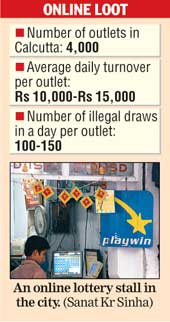
Lottery operators are gambling on lax vigilance in Calcutta to defy an interim instruction by the Supreme Court last Friday to restrict draws to once a week per game instead of one every five minutes.
Result sheets of multiple draws held through the day hang in front of almost every street-corner lottery outlet a week after the apex court reminded the state government of a central law banning more than one draw a week.
On whether he knew that multiple draws were under the court’s glare, a lottery franchisee in Burrabazar said: “Yeh sab chalta rehta hain (such things happen routinely).”
The owner of an online outlet on College Street — the city has around 4,000 of them — argued that lotteries would go out of business if they were to restrict draws per game to once a week.
“Imagine you are going to a party where you are told that one person can have only one drink. Likewise, one draw a week will not be able to whip up the frenzy generated by draws every five minutes.”
Loopholes in the law insulate lottery operators and their franchisees from a crackdown. Section 4H of the Lotteries (Regulation) Act, 1998, states that “no lottery shall have more than one draw a week”.
So the same lottery is held several times a day with a prefix or a suffix to the original name or even a new name. Regular gamblers know they are playing the same game but the law ostensibly can’t call the operators’ bluff.
“We have so many draws that we have run out of names. We have exhausted the names of all fruits and vegetables,” said a central Calcutta retailer.
Lotteries may be a win-win proposition for the organiser and the franchisee, but rare is the lottery addict who has won an amount worth counting and kept the money.
Ask Bibhash Karmakar, a management graduate who gambled away his savings in one day before moving court against “unethical business practices” that have reduced many like him to paupers. Karmakar said “99 per cent of the poor people” who played online lottery were “depressed at the end of the day after losing all their hard-earned money”.
No state has yet formulated fool-proof rules that ensure lotteries are conducted in a transparent manner. Bengal has its own state lottery and so cannot stop any other operator from doing business in the state.
The last time the Bengal government conducted raids on online lotteries and arrested some operators was in 2004. Around 30 online lottery companies immediately moved Calcutta High Court, which dismissed their petition. The lottery caucus then went to the Supreme Court.
Though the apex court did not vacate the high court’s order, it did restrain the state government from prosecuting online operators till the case was disposed of.
Where the government has failed is in stopping new lottery outlets from being opened across the city.
“The court’s verdict meant that the government could not prosecute those already in business but what’s stopping it from launching a crackdown on the new outlets that have mushroomed without licences?” wondered a former distributor.
But for the optimist standing in front of the paan and cigarette kiosk that now rakes in more through lottery sales, the only thing that seems to matter is a chance every five minutes to win back everything he has lost.