
Calcutta: Passengers using the East-West Metro will have to climb 300 steps to safety through a ventilation shaft 13 storeys tall in the event of emergency evacuation because of a fire or any other threat.
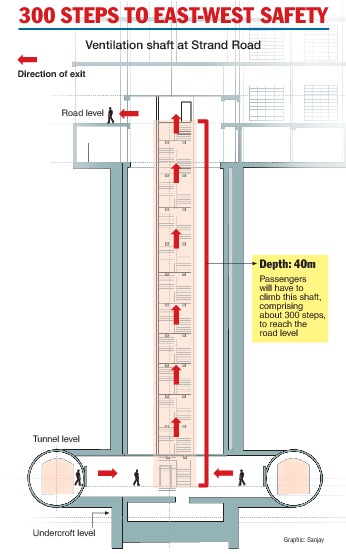
The shaft at Strand Road will be 44m deep till the undercroft level, which officials of the Kolkata Metro Rail Corporation said is the deepest that any underground rail project in India has gone. Passengers will have to climb up 40m or 13 storeys from the tunnel level.
The East-West line running from Salt Lake's Sector V to Howrah Maidan will have another ventilation shaft at Subodh Mullick Square. The depth of this shaft won't be more than 25m, according to an official of the implementing agency for the project.
Shafts are not only used to provide ventilation to tunnels during an emergency, but also for evacuation. Safety norms recommend a maximum distance of 762m between two evacuation points. Usually, stations are the evacuation points and ventilation shafts are created where the distance between two stations is more than recommended.
The ventilation shaft at Strand Road, built with a budget of Rs 45 crore, is likely to be ready in a year's time. While that will be the deepest point of any Metro route in the country, the East-West Metro in Howrah will be 30m or 10 storeys underground. This is also a record for an underground Metro station.
Metro spoke to architects and engineers of Afcons, the construction company building the ventilation shaft, to give the low-down on the steepest evacuation route anywhere in the country.
Steeped in safety
The ventilation shaft, to be used for evacuation if a fire is spotted or a train is stranded for a prolonged period, will be linked to the two tunnels through cross passages with fireproof doors.
Elevators were not considered because of safety reasons. "The guidelines of the National Fire Protection Association prohibits the use of an elevator for emergency evacuation in a public area," the official said.
The flight of stairs will have 10 landings for passengers to catch their breath during evacuation.
Tunnel ventilation
Above the ground, the ventilation shaft will be linked to a three-storey building where two giant fans will be installed for emergency tunnel ventilation.
A moving train usually draws fresh air into the tunnel and pushes out the warm air. But if a train is stranded, ventilation stops. This is when the two fans over the ventilation shaft will come into play. One of them will suck in warm air or smoke out of the tunnel. The other is meant to pump in fresh air.
Pumping station
The shaft will also act as a drainage pumping station. In the event of the tunnel walls under the Hooghly springing a leak, water will accumulate in a pit below. A 1.8m high pump placed 42m below ground level will suck out the water. In the event of a fire, water used to douse the flames will be pumped out in a similar manner, an engineer said.