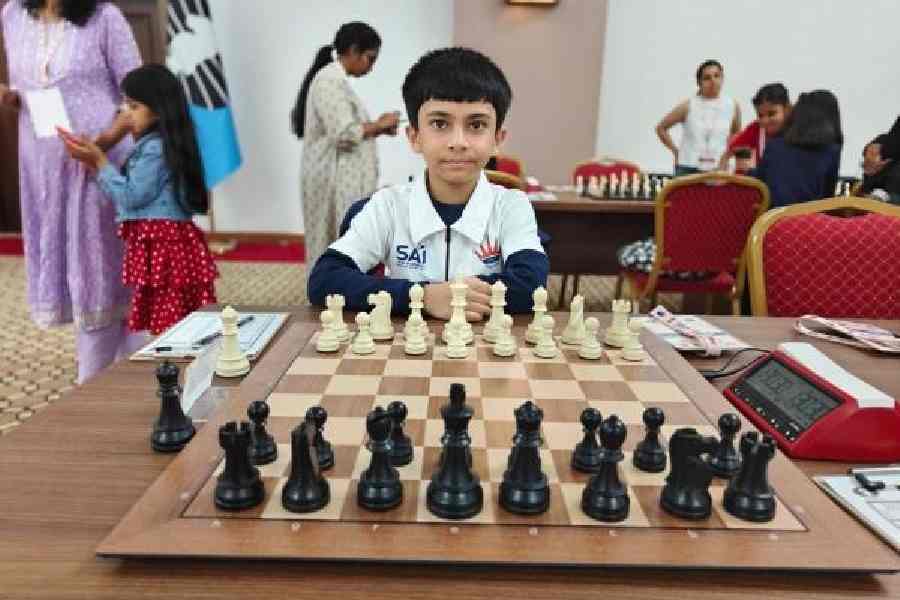
Sarbartho Mani, the Class III student of South Point School who started playing chess with his father when he was less than three years old, became a world champion (Under-10 category) at the Fide World Cup 2025, in Batumi, Georgia.
He also won bronze in the World Cadet Chess Championship 2025 in Kazakhstan, where 81 countries had taken part. "I like strategic thinking and calculated moves in chess," said the champion, adding how his best friend and many others in class are as passionate about the game.
"My best moment was when my achievements were recognised before my peers in the school assembly, and I was called a role model for others," said Sarbartho.
According to educators and chess coaches, there has been a sharp rise in the popularity of chess among students. "Chess is not just a board game. It is part of education itself," said Priyanka Ghosh Jesuraj, principal of the newly formed G.D. Goenka Public School in Shyamnagar Road. The school has a separate chess room, and it is offered to Classes II to VII as part of the co-curricular timetable.
"Students are encouraged to learn chess as a life skill and develop creativity," she said.
Chess clubs, inter-school, inter-house and Fide-rated chess competitions and festivals are now a part of most school calendars, especially since Covid. "I may have taken to chess seeing my father play, but my school also encourages us to take up the board game. We have an annual chess competition in school. Chess is also part of our Saturday school activity," said Shinjini Sengupta, a Class VIII student of Garden High School.
Younger role models and boredom during Covid had made chess popular. Now, it is part of life skills training in schools. "So many students began learning chess and playing online during the pandemic. Since then, the craze has peaked. It is no longer considered an old man's pastime. Gen Z has young Grandmasters, such as Gukesh Dommaraju, to look up to. We have tie-ups with many English-medium schools. Some offer it as a curriculum, others as a club activity," said Grandmaster Dibyendu Barua, whose chess academy trains children as young as three years.
In Birla High School, 150 students from the junior and senior sections are part of a chess club. According to co-curricular coordinator Sanjukta Majumdar, there are slots for different classes — III to V and VI to XI. "Two coaches from the Dibyendu Barua Chess Academy train the boys in strategic thinking and problem-solving skills." The chess club has smart boards for teaching purposes.
"I love our chess room, especially the books that are kept there," chipped in Koustubh Mitra of Class X, Birla High School, Mukundapur.
He has been playing chess for two years, a decision that has improved his focus and rational thinking.
"We actively promote chess as a mind-sport. Chess is included in the curriculum from Classes III to XII. Regular classes are conducted across grades in a dedicated chess room. We hope to groom students for state and national-level championships," said Mukundapur branch principal Jessica Gomes Surana.
Every school has the same focus — to build an interest in chess not just for championships, but to make students smarter.
South City International holds classes in its library for Classes VI to XII, while Mangalam Vidya Niketan has procured standing demonstration chess boards to facilitate teaching. "Matches are held regularly among the students. The chess club has witnessed a surge in interest from last year, when we roped in teachers from the Dibyendu Barua Chess Academy," added secretary Vivek Pancholi.
According to South Point High School principal Jaidev Ghosh, lessons come to a halt when chess competitions are held in their school. "We have a legacy of Grandmasters and chess champions. We offer it as a co-curricular subject."
Added Dalbir Kaur Chaddha, principal of the junior section: "Our Saturday chess class, complete with smart TV and professional advice, is much sought after."