
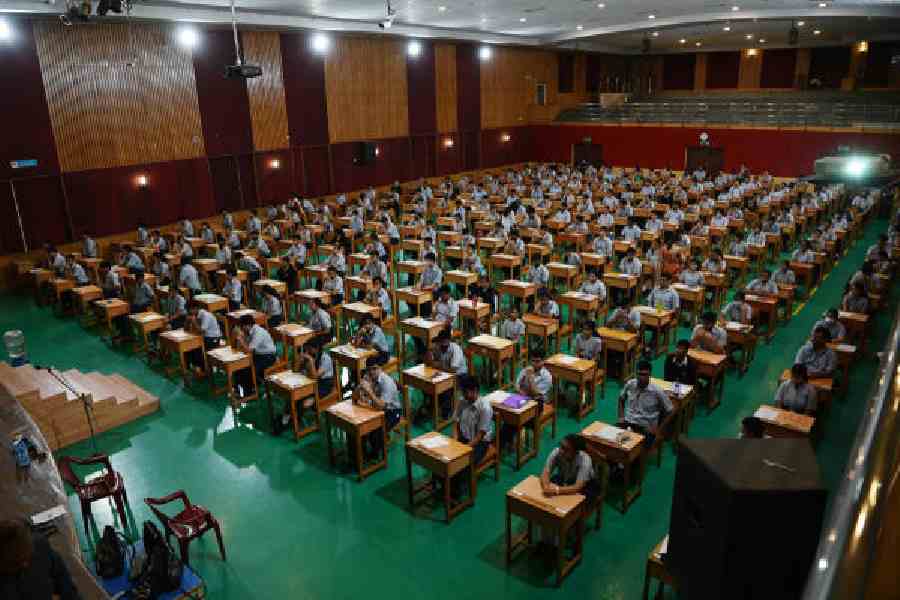
Every individual question paper for the ICSE (Class X) and ISC (Class XII) exams will carry a seal that candidates will have to break when the reading time begins, principals who attended a meeting with the chief of the Council for the Indian School Certificate Examinations (CISCE) on Monday said.
The measure has been introduced this year to maintain the “sanctity of the exam”, a school head who attended the meeting said.
On Monday, the chief executive and secretary of the CISCE held an online meeting with principals and exam functionaries from across the country to reiterate the rules for the smooth and fair conduct of the board exams.
The ISC will begin on Thursday, while the ICSE is scheduled to start on February 17.
“Each candidate will have to break the seal when the reading time begins,” said another school principal.
Once students are seated in the exam hall, the sealed question papers will be distributed. Candidates will be allowed to go through the general instructions on the paper but will not be permitted to open the seal until the reading time starts, the principals said.
“The students can go through the general instructions. They are allowed to break open the seal of the question paper only when the reading time begins,” a principal said.
The reading time for both ICSE and ISC exams begins 15 minutes before the writing time. “Children across the country will start reading at the same time,” another principal said.
A chief supervising examiner said the sealing of question papers was also intended to ensure discipline among students and at exam centres.
More than 2.5 lakh candidates are scheduled to appear for the ICSE exams across the country this year, while about 1.05 lakh students will write the ISC exams.
The purpose of Monday’s meeting was to reiterate the rules and regulations to conveners and chief supervising examiners who are responsible for conducting the exams.
“The purpose was to sensitise school heads and other exam functionaries for a smooth and fair conduct of the exams. They were told to follow the rules strictly and not to deviate from any guidelines given by the council,” Joseph Emmanuel, chief executive and secretary of the CISCE, told Metro.
“It is always important to sensitise people and orient them; otherwise, laxity can creep in. The schools have been doing it well, but when the council addresses them directly, they realise the importance of it,” Emmanuel said.
He said candidates should be instructed to carry only “permissible items” into the exam hall. “Carrying unwanted items to the hall amounts to the practice of unfair means,” Emmanuel said.
Schools have also been directed to use school vehicles, and not public transport, to collect question papers from banks.
“The answer scripts will have to be delivered to specific collection centres in the
vicinity of the school, from where they will be collected,” a principal said.
In larger cities, there will be multiple collection centres to ensure that no centre is more than 10km from an exam venue.
In both ICSE and ISC, students write the exams at their home centres, or their
own schools, while invigilators and chief supervising examiners are drawn from other institutions.
The council chief also cautioned school heads about delegating the powers entrusted to them. If responsibilities are delegated, they must ensure that the work is carried out promptly and efficiently, he said.