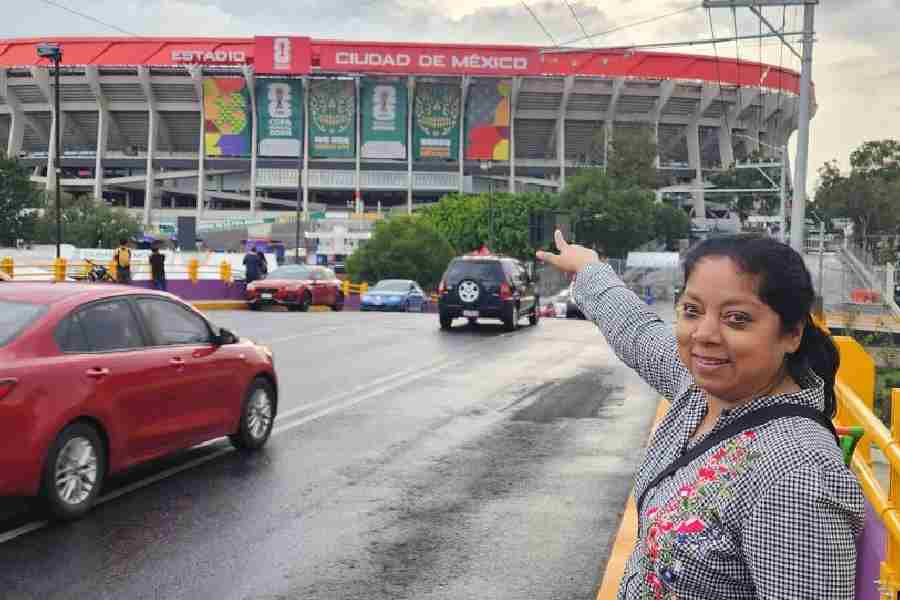
India had a presence at the football World Cup in Mexico City, which hosted the opening match on Thursday night — though not inside Estadio Azteca, where all the action unfolded.
“My eyes popped out when I spotted an India stall at the entrance to the Global Village that came up at Chapultepec, the city’s largest urban park,” said Soma Dattagupta, who had included a five-day stop in Mexico on her way back from the US, without realising that her trip would coincide with the World Cup.
“Imagine my thrill when it struck me that I would be there on the opening day, even if I didn’t have a ticket to the match.”
Dattagupta, who divides her time between Calcutta’s Triangular Park and Dubai, landed in Mexico City on June 4 with friends and watched the capital gear up to co-host football’s biggest spectacle in the days that followed.
The Global Village was located close to their Airbnb. “Dozens of countries had put up stalls selling football merchandise, posters and tourism information. I got myself clicked with a giant cutout of Messi at the Argentina stand.”
But to her disappointment, the Indian stall had no mention of India’s football culture. Instead, vegetarian samosas, pulao, and vada pav were on sale, served by Indians speaking fluent Spanish. “Possibly they were local residents,” she said.
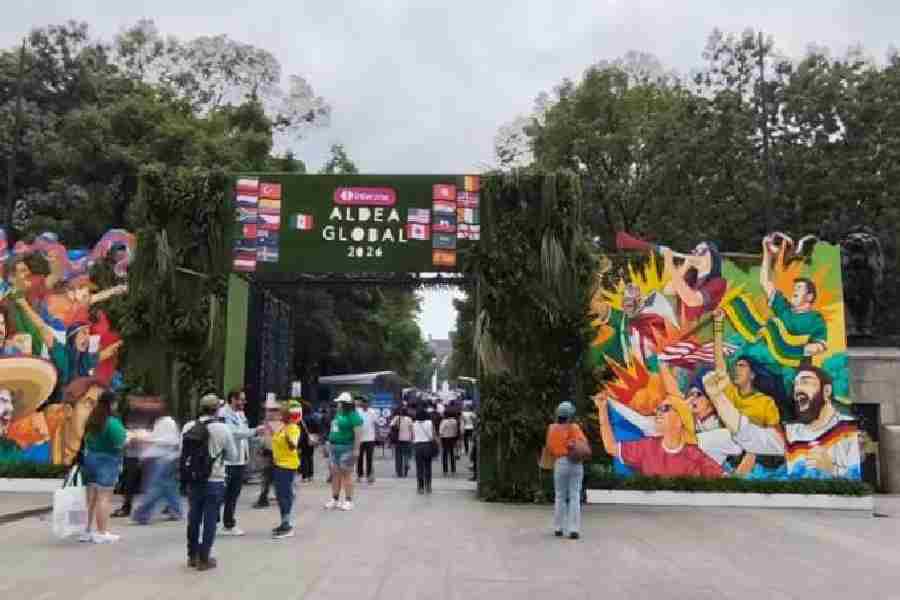
The entrance to the Global Village at Chapultepec
The group could not enter the late-18th-century castle at Chapultepec Park, which is more than twice the size of New York’s Central Park. It appeared to be hosting a football delegation.
The city itself was abuzz. “It was somewhat like the race against time before Mahalaya at Durga Puja pandals. There were mechanical ladders and scaffolds everywhere. Mexico City has a strong mural culture, and walls were being painted in bright colours,” Dattagupta said. The artwork featured Aztec motifs, local fauna, creatures from Mexican folklore and, naturally, sporting icons.
What impressed her most was the inclusion of women. Murals featured Christiane Endler, former Fifa Best Women’s Goalkeeper, and Stephanie Frappart, the French referee who has broken barriers officiating men’s international matches.
No surface seemed untouched. The most eye-catching figures were axolotls — critically endangered amphibians unique to Mexico City. “These cute salamanders have roots in Aztec mythology,” Dattagupta said.
“The feathered serpent painted on Metro coaches is Quetzalcoatl, an Aztec deity,” she added.
The Paseo de la Reforma, the city’s grand nine-mile boulevard, wore a festive look, with flowers blooming along its dividers. Around the Angel of Independence, the avenue’s best-known landmark, flag-waving fans — mostly Mexicans — sang, danced and posed for photos.
But there was also a nationwide teachers’ strike. Protesters demanding higher wages and better working conditions caused traffic snarls and heightened security. Sirens could be heard in the background as Dattagupta spoke from their rented verandah. “Police vans are on alert everywhere, in riot gear,” she said.
Like several tourist hotspots, the city’s central plaza, the Zócalo, remained barricaded throughout their stay.
“The first time we tried to access the plaza, we had to go to a sixth-floor rooftop café just to see the giant screen being installed below. Even on Thursday morning, with only hours left before the inauguration, the police had no idea when fans could be allowed in because of a gatecrash risk from protesting teachers,” she said.