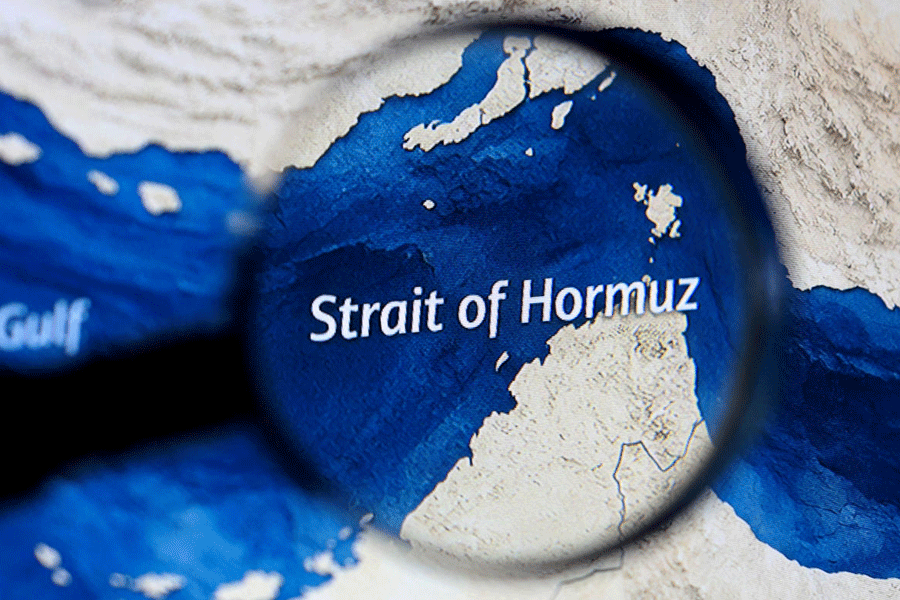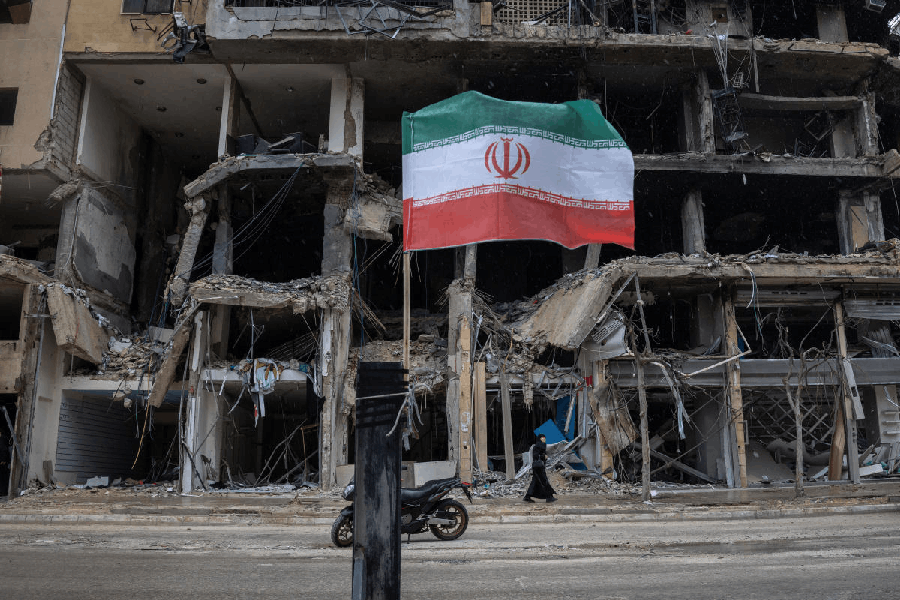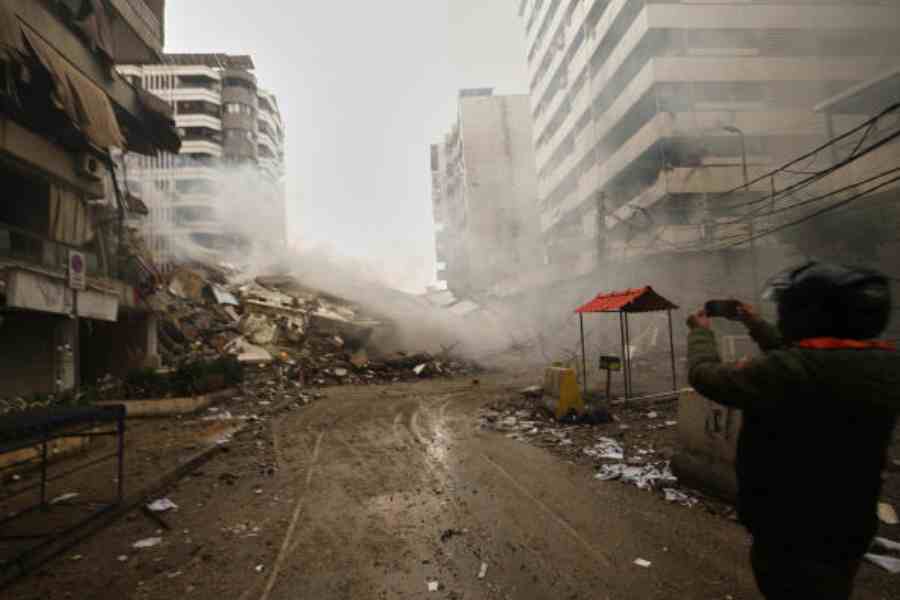
A city school has reached out to parents concerning the “futility of warfare and the importance of compassion” amidst the ongoing war in West Asia.
Veteran educators highlighted the need for conversations with older children about international politics and contemporary issues, ensuring that teachers’ biases are not reflected in these dialogues.
The Heritage School sent the letter to parents on Saturday.
The letter from principal Seema Sapru read: “War, anywhere in the world, impacts each of us. Our country, though not involved, had a shortage of oil and cooking gas. We are interdependent and need to talk to our children about strategic economic and foreign policy. Children need to learn from our history books about the futility of warfare and the value of compassion.”
The school has said that it is ironic that in this age, when artificial intelligence is poised to transform the future of humanity, wars continue to be waged that “destroy lives and also hope.” “May peace prevail across the world, and may we continue to guide our children towards empathy, wisdom, and deep respect for the dignity of human life,” the principal wrote.
Many schools are currently on their session break or in the midst of exams. The Heritage School will begin its new academic session for Classes II to XII on March 23 with a multi-faith assembly during the week that emphasises the notion that “war has no faith, no religion.”
“War shouldn’t be trivialised, and at no point in time should anyone be celebrating death and destruction happening anywhere in the world,” Sapru told Metro.
Several education experts with extensive experience in school education emphasised the importance of instilling the value of peace.
“Schools should play a role, and instead of taking sides politically, they should talk about how war doesn’t help anybody, and everything should be resolved through dialogue and peaceful ways. That is something we have to instil in our children,” said Devi Kar, director, Modern High School for Girls and Modern High School International.
Teachers sometimes find it difficult when children ask uncomfortable questions, but avoiding a conversation is not an answer. “Avoiding conversation can be artificial. It (war) is real, we don’t need to terrify them, but know how to handle it sensitively,” said Kar.
With older students, Classes IX upwards and especially with those in Classes XI and XII, there should be “full-blown conversations” in classrooms, said Kar.
“There should be a free-flowing conversation in Classes XI and XII. We have to be careful not to let teachers’ biases come through, and students should be allowed to express their opinions instead of imposing an adult’s view on them,” said Kar.
The English literature syllabus of the Council for the Indian School Certificate Examinations ( CISCE) has war poetry by Wilfred Owen and Vikram Seth, which talks about the futility of war, said Hilda Peacock, resource person for English, CISCE and an academic consultant to schools.
“It is packed into the syllabus. We teach children poems such as Wilfred Owen’s Strange Meeting and Vikram Seth’s A Doctor’s Journal Entry for August 6, 1945. We teach children that there are no winners in war. Even when we are doing extracurricular activities, we talk about their effect on the environment and the cost it entails,” said Peacock.
Jaidev Ghosh, the principal of South Point High School, said that at this critical time, when social media is flooded with war-related information, it is important to stick to conventional news sources rather than believing social media feeds.