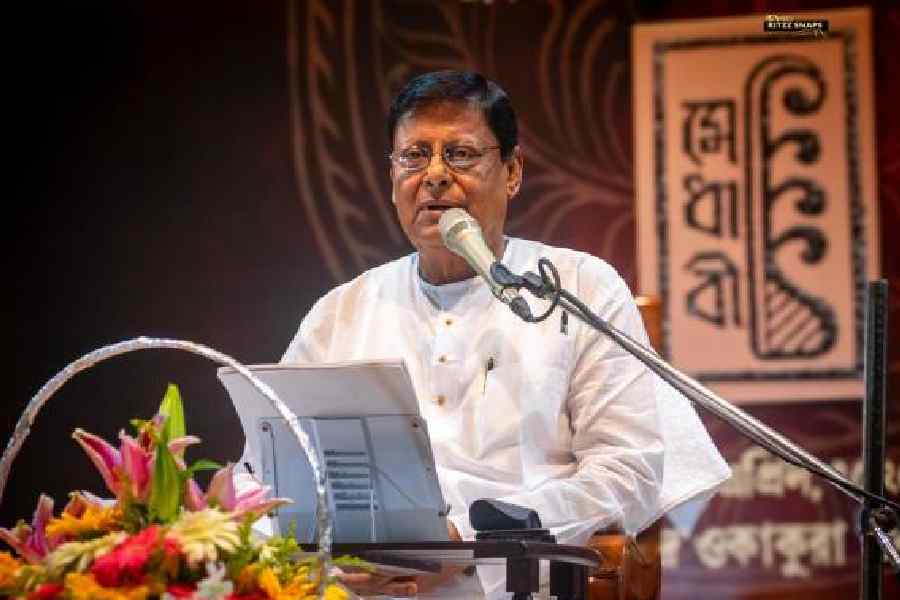
Students of the CL Block-based music school Medhabi hosted a cultural evening to commemorate the 80th birthday of their teacher, Rabindrasangeet exponent Ashis Bhattacharya.
The chief guest at the show was Sudin Chattopadhyay, former president of the state council of Higher Secondary education. “Tagore repeatedly paid tribute to his mentors — Vidyasagar, Rammohan Roy and Bankimchandra Chattopadhyay and today, the disciples of Ashish Bhattacharya too have upheld that tradition by celebrating his 80th birthday,” he said.
He added that Bhattacharya was among those who had preserved the essence and ethical integrity of Tagore’s songs with unwavering commitment, spreading light amidst contemporary cultural chaos, while also carrying forward the legacy of Rabindrasangeet exponent Sailajaranjan Majumder.
The final segment featured a solo performance by Bhattacharya, who rendered 12 songs from puja paryay and another six from bichitra paryay, with only a five-minute interval.
Ahead of his performance, Bhattacharya revealed a lesser-known episode from his musical journey, which he wished to place on record. “In mid-1985, Sailajada urgently summoned me and asked me to notate the song Ananter bani tumi, basanter madhuri utsabe. I prepared the notation sitting in front of him,” he said.
He explained that the song was originally sung in 1926 at the wedding of Rabindranath’s eldest brother Dwijendranath Tagore’s son Ajitendranath Tagore with Amita Chakraborty, daughter of poet Ajit Chakraborty. Rabindranath had originally penned it as a poem titled Nababadhu. “It was a great achievement and matter of fortune for me that, in 1986 — 60 years later — I sang the song for only the second time, at Sailajada’s initiative, at a programme held at Bichitra Hall, Visva-Bharati,” Bhattacharya recalled.
He further narrated that on seventh Poush, 1987, a commemorative publication titled Agniraksha was released. “For publishing the song in the souvenir, Hemendra Mohan Sen, son of scholar Kshitimohan Sen, approached Sailajada, who asked him to collect the song and its notation from me. Later, the Visva-Bharati publication unit sought Sailajada’s approval for proof-checking, but he reprimanded them and asked them to have the notation checked by me, since I had prepared it.
“But despite submitting my handwritten notation, Sailajada was eventually credited for the work. Later, when the song was included in the 63rd edition of Swarabitan, too, there was again no mention of my contribution,” Bhattacharya said. “As I am ageing, I felt this fact should be placed on record. I do not mean to show any disrespect towards my guru, but my name could have been mentioned. Still it is a solace to me that I could at least prepare the notation of a song penned by gurudev Rabindranath Tagore.”
Bhattacharya’s wife Jayasree, who assists him in his research and other work, shared how his musical philosophy has always prioritised melody and lyrical expression. “He believes that the sonorous quality of instruments should never overshadow the song itself. That is why he prefers string instruments such as the esraj, violin and tanpura as accompaniment,” she explained.
Laban Hrad Mancha in BD Block was packed with theatre lovers when the township-based group Britya staged two productions.
The first was a satire on superstition, Swapnasiddha, directed by Chandra Banerjee. A BB Block resident, Banerjee has been an actress and debuted as a director this time, at the age of 74. “Age is just a number. It is never to late to catch up with your dreams, or start dreaming anew,” she said.
The set design was assisted by one of the founding members of Britya, Bijan Ghosh of BC Block, while secretary Sujit Ghosh handcrafted the props.
The play had an all-female cast and introduced new faces on stage. Sulaghna Palai, a Class XII student of Labanhrad Vidyapith for Girls, is a Bharatnatyam dancer but this was her first time acting. “I had almost given up in the middle of rehearsals but Chandra didun held me back. I was so nervous I couldn’t sleep last night,” confessed the girl who played Gugli.
Sutapa Basu Dutta is a professional singer but had not acted at this level before. “We had made a second home out of Chandradi’s house and became much more than professionals working together,” she said.
Banerjee’s biggest supporter turned out to be her husband Sudarshan Banerjee, who is also the president at Britya. “I played the real-life chef at the rehearsals,” laughed the CA Block resident.
Another actor was 74-year-old Sanjukta Pal, retired biology teacher at Salt Lake Point School, who has been acting with Britya for almost 10 years. “I found the courage to act at this age as it was before friends and neighbours,” she smiled.
The second play, Shibankar Chakraborty’s Jongoler Din-Raater Jongol, was directed by Arijit Roy and Arup Ghosh. The play was about urban-tribal conflicts and the actors did an incredible job of picking up the Santhali dialect and body language.
Roy, who himself played the role of Mahato, a Santhal, said: “Without the right dialect, this play would lose integrity.”
“It is the director’s job to help actors transcend their own identity and become the character,” added the other director, Ghosh of AC Block. BC Block resident Mousumi Dutta said she had to go out of her comfort zone but pulled off the role of Kanta. “I had to practise all my emotions keeping in mind my identity as a Santhali woman. I had to express anger and sorrow without swaying away from the dialect and body language.”
Ria Roy