The annual pollution emergency in New Delhi nudged Jason Walker, a lawyer from Melbourne, into an unplanned detour, back to a city he has loved for decades.
His first visit to Calcutta since the long, pandemic-induced pause led him to what was once North Park Street Cemetery, a place now erased from the city’s memory.
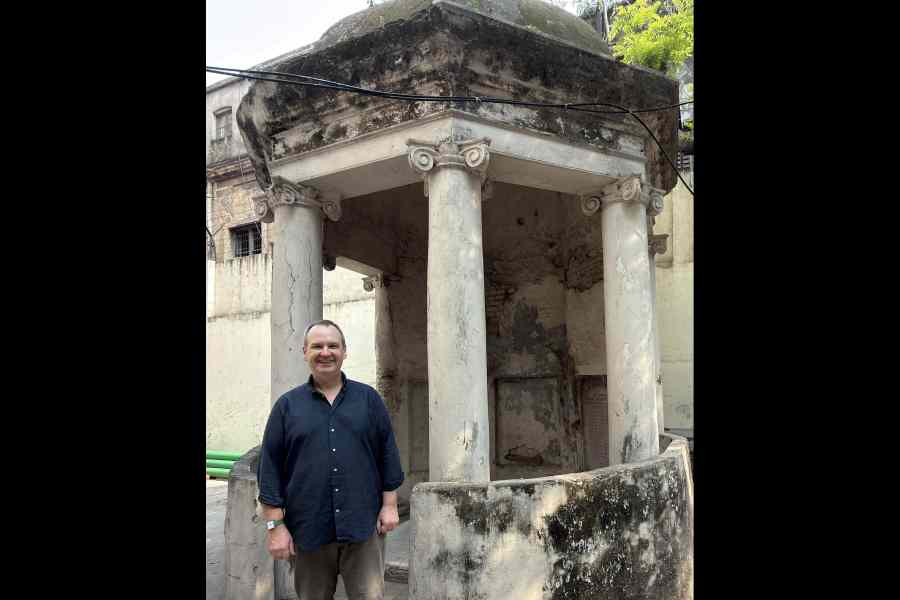
In a quiet corner of the grounds — today home to the Assembly of God Church, its towers, school and hospital — stands a lone sepulchre, stubbornly resisting time and redevelopment.
“My grandfather’s sister, Dorothy, married a Robertson. It’s her husband’s people,” Walker says, standing by the tomb.
“They were mostly in the police force; something like deputy police commissioners. I don’t know enough about them, as they are cousins of my mother’s cousins. Many of them left for Britain around 1947-48.”
Walker, now in his early 50s, pauses, measuring memory against history.
The cemetery itself was levelled in 1953. The open land that was created was occupied and the Bustee Congress was formed, until the late Mark Buntain, founder of the Assembly of God School in the city, succeeded in bringing order to the place.
Among those once buried here were Richmond Thackeray, father of the novelist William Makepeace Thackeray, and James Achilles Kirkpatrick, one of the main characters in William Dalrymple’s White Mughals.
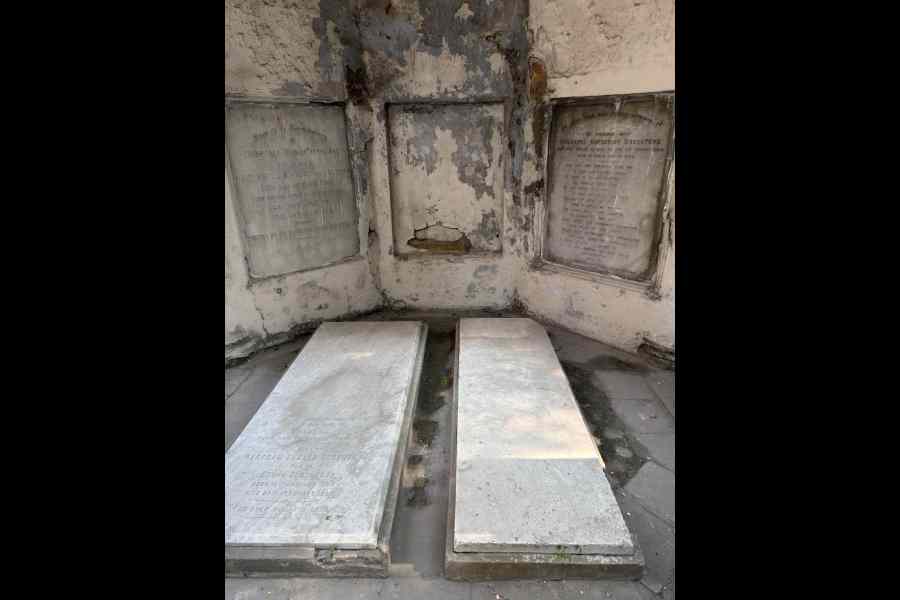
Graves belonging to the Robertson family.
“My grandparents wondered why they should leave when this was where they were born,” Walker says. “Unlike another branch of the family that departed quickly, mine stayed on after Independence. There are more graves at the Lower Circular Road
Cemetery that belong to closer ancestors of my cousins.”
What remains today is what many refer to as the Robertson Monument or the last surviving tomb of North Park Street Cemetery. Its dome is weathered, its memorial plaque scarred by time and neglect.
Walker’s mother, Pamela Stock-Hall, was born in Calcutta in 1947 and left in 1969. She grew up around Park Circus and Theatre Road and studied at Our Lady Queen of the Missions School. Generations before her — grandparents and great-grandparents — were also born in India.
“She was still a child when the cemetery was cleared in the 1950s,” Walker says. “Her aunt and her mother would bring her here for walks, just to look around. She had no idea then that members of her own family were buried here.
“It’s only through research over the past 30 or 40 years that we’ve been able to piece together our history. Some of my ancestors are buried at South Park Street Cemetery.”
Why this one grave survived remains unclear. “We don’t know if it was because the Robertson family had police connections, or simply because this was an unused corner of the plot,” Walker says.
The family’s roots in India, Walker believes, stretch back nearly two centuries. “They worked across trades, like indigo, tea, the military, policing and later, the public works department,” he says.
“One ancestor, around 1820, was even a writer at Writers’ Buildings. That’s our first clear connection to Calcutta. There was also a marriage at St John’s that same year.”
“With this kind of lineage,” he adds quietly, “there are Gujarati, Tamil and Bengali strands in my DNA.”
Walker first came to Calcutta in 1981-82, when he was seven or eight. Since then, he has returned nine or ten times. His father, an Australian, was drawn in by the city’s intensity.
“As my mother would say, it’s a tamasha,” Walker smiles. “There’s always something happening. There’s energy here.”
Walker, who visits India every few years with his family, had arrived in Delhi but, seeing the air pollution, decided that Calcutta would be a better bet.
A keen photographer, Walker plans to spend the next few days wandering round the city, revisiting old favourites — fruit cake from Nahoum’s, kati rolls from street corners.
“Back then, it was five cubes of meat inside a paratha the size of your hands,” he laughs. “Now it’s a whole conglomeration of sauces.”
Like many who return to a beloved city, Walker is torn between nostalgia and acceptance.
“Part of me wants to pull everything back. But you can’t live in the past; you have to move forward.”
Calcutta has evolved. There’s a constant cycle of regeneration. “The past,” he says, “is a different country.”