Mexico may have hosted the Fifa World Cup thrice, but for many from Bengal now living in Guadalajara, the country’s second-largest city, it is an experience unlike any they have known before.
“Imagine being a football fan living in a city hosting the World Cup,” Krishnendu Sinha told Metro over a WhatsApp call, the excitement palpable in his voice.
Guadalajara, often described as Mexico’s Silicon Valley, is home to a sizeable community of IT professionals from Bengal.
Living a short distance from the stadium did not make the process any easier for Sinha. He, too, spent almost four hours glued to his computer before securing a ticket.
“I logged in sharp at 8.30am. By the time my turn in the online queue came at 12.30pm, only tickets for the South Korea-Czechia match were left, and those too were Grade I seats costing around ₹47,000,” he said.
The 43-year-old Mohun Bagan supporter from Sonarpur booked his place at Estadio Guadalajara for the June 11 fixture. “I went wearing my green-and-maroon jersey,” said Sinha.
His colleagues, Ipsita Saha and her husband Abhishek Ghosh, were less fortunate with tickets but have been immersing themselves in the spirit of the Cup. “The city looks transformed,” said Ipsita, who grew up in Durgapur.
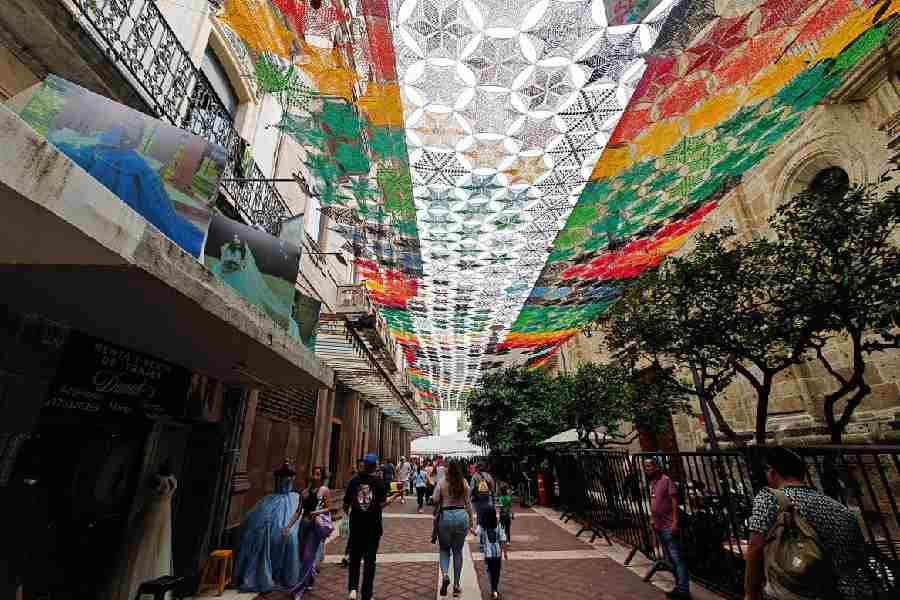
One of the most striking attractions is a canopy installed at Zapopan Centro, the tourist district surrounding the Basilica of Our Lady of Zapopan.
Stretching 220 metres from the iconic Arcos de Zapopan to the main square and basilica, the colourful installation — known as Bosque Mundialista (World Cup Forest) — celebrates the seven nations playing their group-stage matches in Guadalajara.
The hand-crocheted canopy was created by a collective of 250 women artisans who earned a Guinness World Record in 2019 for the world’s largest crochet canopy.
On Wednesday, the eve of the Mexico match, Guadalajara hosted a Fifa Fan Fest at Glorieta de La Minerva, the city’s traditional gathering place beneath the statue of the goddess Minerva. Mexican rock legends Maná performed before an estimated crowd of 160,000, with local ska-reggae fusion band Los Afro Brothers opening the concert.
The World Cup buzz had been building for weeks. “About a fortnight before the tournament, malls began stocking World Cup merchandise and the Mexico shirts sold out in no time,” Abhishek said.
While the family bought Mexico jerseys — widely praised for their bold Aztec Sun Stone-inspired geometric design — Ipsita also picked up an Argentina shirt in support of her favourite, Lionel Messi. “The entire city is walking around in jerseys,” she said.
For Abhishek, the tournament has had a more practical impact. His office is close to the stadium, prompting employees to work from home on match days. Their son Aditya’s school is located behind the Hilton hotel, where the Mexico team had been staying.
“Football is all they are talking about in school,” said Ipsita. “We saw the team bus drive by, but access to the hotel is heavily restricted.”
The couple, the only foreigners in their twin-tower residential complex, spoke warmly of the hospitality shown by their Mexican neighbours.
“They invited us to watch the Mexico-South Korea match together,” said Abhishek. “We gathered at the bar downstairs, wearing Mexico jerseys. Watching the team win together was such fun.”
“The Mexicans are incredibly warm people,” added Ipsita. “Even the large number of Korean visitors here are saying they have never felt more welcomed in a city.”
Krishnendu noticed another interesting trend. “Mexicans in the galleries supported South Korea against Czechia. Korea is very popular here, probably because of K-pop and K-drama. Even my daughter is a fan,” he said.
Mention of Guadalajara often evokes memories of cartel violence and its portrayal in popular culture, particularly through the OTT series Narcos: Mexico.
The Bengalis who have made the city their home, however, are quick to put such concerns into perspective.
“Mexico gets a bad reputation,” said Ipsita. “But every place has its problems. If something happens, stay indoors for a while. Ordinary civilians are rarely affected.”
She deliberately avoided watching Narcos: Mexico.
Security arrangements around the World Cup venues have nevertheless been extensive. Visitors are required to leave their cars several kilometres from the stadium and complete the journey by shuttle bus, which also stops short of the venue.
“Walking the final kilometre amid a sea of fans, with Shakira’s World Cup anthem echoing through the streets, was hardly an effort at all,” Krishnendu said. “It felt like the world had come together for one big festival.”