More than 700 new animals have been recorded in India in 2025, said a report published in Calcutta on Tuesday.
Kerala recorded the highest number of new species, followed by Bengal.
The report was published by the Zoological Survey of India, which functions under the Union ministry of environment, forest, and climate change.
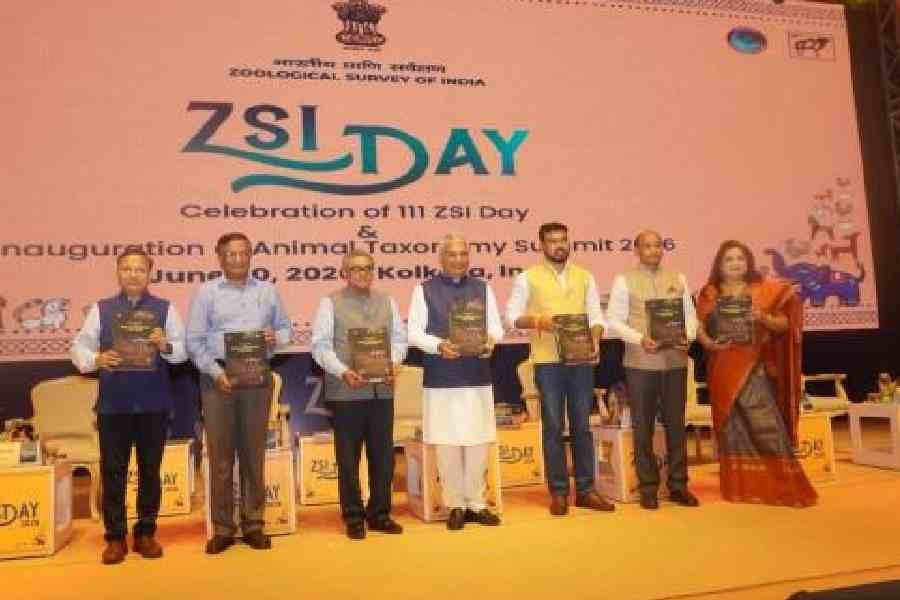
The Calcutta-headquartered ZSI, the country’s oldest taxonomic research organisation, celebrated its 111th Foundation Day at the Dhono Dhanyo Auditorium in Alipore on Tuesday.
The report, Animal Discoveries–2025, states: “709 new faunal records have been added to the national database”. This includes 483 species entirely new to science and 226 species recorded for the first time in India.
The ZSI also unveiled “Version 3.0 of the Fauna of India Checklist”. This compilation, building upon decades of research and the initial version released in July 2024, meticulously details 1,05,953 species.
“India’s total faunal biodiversity now stands at 1,05,953 species, reaffirming its status as one of the world’s premier megadiverse nations,” said a communication from ZSI.
Insects — particularly beetles, moths, and bees — represent the highest diversity within the registry, while fishes lead among vertebrates. This checklist will be updated annually, said ZSI officials.
“The creation of the online Fauna of India Checklist Portal and other digital resources is an example of ZSI’s successful initiatives in the digital era of biodiversity sciences,” Dhriti Banerjee, director of ZSI, writes in the preface of the report.
The Union minister for environment, forest and climate change, Bhupender Yadav, was the chief guest at the celebrations.
“Institutions like the ZSI provide the knowledge that makes conservation possible. We cannot conserve what we do not understand. We cannot protect what we have not documented,” said Yadav.
To commemorate its foundation day, the ZSI is hosting the Animal Taxonomic Summit-2025 from June 30 to July 2. Yadav inaugurated the summit.
Swapan Dasgupta, Bengal finance minister, and Manoj Oraon, the state’s minister of forests and environment, attended the celebrations.
“We tend sometimes to underestimate the phenomenal importance of institutions such as the ZSI. It contains a vast repository of accumulated knowledge built over decades by very dedicated people who have worked silently on the ground, sometimes
unhonoured and unsung. In our preoccupation with the oral tradition, we sometimes overlooked the importance of documentation. We inherited this (documentation) from our colonial masters. They did it partly because they were in an unfamiliar country. We need to do it because otherwise a lot of knowledge will be lost,” Dasgupta said.
Oraon recalled his student days, remembering that he wanted to study zoology but could not because seats were limited. Eventually, he had to settle for botany.

In the run-up to the celebrations, the ZSI had organised a nationwide 111-hour hackathon on “Traditional Knowledge on Biodiversity Conservation”.
The event brought together students, researchers, and innovators from diverse backgrounds to “bridge the gap between indigenous ecological wisdom and modern technological advancements to tackle pressing environmental and conservation challenges”.
The top three teams were awarded on Tuesday.