Parents of board examinees are being advised by several schools that children should not be completely barred from screen access; instead, they should have “intermittent exposure”.
The gadget or screen is not solely a form of entertainment; it also acts as a communication tool for children. Taking it away could lead to increased distress, particularly as they prepare for their school leaving examinations, which might negatively affect their readiness, according to the insights of school principals and mental health specialists.
The ICSE (Class X), ISC (Class XII) and CBSE (Class X and XII) are scheduled to begin next month.
“My advice to parents is that the child should be allowed to have some screen time as well. Children are used to the mobile phone, and instead of seizing the device, they should allow them to use it for 10 minutes or 20 minutes when they are taking a break from studies,” said Terence John, director of education and development, Julien Day Group of Schools.
The consortium comprising four educational institutions located in Calcutta, Howrah, Ganganagar, and Kalyani has conducted meetings with parents and will shortly provide them with an advisory.
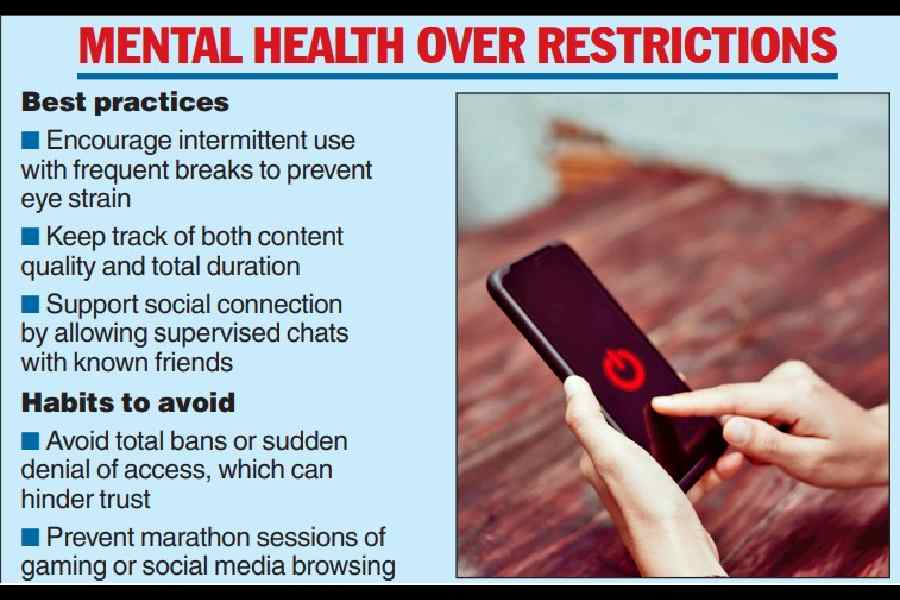
“We have told parents that if they are adamant and create a blanket ban, children would find a way of sneaking in a mobile phone, but if they are flexible, children would respect that and use it judiciously,” said John.
Adolescents or teenagers use gadgets for four or five hours a day, several principals said.
“You can’t expect a student to cut themselves off from the screen all of a sudden. Say, for example, a child was used to four or five hours a day, and that could be changed to intermittent exposure to the screen instead of cutting it down to zero,” said Satabdi Bhattacharjee, principal, The Newtown School.
The school has planned a session with the parents of board examinees at the end of the month.
There have been students who ask for some “me time with a mobile phone” to be able to perform optimally.
Bhattacharjee said parents need to recognise this is a “screen generation” and suddenly taking it away completely could lead to more brain fatigue.
“Earlier, it used to be the music system, television or even books that children would use to relax. Now the mode of relaxation has changed, and parents have to recognise that,” said Bhattacharjee.
According to John, the advisory is aimed at parents since they often become more anxious about their child’s readiness and performance.
He said: “We interact with children all year long, and they are familiar with guidance, but it is essential to also focus on parents during this period.”
The ownership of how to use the screen also has to be taken by students, said Anjana Saha, principal, Mahadevi Birla World Academy.
“Children should be responsible and time themselves and they should be the owners, and parents should be supportive of that is what I tell my parents and students,” said Saha.
Psychiatrist Sanjay Garg said the screen or the mobile is not alone a source of entertainment for this generation, but also a “mode of communication with their friends or the outside world.”
“They use the mobile phone to discuss with their friends, search for information or even clarify doubts. If a device is suddenly taken away from them just before the exam, they would feel cut off from the world outside,” said Garg.
Parents have to allow them to use the device in moderation and monitor what they are seeing or whom they are chatting with online, he said.
According to a school counsellor, parents need to monitor that their children are not dedicating too much of the night to internet surfing, chatting, or gaming before the examination.
“There has to be trust between the parents and the child, too,” said Garg.