
Artificial Intelligence can be used to generate ideas, but not to complete a child’s work. Children must be helped to understand both its real-life applications and its limitations, said new guidance documents released by two associations focused on early childhood development.
The AI guidance tool comes at a time when several private English-medium schools in Calcutta have begun introducing AI into the timetable from Classes II or III onwards.
The Early Childhood Association (ECA) and the Association for Preparatory Education and Research (Aper) have launched three documents and circulated them among schools to familiarise students, parents and teachers with AI before children are formally introduced to it in classrooms.
Preparing children
“We are not preparing our children for the new inventions that are entering their world. With the advent of mobile phones and AI, we are allowing these to creep up on children, and then we grumble about safety and addiction,” said Swati Popat Vats, president of ECA-Aper.
Schools in Calcutta that are members of ECA-Aper have shared the documents with teachers. The associations point out that many children are already using AI tools on their phones without realising that they are interacting with AI.
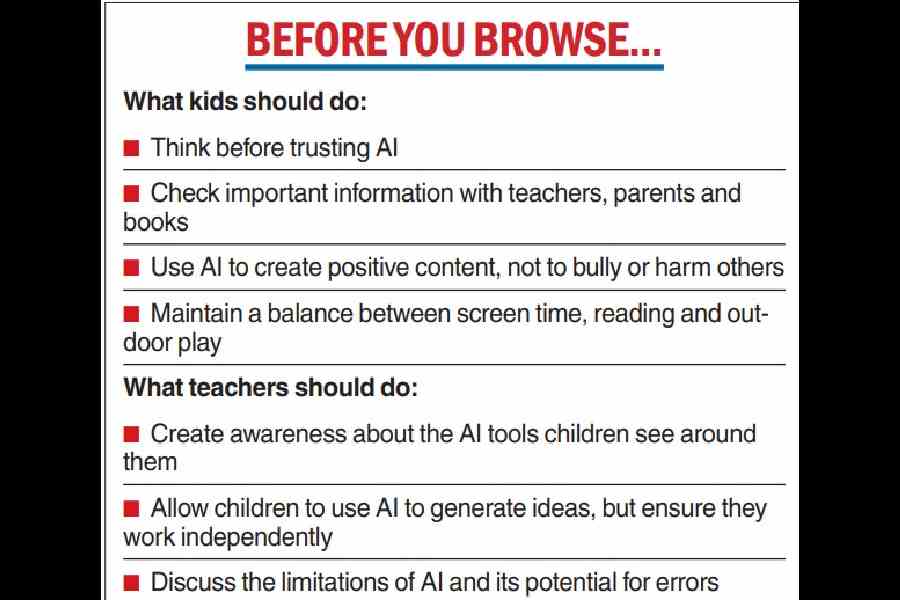
The documents emphasise that children should be taught to think before trusting AI-generated answers and to verify important information with teachers, parents or books. They also stress that AI must be used to create positive and respectful content, and not to harm, bully or spread misinformation. Maintaining a healthy balance between screen time, outdoor play, reading and time spent with family and friends is another recommendation.
Some of the rules are presented as rhymes to help children remember them. For example: “I will check what AI may say/Not trust it blindly right away,” and “I’ll use kind words in all I do/Create good things — helpful and true.”
Guidance for teachers
The documents also outline how teachers should introduce AI and frame discussions around it.
“Both teachers and parents need to know how to introduce AI because it is scaffolding — we are helping children navigate the world of AI. When we introduce swimming, we don’t push a child into the water; we provide support and training,” Vats of ECA-Aper said.
The documents encourage teachers to begin with AI tools children already encounter, such as voice assistants, learning apps and chatbots. Classroom discussions should include examples of whereAI is used in daily life, alongside conversations about its limitations and potential for error.
AI, the documents note, can help explain difficult concepts or generate ideas. However, it should not be used to complete assignments. Teachers are advised to promote collaborative classroom use, encourage students to research topics independently and compare sources.
Role of parents
Psychologist and school counsellor Ruvena Sanyal underscored the need for parental vigilance. “The concern is what we are doing to children’s brains when we are not monitoring their online activities. As parents and sensible adults, we have to put restrictions in place,” she said.
Children may use AI for school projects or search online for images and reference material. However, parents should remain aware of their browsing habits and supervise their activity, she said.
“When a project is ready, parents should check whether it has been blindly copied and pasted from the internet, or whether the child has used their own ideas to innovate and create,” Sanyal said.
She added that responsibilities cannot be abdicated. Parents, she said, cannot plead ignorance or professional commitments as anexcuse.
“Parents need to tell children that certain restrictions are not meant to trespass on their privacy, but to safeguard them in the online world,” Sanyal said.