 |
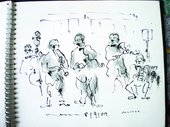
| Pipe on: A pen-and-ink sketch contributed by city artist Prabal C. Boral. He attended a midnight orchestra at Piazza San Marco, the main square in Venice, Italy. The square is often referred to as the “the drawing room of Europe” |
Tintorettor Jishu is running to packed halls. The magic of seeing Satyajit Ray’s super sleuth in action is drawing Bengalis of every age and shape (and some “non-Bengalis”, too) to the movie halls.
The Bengali is enjoying the film thoroughly, laughing at Jatayu’s “Reneshash”, marvelling at Feluda’s razor-sharp brain, delighting in the fight sequences and even managing a few claps and whistles when Feluda breaks a painting over the villian’s head.
But as soon as the last scene ends, the viewer jumps up from his seat, giving Jack-in-the-box a desperate run for his money.
The credits begin rolling, but he has no time to know that the theme score of the film is Satyajit Ray’s composition or that Tota Roy Chowdhury designed the fight sequences. For the minuscule minority interested in such pedantic details, too bad, the multitudes shuffling out will not let you catch even a glimpse of the screen.
Irritated with the hasty retreaters, one lady asked the people in front to move or sit down as she wanted to read the credits. Pat came the reply, “Ki didi, ek ticket-e duto show dekhben naki (Are you planning to catch two shows with just one ticket)?”
The little red dress
Mrs S. always prided herself for making the best tattva (trousseau) trays in this part of the world. As the Bengali wedding got bigger and fatter, Mrs S. burnt the midnight oil to deliver customised trays dolled up to match any designer do. Levis and Gucci replaced tangail and tussar on the trays, but Mrs S. was unperturbed. She is “modern”, she claims.
At a recent wedding, Mrs S. was heard scolding the groom’s mother for buying only saris and salwar-kameez for her daughter-in-law’s tattva. “E ki! Shobai bhabbe tui khub shekele, kichhu modern item kiney aan (Everyone will think you are outdated, buy some modern items for your daughter-in-law).”
Suitably chastened, the groom’s mother went shopping and came back with armloads of “western” clothes — jeans, jackets, skirts, blouses and the pièce de résistance — a bright red bustier.
Mrs S. was now in a fix. How to refer to the bustier in the tattva shuchi, the highly decorated and ornate list of gifts? Should it be clubbed with innerwear? What is Bangla for bustier? Some said let’s call it bokkho-bondhoni, others shuddered at the very idea. Finally, Mrs S. admitted defeat and labelled it laal jama (red dress).
(Contributed by Samhita L. Chakraborty)