 |
| Bijan Chowdhury |
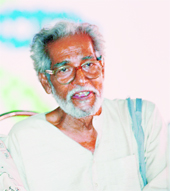
Bijan Chowdhury was a rare artist who was deeply involved in Left politics and was concerned more with the struggle of the common man and the troubled city he lived in than in creating objects of beauty. His works were akin to social commentary which he captured with abundant sympathy in his large, vivid and dramatic canvases.
Chowdhury, who died in Calcutta on March 16, was born in 1931 in Faridpur, now in Bangladesh. He had joined the art school in Calcutta in 1945, when Zainul Abedin, Prahlad Karmakar and Atul Bose were his teachers. But he was thrown out of this institution for his active involvement in a students’ movement to turn it into a college. No college would accept him here, so he joined the Government Institute of Arts in Dhaka where Zainul Abedin was already a teacher after Partition. At that time and throughout his life, Chowdhury was part and parcel of Dhaka culture and he always wanted to return to his roots.
In 1959 he returned to Calcutta and formed a group along with his contemporaries Nikhil Biswas, Prakash Karmakar, Arun Bose and other like-minded people, who created the Society of Contemporary Artists. But they broke away from it owing to ideological differences and created Calcutta Painters. He was once principal of Indian College of Art and in 1995 given the Abanindra Puraskar. His studio had for years been in Bally in Howrah, but in the early 1970s he had to leave it and seek refuge in Calcutta when it was attacked. That was the price he had to pay for his politics.
His art was influenced by Kalighat pats and he was not averse to exploring the inter-relationship between painting and music, as he did in his series on Indian classical music.
Human beings and their struggle for survival were always his theme and even when he painted landscapes the human presence was quite visible. He felt the human spirit could never be defeated, not even by death. His horses symbolised this energy that could not be negated.
Coffee or Likar Tea?
Somewhere near Golpark lies a small, neat, tea (and coffee) shop you are likely to miss. But it has a loyal bunch of customers, those who have enjoyed the hospitality of its affable owner and equally pleasant helper come back to it again and again. One of them has gifted the shop its most striking feature: its name, Billarista, and an accompanying poster that lays down the menu, designed to go with the name while not compromising local flavours.
So at Billarista, you can have “Billachino” (“Strong coffee with stretched milk and froth”), for Rs 15, “Straight black” (“Strong, thick. It’ll keep you standing all night”), also for Rs 15, “Chai Da Punjab” (“Selected tea dust boiled to death in milk”), “Bangalee Cha aka Chalu Cha” (“Short sweet weak tea”) or “Likar cha”. You also get “Mamlette”. Cha cha cha!
Spirit of women
The short film on a sprawling market, completely run and controlled by women, set the mood for the second edition of the programme Our Voice Our Journey II… Voices Across Generations at the American Center on Thursday. Directed by Binot Prajna
Tewari, the short, titled Manipur Cocktail, captured the Ima Keithel or Mother’s Market in Imphal as a space that these women have crafted out for themselves. Both traders and buyers are women.
In the second half of the programme four women achievers shared with the gathering their struggles. Former member of Parliament Krishna Bose, serial entrepreneur Anupama Arya, first the woman officer-in-charge of Calcutta police Debashree Chatterjee and Calcutta High Court advocate and social activist Maitreyee Trivedi Dasgupta shared their experiences with the audience. Moderated by educator Jane
Thompson, wife of the US consul general, the discussion brought into focus personal and social battles. “Women have many roles — some are visible, others not. If we have one fault, it is that we often undervalue ourselves,” Thompson said.
When Krishna Bose was a post-graduate student, one of her teachers told her mother not to send her to the university. Bose continued with her classes. “When I enter the courtroom, the male lawyers still ask me who my senior is. I don’t tell them I am the senior. They are very indulgent to start with, then as I start my argument, they slowly become angry,” said Maitreyee Trivedi Dasgupta. The discussion ended with Brinda Dasgupta speaking of “The Safe City Campaign”, started in partnership with Metro.
Clarification
In the item “Sons of Sutanuti”, carried in this column on March 18, Radhagobinda Kar was inadvertently referred to as a businessman. He was an eminent physician and philanthropist. We thank reader Garga Chatterjee for pointing it out. We regret the error.
(Contributed by Soumitra Das and Poulomi Banerjee)