 |
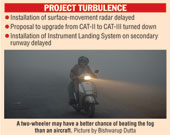
A piece of equipment that guides flights safely through low-visibility ground conditions was lying in cold storage when the season’s first fog attack crippled Calcutta airport last weekend, leaving fliers stranded for four hours on an average.
As many as 25 flights were delayed, three had to be cancelled and two were diverted on foggy Saturday, thanks to the authorities’ failure to install an Airport Surface Movement Guidance and Control System that was delivered to them with seven months to go for winter.
“The ground-control equipment arrived mid-year and was to be installed before winter. But we missed the deadline because of various reasons, and it appears unlikely that the system will be in place until at least next winter,” said a senior airport official.
Luckily for those booked on flights over the week, a cyclonic storm brewing off the Tamil Nadu coast played the unlikely saviour by pumping hot air into south Bengal, chasing away the fog in a day.
So can the city airport do without the equipment it has but hasn’t installed for the rest of the winter?
According to officials, the foggiest days of the season lie ahead with the prospect of fliers losing more precious hours waiting for flights to take off.
And who is to blame for the go-slow? P.K. Singhal, the regional executive director (east) of the Airports Authority of India (AAI), blamed the company that provided the equipment for the delay but declined to elaborate.
“The installation process will start soon. The optical fibres are being laid and the sites where monitors and towers will be installed have been identified,” said Singhal.
Calcutta airport, a work in progress, has been a poor performer in terms of meeting deadlines for development of infrastructure and passenger amenities. Work on upgrading the secondary runway and modernising the terminals is running behind schedule, sources said.
A pilot said AAI had been repeatedly turning down requests to upgrade the airport’s Instrument Landing System to CAT-III so that flights could safely operate even if visibility dropped to 50 feet.
“We have been raising the topic at quarterly meetings but to no avail. A CAT-III system can solve the problem of fog to a large extent because visibility usually doesn’t drop to below 50 feet in the city,” he added.
Regional executive director Singhal said the suggestion was financially not feasible. “We face such low-visibility conditions for only 10 days a year. Incurring huge expenses on an upgrade (specifically for this short period) is not viable,” he explained.
While a CAT-III system helps an aircraft land despite low visibility, the equipment lying in the airport storeroom is meant to help air traffic control guide aircraft to and from the runway in similar conditions.
The equipment has two components — a surface-movement radar that detects aircraft and a multi-lateral system to spot vehicles on the tarmac. The primary runway of the airport is equipped with a CAT-II landing system that enables flights to operate up to a minimum visibility of 350 metres.
But CAT-II cannot prevent delays in winter. “Once visibility drops, air traffic control doesn’t know the position of an aircraft that has landed or one about to take off. Flight operations resume only after minimum visibility improves to 350 metres,” an official said.