
Calcutta: A technical study that was never done could be the last throw of the dice for the stalled Baranagar-Barrackpore Metro project.
A senior state government official said the Calcutta Municipal Corporation had been asked to hire a consultancy to find out whether there is any way of avoiding damage to the water lines running under BT Road in north Calcutta while building piers for the Metro.
The possibility of saving the Rs 2,070-crore project was discussed at a meeting recently that focused on the "hurdles" cited by the municipal authorities while withholding permission to dig up portions of BT Road.
"The decision not to allow Metro construction on BT Road was based entirely on apprehension. We need a technical study before giving up on the project," a senior official in the state administration said.
The Mamata Banerjee government's prod to examine the technical feasibility of reviving the Baranagar-Barrackpore Metro comes within weeks of Prime Minister Narendra Modi saying that Bengal must not abandon the project at any cost.
Modi had made the statement during an interactive session with officials of several state and central ministries on September 27. Chief secretary Moloy De represented Bengal at PRAGATI, the central government's new integrated, interactive platform to ensure timely implementation of projects.
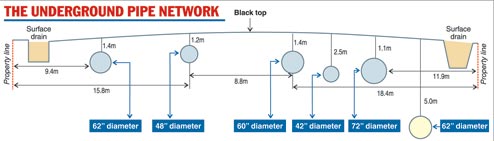
There are six water lines under BT Road connecting Palta waterworks to the Tallah reservoir. The network comprises pipes in various sizes - 42, 48, 60, 62, 64 and 72 inches in diameter.
"The technical study will assess whether the Metro piers will pose any danger to the water pipes. Once the technical report is available, we will think about the next course of action," mayor Sovan Chatterjee said.
Project officials said no proper study had been done yet to assess the potential for damage when the Metro viaduct and stations are built.
Rail Vikas Nigam Ltd, the implementing agency for the project, had hired a French firm called Egis Rail to design the project. The contract was foreclosed once the project plunged into uncertainty.
The initial plan was that the median divider along BT Road would be shifted by about two metres towards the Calcutta-bound flank.
"One stretch would have become narrower than the other, but that would ensure the least chance of damage to the water pipes," a railway official said.
An agency had been hired to widen BT Road in preparation for Metro construction, but even that contract was terminated when the project did not make headway.
Of the Rs 2,070 crore sanctioned for the Baranagar-Barrackpore Metro in 2009, barely Rs 38.91 crore has been spent so far.
The railway official said the tendering process was almost complete in 2012 when the state government agreed to close two old water lines running under BT Road. "The government later refused to do so and said the project could not go ahead."
In August 2015, the state government decided to do a survey to find out if the viaduct could go through an alternative alignment like the Kalyani Expressway. The proposal did not materialise.
If the project is now saved by a long-delayed technical study, the upshot would be cost escalation. The total project cost is estimated to shoot up by 20 to 25 per cent because of the time lag between work being stalled and a potential solution being found.
Almost every Metro project in Calcutta has had a stop-start journey, getting delayed by four to five years on an average because of land logjams at various points.
Each of these projects has resumed following a change in the state government's stand on easing land-related problems, the Baranagar-Barrackpore Metro being the only one still awaiting a breakthrough.
The 12.5km Baranagar-Barrackpore link could potentially solve the commuting woes of lakhs of people living on the northern fringes.
Commuting through BT Road has been a nightmare for decades, and it still takes nearly one-and-a-half hours to travel from Sodepur to the heart of the city, a distance of 15km. A Metro ride over the same distance would take about 20 minutes.
At least on paper, BT Road seems to be back on the city planner's map.
The state government has planned a six-lane elevated corridor over BT Road between Tallah Bridge and Dunlop after realising that the volume of traffic has almost doubled in the last few years. The 5km project would cost the government around Rs 1,200 crore.