 |
Air-conditioned Metro trains have been spending more time in the maintenance yard than on the tracks this summer because of frequent snags caused by overcrowding.
Metro Railway’s 12-strong AC fleet is not more than two years old — the last rake was inducted barely three months ago — but its downtime is apparently worse than that of the non-AC trains doing duty for more than a decade.
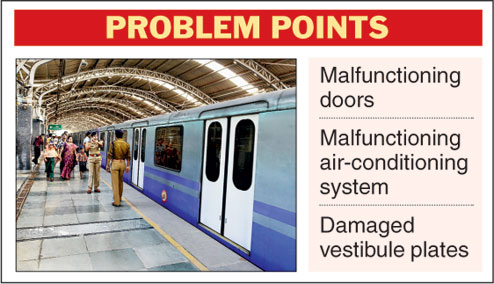
Most of these rakes have been going to the doctor every three days for treatment of nagging problems ranging from malfunctioning doors and air-conditioning to damaged vestibule plates. Officials blame overcrowding for this but say there is little they can do to prevent it.
“All our air-conditioned coaches are stable. We have observed that passengers wait for AC rakes and skip the non-AC ones and this causes unnecessary overcrowding and delay,” said Protyush Ghosh, deputy general manager of Metro Railway.
On an average, an AC rake exceeds its capacity per ride by around 1,000 commuters. Experts say the only solution is to increase the frequency of trains but Metro Railway isn’t technically equipped yet to improve on its peak-hour service of a train every five minutes.
“As of now, increasing the frequency of service to a train every four minutes is just not possible for several reasons,” a senior official said.
Turnaround time is a key factor. On reaching the terminal stations at Dum Dum in the north and Kavi Subhas in the south, trains take four minutes to change from one track to another. Another minute is used up by passengers alighting and boarding.
Metro Railway ferries more than 6.5 lakh passengers a day on an average, an increase of more than a lakh over the commuter count a year ago. The passenger load shot up by more than 30,000 when the New Garia suburban railway station was thrown open last November, sources said.
Last week, Kasba resident Joy Chakraborty was waiting at Kalighat station to take a train to Park Street when he encountered a problem that has become typical of the transport lifeline.
“The train came to a halt but the rear door of the last compartment wouldn’t open. Then we saw a sign ‘Defective Door’. The commuters rushed to the next door and somehow managed to board. This has become so frequent,” he said.
“AC coaches are built to carry about 300 passengers each at a time but during rush hour, each coach is packed with nearly 450 people,” an official said.
Overcrowding forces passengers to lean on the doors and often the hydraulic mechanism used to operate them malfunctions. Another recurring problem is people trying to force open closing doors by sticking a foot, a bag or an umbrella between them.
Standing on the vestibule plates of AC trains also causes damage, an engineer said.
A frequent complaint by commuters is that the air-conditioning doesn’t work. Officials say that happens whenever a coach is overcrowded.
“When more people than specified are inside an AC coach, the cooling effect is anyway reduced. That also causes the air-conditioning system to malfunction,” an official said.
Of the 12 AC rakes that were built at the Integral Coach Factory in Perambur, near Chennai, four to five are stationed at the maintenance base in Noapara for repairs and installation of the Train Protection and Warning System, a new anti-collision device.
That has added to the pressure on the AC fleet. Each AC rake is capable of carrying a maximum of 2,500 passengers but the morning and evening rush hours see the load increase to more than 3,500 on each trip.