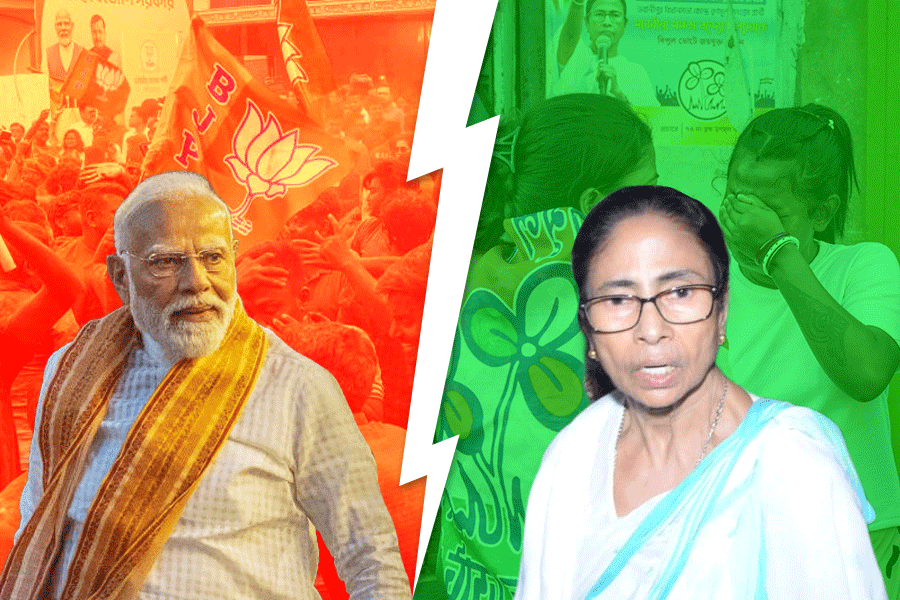
Hindsight is always 20:20, as the saying goes. And in that perfect vision, the BJP’s sweep of the Assembly election in Bengal does not come as a surprise.
Here are five factors that may have contributed to the stunning fall of Mamata Banerjee’s Trinamool Congress.
- Anti-incumbency (primarily corruption)
Fifteen years into office, the government led by Mamata Banerjee presented a layered political trajectory, from early developmental momentum to later controversies.
In its first term, the TMC mirrored in some ways the early years of the Left Front government that came to power in 1977. The focus was firmly on rural development. Across large parts of the state’s hinterland, improvements in basic infrastructure — roads, culverts and bridges — became visible markers of change.
Even Kolkata had become cleaner.
The narrative of a shifting rural Bengal gained currency, helping the TMC consolidate support beyond its traditional urban base in Kolkata. This expansion was reinforced in subsequent years through an extensive welfare architecture.
Schemes such as Kanyashree, Swastha Sathi, and Sabuj Sathi broadened the party’s outreach, embedding it deeper within rural and semi-urban communities.
By the mid-2010s, the TMC had successfully transitioned from a Kolkata-centric outfit into a party with a robust grassroots presence across Bengal. However, this phase of consolidation was accompanied by a series of allegations that began to cloud the government’s image.
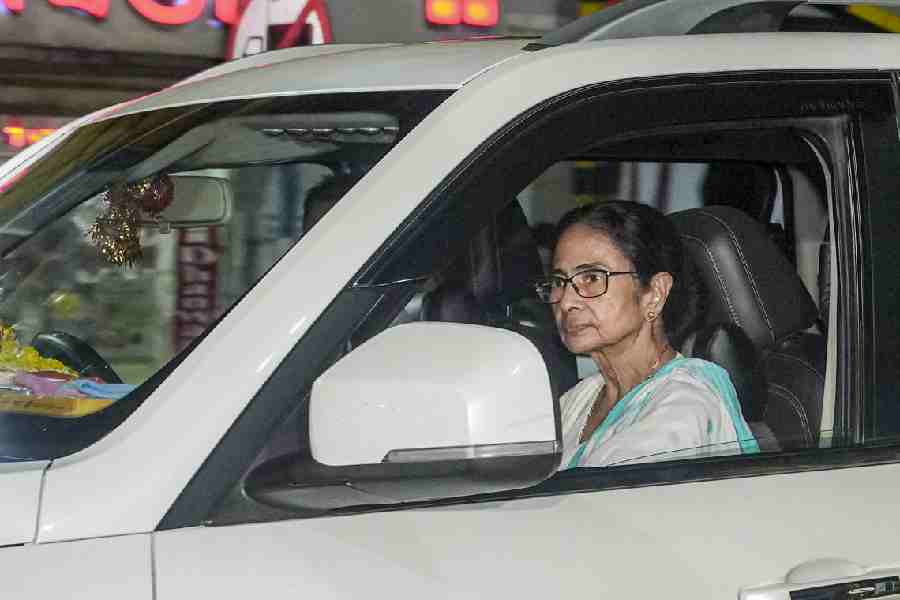
Mamata Banerjee arrives at her residence on the day of Assembly election results, in Kolkata, Monday, May 4, 2026. PTI picture
The Saradha chit fund scam and Narada sting operation brought questions of corruption to the fore, while persistent accusations of a “syndicate raj” and extortion added to concerns about governance and political culture.
Despite these issues, the absence of a cohesive opposition — partly attributed to a climate of alleged political intimidation and violence — meant that electoral challenges remained limited.
The TMC secured emphatic victories in both the 2016 and 2021 Assembly elections, with a dip in the 2019 Lok Sabha polls. In the years following the 2021 mandate, however, a succession of alleged irregularities further intensified scrutiny.
Investigations into the teacher recruitment scam, the ration distribution scam, municipal recruitment irregularities, and coal and cattle smuggling cases led to arrests of senior figures, including a state minister and several legislators.
The recovery of large sums of cash during enforcement actions amplified the political fallout, with opposition parties directly targeting the TMC leadership.
2. Appeasement, polarisation
In 2019, Mamata Banerjee remarked that she was “ready to be kicked by the cow that gives milk,” a comment interpreted by her critics as an acknowledgement of minority-focused political outreach.
In the years since, that line has been invoked by the BJP as emblematic of what they called an “appeasement” strategy — an argument that has gained traction in Bengal’s polarised political climate.
After 2016, with Narendra Modi firmly in power at the Centre, the political debate in Bengal sharpened.
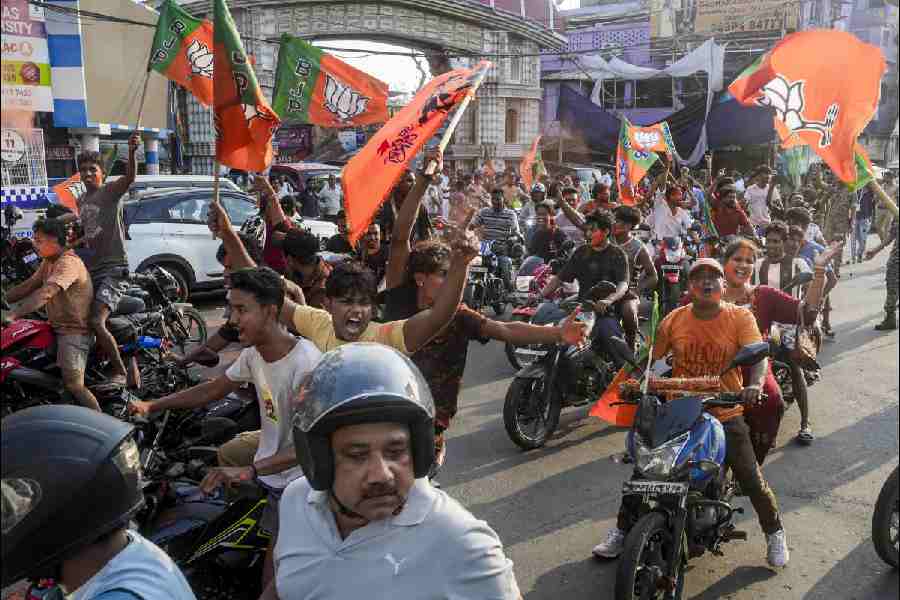
BJP supporters celebrate party's lead near the residence of West Bengal Chief Minister Mamata Banerjee on the day of Assembly election results, in Kolkata. PTI picture
The BJP intensified its campaign around allegations of minority appeasement. This period also saw sporadic incidents of communal tension in districts such as Canning, Deganga, Howrah, Basirhat and Asansol, raising questions about administrative response and law-and-order management.
The backdrop to this phase can be traced to earlier moments in the TMC’s political evolution.
In 2009, the party was at the forefront of protests over the death of Rizwanur Rehman, with demonstrations in Kolkata turning volatile — marked by vandalism, attacks on a police station, and the deployment of the army for a route march.
It can be argued that such mobilisations reflected a tactical alignment with social forces that could yield electoral dividends, but also carried longer-term risks.
The BJP’s rise in Bengal has been closely tied to an assertive religious mobilisation strategy. In response, the TMC leadership has, in recent years, sought to recalibrate its positioning by temple building (Jagannath Mandir, Durga Angan).
Yet, as Arun Jaitley once remarked in a different political context, “who needs a B team, when you have A team?”
The cumulative effect? A seeming consolidation of Hindu votes in the 2026 Assembly elections, with some post-poll analyses estimating this figure at over 62 per cent.
3. Women voters
The TMC sought to consolidate a crucial segment of women voters through welfare interventions such as the Lakshmi Bhandar, the women’s dole. Periodic increases in the amount helped sustain its appeal and, for a time, acted as a political cushion for the ruling party.
This welfare push has increasingly been weighed against structural concerns. Migration remains a persistent issue, with many households relying on earnings from family members working outside the state due to limited local employment opportunities.
Districts such as Murshidabad, Malda, and parts of the North 24 Parganas and South 24 Parganas have seen out-migration shape local socio-economic realities, reflecting the reality about job creation in the state.
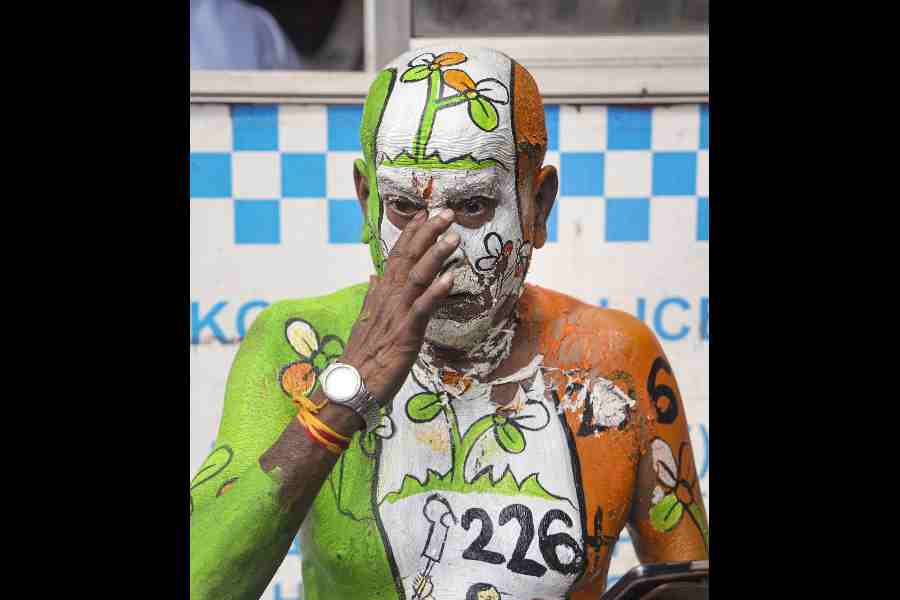
A Trinamool Congress supporter with party symbols painted on his body on the day of Assembly election results, in Kolkata. PTI picture
Compounding this has been the disruption of the rural jobs scheme amid allegations of irregularities and “cut money”, which have compounded rural distress.
At the same time, the BJP attempted to counter the TMC’s welfare plank with promises such as the proposed Annapurna Bhandar, pitched as offering the same benefits at a higher scale.
The women’s sentiment was further strained by the fallout from the RG Kar rape-murder case in August 2024. Allegations of mishandling — including reports of vandalism at the crime scene and police action against protesters — intensified scrutiny of the administration and turned large sections of the hitherto not overtly political population against the ruling party.
The episode triggered significant public mobilisation, particularly in Kolkata, where large crowds — estimated in the hundreds of thousands and not visibly aligned with any political party — took to the streets.
4. BJP strategy tweak
The BJP framed its campaign around themes such as “bhay versus bharosa [fear versus assurance]”, “nirmamata ki sarkar [government of the cruel]”, and the potent political slogan of “paltano dorkar.”
Even many Kolkata schoolkids know the slogan now.
In an effort to shake off the “outsider” label, BJP leaders invoked Rabindranath Tagore and Kazi Nazrul Islam, and made visible attempts to align with local culture, down to sharing meals of fish.
The party avoided fielding defectors from the Trinamool Congress, a departure from the 2021 strategy when more than 50 candidates were turncoats who subsequently lost their seats.
5. SIR and central forces
The TMC, unlike disciplined-cadre-driven outfits such as the BJP and the CPM, appeared to struggle without its traditional organisational and local enforcement networks.
Several IPS and IAS officers perceived to be close to the state administration were transferred. At the same time, local strongmen such as Raju Naskar and Sona Pappu — often accused of land grabbing and operating with political patronage — retreated.
The Election Commission also adopted a granular approach, removing multiple officers-in-charge across police stations.
More than 2 lakh central forces were deployed across the state for each phase, significantly tightening oversight and curbing allegations of rigging and electoral malpractice.
The special intensive revision of electoral rolls further altered the landscape, with names of deceased voters and those who had permanently migrated out of the state being struck off. Many analysts believe that took out a large chunk of the Trinamool’s false votes.
A BJP leader from Noapara, who switched from the TMC in 2022, claimed that in his booth alone, 380 such names were deleted, alleging that “10 to 30 votes of deceased individuals were typically cast in each booth during past elections.”
A large number of Bengal citizens who have migrated to other states for jobs returned to participate in the polls. While one view of that was that they had returned to prevent deletion of their names in the special intensive revision, another could be that they returned to vote out the party that forced them out of the state.
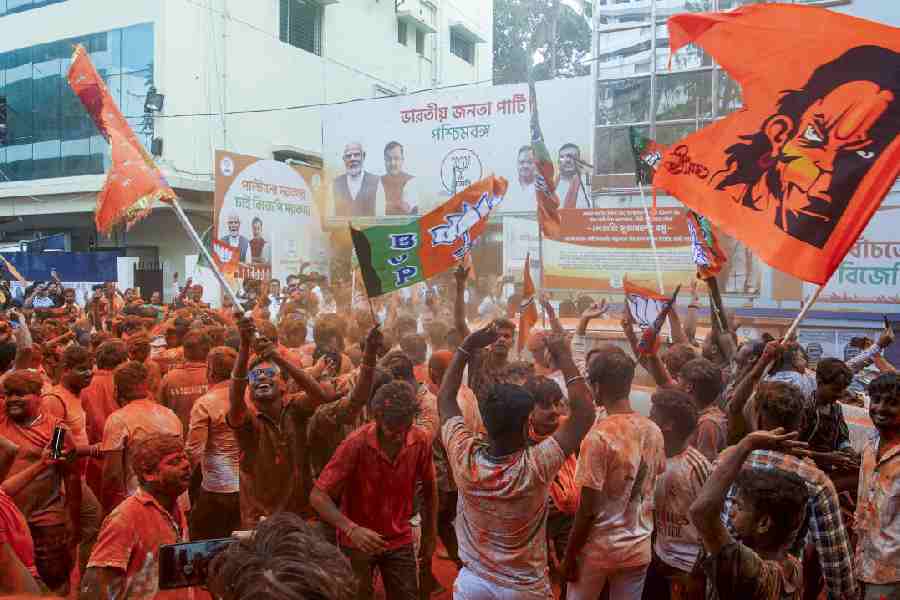
BJP supporters apply 'gulal' amid celebrations during vote tabulation on the day of West Bengal Assembly election results, in Kolkata. PTI picture
An anecdote from 2016 — where ideological rivals found common cause against a dominant political force — also captures the broader political shift driven by anti-incumbency, turning the vote into one of rejection.
At a restaurant in Delhi’s Connaught Place, P. Roy, a college teacher from Bengal’s West Midnapore who was in the capital city for his PhD work, said: “It is difficult to keep your cool. I have fights with the TMC-backed teachers and the staff almost daily. Thankfully, Chaitanya da (name changed), my colleague, helps me keep my cool, safeguard and guides me.”
It was surprising. Roy had been an ardent right-wing supporter since the days of the CPM raj in Bengal. Chaitanya da was a former stalwart leader of the SFI, the CPM Left’s student wing.
The right and the left had united to fight the onslaught of the TMC at the college. Ultimately, both of them were transferred to other colleges.
The Trinamool had successfully – and inadvertently – brought the Right and the Left together.
Why is the anecdote part of this election analysis? Because it shows that when emotions work, cold arithmetic is swept away.