 |
 |
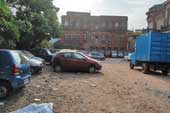
| The Bose residence on Amherst Street; (above) Kartick Bose in action. Picture by Anindya Shankar Ray |
The 22 yards in the backyard of Kartick Bose’s Amherst Street home, where greats like Lala Amarnath and Vijay Hazare, not to mention home-grown heroes like Pankaj Roy, once took guard, is now a parking lot.
Almost every club cricketer of note in the city practised on the pitch, which was laid by Bose in 1932 and later re-laid with concrete, till the coach’s death in 1984 at age 77.
The compound on which it stands now provides parking space for local people. There is also a legal battle on for ownership of the property.
“It will be difficult to restore the pitch unless there is a verdict from the court,” says Bose’s nephew Sugata Mohan Bose, who is fighting the case on behalf of the family.
Kartick, or Nripendra Mohan Bose, was a prominent member of the 1939 Bengal side that won the Ranji Trophy. He played 44 first-class matches for Bengal from 1930-31 to 1951-52, scoring 1,679 runs, at an average of 24.76.
Bose’s forte was coaching. Most of the successful cricketers from the state have either been coached by him or by those who learnt cricket from him, says former cricketer Sunil Kumar Banerjee, who is married to Bose’s niece.
“The matting wicket was built on a six-ft-deep foundation. It offered true pace and bounce. Only the Eden Gardens and the Town Club strips could give it competition. Many stalwarts of the game honed their skills on the pitch,” recounts Banerjee.
One of the most successful coaches of the Bose gharana, Snigdhangshu Shekhar Mitra (Tuntu) says that the 52 Amherst Street address was more than a free cricket coaching school; it was a “second home” for budding and established cricketers alike.
“There was a balcony adjoining Kartikda’s room that overlooked the pitch. All morning, he used to watch us practise from up there. On occasions, he would take guard first and show us how to bat,” says Mitra.
Many of the players would return to the palatial Bose residence in the evening for a cricket adda. Sometimes, they would be joined by achievers from other walks of life, including Satyajit Ray, who was related to the family. Bose and his elder brother Ganesh, also a Bengal cricketer, played the perfect hosts. “The addas added to the appeal of the place,” says Mitra.
Bose was a gifted curator. “He laid the pitch at Barabati Stadium, Cuttack,” says Banerjee. Old-timers in Mumbai still swear by Babuji, as Bose was called at the Cricket Club of India, where he played, captained and coached between 1946 and 1952.
“All that the Cricket Association of Bengal (CAB) has done is name its lifetime achievement award after Kartikda,” says Sanjiban Acharya, another student of Bose.
CAB joint secretary Saradindu Pal, however, pledges “full support” for the restoration of the pitch. Sugata Mohan Bose, who is in possession of the property, says he would be delighted if the association gets in touch with him and “restores the pitch to its past glory”.