|
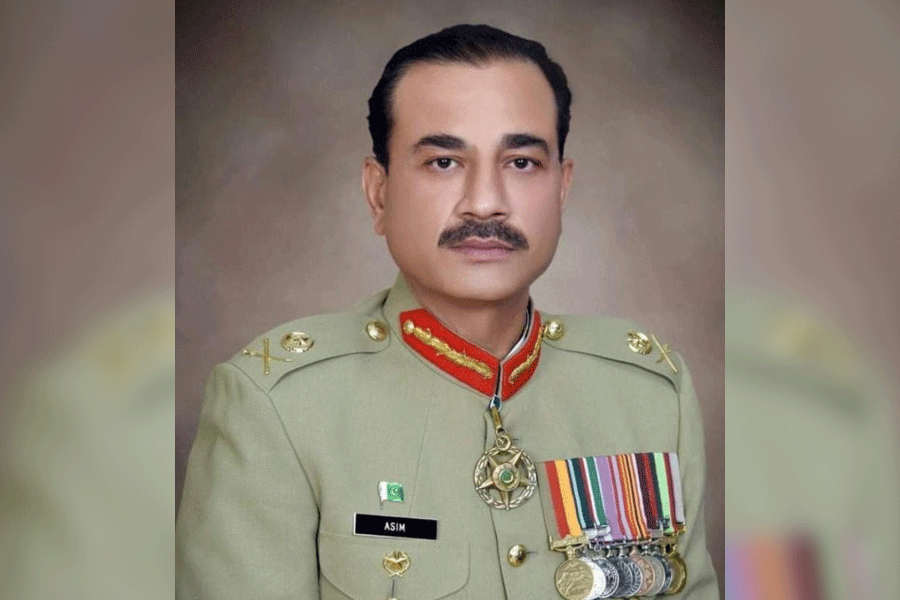
Calcutta, Aug. 11: Arrested CPM MLA Sushanta Ghosh’s rise was mainly by virtue of his “strong-arm and terror tactics’’ that helped the party gain ground in vast swathes of West Midnapore even though such ploys were disliked by Anil Biswas and Buddhadeb Bhattacharjee, sources said.
The former paschimanchal development minister lorded over large parts of Keshpur, Garbeta, Salboni, Pingla, Debra and Lalgarh with the CPM leadership grudgingly accepting his ways “for the sake of the organisational spread” he helped the party achieve in the district, the sources added.
“Ghosh’s style of functioning wasn’t liked by many in the party. His tactics were weird. He used to ask cadres to marshal 10,000 people to processions and meetings at a short notice. If a cadre expressed doubts about organising such meetings so fast, Ghosh would ask him to tell the people that if they did not turn up, they would not be able to harvest their paddy. The consequences were more terrible sometimes,” a CPM state committee member said.
He said the CPM organisation “reaped benefits” from such moves but Ghosh’s “image suffered’’. “To add to that, he is not liked by Buddhada. It was the same with Anilda too,” the leader added.
The late Biswas, who was the CPM state secretary, had objected to Ghosh becoming a member of the party’s West Midnapore secretariat in the late nineties. “But Anilda had to accept his induction after Dipak Sarkar (the district CPM secretary) threatened to quit his post if Ghosh was not made a member of the district secretariat,’’ the leader said.
Former chief minister Bhattacharjee, however, ensured in 2005 that Ghosh did not find a place in the party’s state committee, a source said.
Ghosh, who lives in a two-storey house in Garbeta’s Chandrakona Road town, is possibly the only former Bengal minister to have been arrested, a CPM old-timer said. “There was a (rioting) case against Narayan Biswas but he wasn’t arrested,’’ the leader recalled.
Ghosh’s wife Karuna, a district committee member of the CPM, is a primary school teacher in Garbeta. The couple have no children.
The CPM today stood by Ghosh. A meeting was held at Alimuddin Street to discuss the party’s course of action in the case. CPM leader Mohammad Salim said: “Our party thinks he is not guilty. It’s clear that political vendetta played a part in the case against him. The law will take its own course. But we will stand by him organisationally and legally.’’
Salim said “several false cases had been started against our party leaders and workers”. “We will have to defend everybody.’’
As paschimanchal minister, Ghosh had proposed some development plans for the region, including setting up of schools, irrigation facilities and drinking water projects. But most of those schemes were given the go-ahead by Bhattacharjee without even having a word with Ghosh, a Writers’ official said.
“Buddhababu used to vet the projects submitted by Ghosh. But the then chief minister never called him to his chamber to discuss the schemes. He used to consult officials before giving his nod, so strained were his ties with Ghosh,” the official added.
In the late nineties, when Trinamul invaded Keshpur and Garbeta, Ghosh led cadres to free the areas from the rival’s clutches with police’s help,” a CPM leader said.
“He had asked the police to keep track of Trinamul leaders’ movements. He used to organise night raids by the police, instilling fear in the Opposition. Gradually, the CPM cadres got the better of us and we were outnumbered in Garbeta and Keshpur in 2001,” said food minister and Trinamul general secretary Jyotipriya Mallick.
“Ghosh had also threatened CBI officers investigating the Chhoto Angaria explosion (in 2001, in which 11 Trinamul supporters were allegedly killed),’’ Mallick added.
Ghosh’s victory in this year’s Assembly polls, albeit by a much reduced margin, had been attributed to his muscle power and the inclusion of “several bogus voters” in the electoral list, a CPM leader said. He said Ghosh had used such tactics in the past too.
Ghosh’s rise as a strongman mirrored that of Lakshman Seth, Tarit Topdar, Amitava Nandi and Anil Basu. “All of them are disliked by our party leadership. But we couldn’t do without them because of their capability to boost our organisational strength,’’ a CPM leader said.