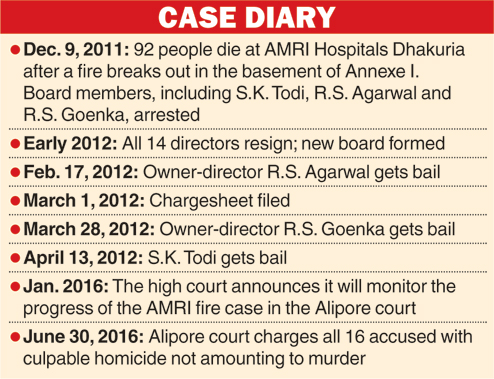

Twelve erstwhile directors and four officials of AMRI Dhakuria were on Thursday charged with culpable homicide not amounting to murder, setting in motion the process of bringing to trial those blamed for the hospital blaze on December 9, 2011, that took 92 lives.
"All the directors had direct knowledge that the upper basement (of Annexe I) had been illegally converted into a store for highly combustible materials and a pharmacy. Yet, they took no steps to stop this," special public prosecutor Shakti Kumar Bhattacharjee said, quoting from the list of charges read out in the third court, Alipore.
He pointed out that the building completion certificate obtained from the Calcutta Municipal Corporation (CMC) mentions the upper basement as being meant only for parking.
Additional district judge Indranil Adhikary fixed September 5 as the date for the start of the trial, barely three months short of five years since the fire tragedy. If proved guilty, the accused can be imprisoned for up to 10 years.
The former AMRI directors in the dock are Radhey Shyam Agarwal, Radhey Shyam Goenka, Shravan Kumar Todi, Ravi Todi, Manish Goenka, Prashant Goenka, Aditya Agarwal, Priti Sureka, Rahul Todi, Mani Chhetri, Pronab Dasgupta and Dayanand Agarwal.
The four officials in the list of accused are Preeta Banerjee (then vice-president, administration), Satyabrata Upadhyay (then senior vice-president), Sajid Husain (then night manager) and Sanjib Pal (then assistant general manager, maintenance). Upadhyay has since quit AMRI.
All 16 accused have long been out on bail. They have the option of appealing in a higher court for a stay on the trial, in which case the proceedings could get further delayed.
Lawyers representing the accused had been arguing for the lesser charge of causing death by negligence under Section 304A of the Indian Penal Code during hearings spread over two years. But special public prosecutor Bhattacharjee continued pressing for the more grievous offence of culpable homicide not amounting to murder under Section 304 of the IPC.
The chargesheet submitted by police in March 2012 mentions the same section.
The maximum punishment for culpable homicide not amounting to murder is 10 years in jail and/or fine, based on the premise that the accused had knowledge of their act being likely to cause death but without any intention of doing so. The maximum punishment for causing death by negligence is much lighter at two years' imprisonment.
Apart from culpable homicide not amounting to murder, the court has charged all 16 accused in the AMRI case under Section 308 (attempt to commit culpable homicide). The erstwhile directors further stand charged under sections 11J, 11L and 11C of the West Bengal Fire Services Act, all of which pertain to violation of fire safety rules.
"Just as the board members, all the officials knew about the conversion of the parking lot into a store. Sanjib Pal submitted an affidavit to the fire brigade that all constructions would be removed from the upper basement while applying for a no-objection certificate," the special public prosecutor said.
Once the charges had been read out, the additional district judge asked each of the accused individually whether they would plead guilty or not guilty. Everyone pleaded not guilty.
Paromita Guha Thakurta, who lost her mother in the fire, said she was happy that the trial would "finally" begin. "We have waited for this day for more than four years. Two previous dates for framing charges had been cancelled. I am just happy that trial will start in September," she said.
Paromita recounted how family members of the victims got together to jointly appeal to Calcutta High Court to set up a special court to speed up the case. "There used to be a three or four-month gap between hearings. So we approached the high court, which fixed a deadline for framing of charges in the lower court. It helped speed up the process," she said.
The trial could still be delayed. "All the accused persons have told the court that they are not guilty. They will prove their innocence in due process," said Salim Rahaman, one of the lawyers representing the former AMRI directors and officials.
A lawyer not associated with the case said the accused could choose to fight the charges either during the trial or by challenging the Alipore court's order in a higher court before September.
Kishore Dutta, a lawyer representing Guha Thakurta, had last year termed the proceedings in the lower court "a circus".
"At each hearing, someone or the other among the accused cites some reason to seek another date and delay the matter.... If one accused is citing a visit to Bangkok, another accused speaks of a visit to London while a third says, 'I am sick'," Dutta had said.