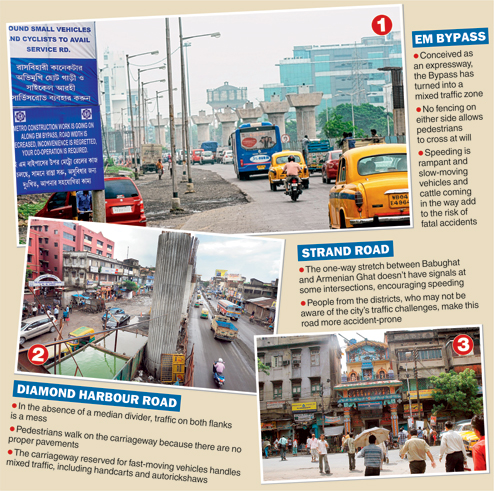

The Bypass is the deadliest road in Calcutta, accounting for 17 of the 265 fatal accidents in the first eight months of the year.
Diamond Harbour Road is next on the list with 15 deaths, followed by Strand Road with 10, according to data of fatal accidents between January 1 and August 31 available with the transport department.
The reasons for fatal accidents on these three roads, all of them away from the city centre, are more complex than just the need for speed on wide carriageways.
Intrusion of slow-moving vehicles into carriageways reserved for high-speed traffic, lack of median dividers and mixed traffic on road surfaces meant for fast movement are some of the other reasons that have been cited for the higher number of fatalities.
The cumulative death toll of 265 between January and August is less than the figure for the corresponding period last year. In 2014, Calcutta had witnessed 288 road deaths during the first eight months. In the remaining four months, the number shot up to 450.
According to engineers, the Bypass was conceived as an expressway but ended up being just another multi-lane thoroughfare with no barriers to restrict dangerous pedestrian crossovers.
Worse, traffic is mixed, fast and furious.
"You have different types of vehicles vying for space on a road where speeding is rampant. Throw in cattle and you have a safety problem for everyone," said a senior official of the transport department. "Vehicles tend to speed from the Parama rotary onwards and anything slower coming in the way is a potential trigger for an accident."
On Diamond Harbour Road, the main problem is apparently the absence of a median divider. The thumb rule for a two-lane-two-way road is to have a median divider in accordance with the guidelines of the Indian Road Traffic Congress.
"The width of a flank of Diamond Harbour Road is seven metres (3.5m x 2) and the carriageway is supposed to be reserved for fast-moving vehicles. But we have to deal with intrusion by different kinds of traffic, including handcarts and autorickshaws," said a senior traffic police officer.
The risk factors common to Strand Road and Diamond Harbour Road include the short bursts of speed that motorists tend to employ between traffic signals. Sometimes, they are late in braking and an accident occurs.
The stretch between Babughat and Armenian Ghat on Strand Road is a case in point. The one-way zone is currently undergoing repairs near the approach to Howrah Bridge. According to traffic police officers, visitors to Millennium Park spilling over to Strand Road is a challenge too.
But road accidents have declined despite the challenges. "What is important is that we have been able to bring down cases of accidents across the city," the police officer said.
Traffic experts argue that the rate of accidents would have dropped anyway given the pace of traffic. Road space accounts for around seven per cent of Calcutta's area while the number of vehicles has grown at close to four per cent, raising the volume:capacity ratio and slowing down traffic.
"Prince Anwar Shah Road, where the South City Mall is located, is likely to witness fewer accidents than Diamond Harbour Road because the intensity of traffic is high and speed of vehicles slow. The moment these drivers hit wider roads like the Bypass, they are more likely to be involved in an accident," said Bhargab Maitra of IIT Kharagpur, an expert in traffic engineering.
Which Calcutta road do you find most unsafe? Tell ttmetro@abpmail.com