 |
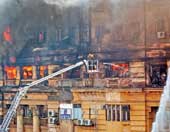
| Firemen battle the flames at Stephen Court in March last year. The blaze exposed infrastructure problems of the fire brigade |
The first five fire engines in Calcutta — three horse-drawn and two man-driven — were imported from Britain after the fire services came under Calcutta Corporation in 1871. The fire engines, which had to be winded, have given the Bengali name, damkal, to this mammoth institution.
Calcutta’s fire services are about 190 years old, the oldest in India. They were started in the 1820s with a humble monthly budget of Rs 740 for two European constables and 234 khalasis and bhistiwallas by insurance companies. Now the fire brigade — the city fire services were merged with the state services after Independence — is an organisation of 10,000 men with 109 fire stations. Its annual budget is over Rs 150 crore. It now has sophisticated equipment at its disposal. Helicopters are an impossibility in Calcutta, but the brigade has sophisticated, tall turn-table ladders and telescopic ladders.
 |
| Fire engines outside the fire brigade headquarters in 1926 |
Still, perhaps the most impressive feature of the fire services is its history. When Mamata Banerjee inspected the control room and central workshop at the fire brigade headquarters on Free School Street two weeks ago, she was unimpressed, as any visitor would be.
Firemen told her that the workshop, where tools used by firemen are repaired and maintained, was dying a slow death because of neglect. There are only 22 employees at the workshop; all the work is done by contractors. Employees also complained about dim light and dearth of drinking water at the workshop. She asked fire minister Javed Ahmed Khan to sell off the abandoned vehicles dumped on the premises and draw up a modernisation plan.
A hundred years ago, Calcutta’s fire services were truly modern. That was also the last time modernisation took place in the services. Its architect was a man on loan from London, who made Calcutta Fire Brigade into a state-of-the-art institution.
 |
| A fireman slides down the pole at the current headquarters. (Anindya Shankar Ray) |
The first fire brigades started in England after the Great Fire of London in 1666. Another great fire was needed in this part of the British colony to organise the fire services in the city. Though services were available from the 1820s, in 1871, after two jute warehouses at Dharmatallah, now Esplanade, and Armenian Street, were reduced to ashes, five fire stations were set up at Lalbazar police station, the fire brigade headquarters for many years, Tallah, Palmer’s Bridge, Bhowanipore and Watgunge. The jurisdiction of the new Calcutta Fire Brigade was limited to a radius of 12 miles from the headquarters at Lalbazar. Till 1893 the control and administration of Calcutta Fire Brigade rested with the commissioner of Calcutta Municipality, now the Calcutta Municipal Corporation. In 1893, the control was transferred to the commissioner of police, Calcutta.
In 1910, a committee was formed for the reorganisation and upgrade of the fire brigade. Next year, following its recommendation, the service of an expert from London Fire Brigade, Captain Bernard A Westbrook, was requisitioned. Though Calcutta Fire Brigade remained under the authority of the commissioner of police, Westbrook was designated its chief officer.
 |
Westbrook designed a system that was modelled on the efficient London fire services, taking ground realities of Calcutta into account. When he took over, there was no motor appliance in the Calcutta Fire Brigade. There were five horse-drawn steam fire engines, two hand-drawn Valliant steam fire engines, two hand-drawn manual pumps, horse carts and several hose reels, according to the Calcutta Municipal Gazette. In 1911 Westbrook procured one 80hp motor chassis with a centifugal pump capable of delivering 750 gallons of water per minute, one 45hp motor tender fitted with a positive rotary pump, and a telescopic ladder. By the end of 1912 three motor pumps and one motor turn-table ladder were commissioned. By 1926 the fire brigade was motorised. The movement of the fire engines sped up and firefighting capacity was enhanced manifold. The fire stations at Watgunge, Bhowanipore and Palmer’s bridge were abolished before the Second World War: undivided Bengal had only two city fire brigades — Calcutta Fire Brigade and Darjeeling Fire Brigade.
Westbrook had turned Calcutta Fire Brigade into an organisation that never slept, was never off-duty and was ready to move at a second’s notice. Standard turn-out time was set at within 15 seconds of the ringing of a fire alarm. The office and barracks were on the first and second floor of the building. Since after a fire alarm it would take time to come down the staircase, Westbrook installed two steel pillars — one between the ground floor and the first floor and the other between the first floor and the second floor. Firemen used to slide down the pillars from the second floor to save time. The pillars are still there but it’s difficult to envisage any firefighter sliding down them these days. The majority of them are middle-aged, not to mention the preponderance of bulging midriffs. The turn-out time has got reset to 60 seconds. In a hundred years the fire brigade has slowed down four times.
 |
| Captain Westbrook |
“When we entered into the service in 1974 the steel pillars were always shining as they were used. The practice of sliding down the pillars to save time discontinued soon after the state co-ordination committee opened its wing in the West Bengal Fire Service in 1978,” says a divisional officer. “Now the pillars are painted to hide the rust.”
Immediately after getting a fire call the brigade would contact the civic body and asked them to increase water supply in the hydrants in that particular locality. Hydrants have now dried up and their brass fittings have been stolen away.
Westbrook installed chains of fire alarm pillars on the roads. One hundred and fifty fire alarms were installed and were maintained by the Bengal Telephone Corporation. The pillars were hotlines between the fire spot and the brigade headquarters. As soon as the handle of a pillar was turned a corresponding light on the command board at the headquarters started glowing.
These pillars are no longer visible in the cityscape. But the city still needs fire alarm pillars, particularly in the slum and market areas, because they don’t require a caller to know how to use the telephone, says an officer in the fire brigade control room.
After return a fire engine would be attended immediately and replenished with petrol, oil and water. The wet hose pipe was hung up to dry and a dry hose from the store would replace it in the engine. The system has been discontinued and maintenance work has been left at the whim of the trade unions.
Westbrook had introduced the system of “card indexing of a hose”: details of a hose, its length, number of hours it had worked, how many times it had been repaired, its test-run report. The system is not in place today. It explains why so many leaky hose pipes are seen at the scene of a firefighting. A senior officer alleged that during the last 25 years hose pipes to the tune of Rs 100 crore had been procured on paper only. Old hose pipes have not been actually replaced.
 |
An intelligence branch of the fire brigade, under Westbrook, would map roads and water sources in Calcutta. The branch was abolished 30 years ago. It may be recalled that at the time of the New Market fire in 1986 the fire brigade faced severe water shortage and the army had to be called from Fort William. Army officers then pointed out that there was a pond in the backyard of the Indian Museum, very close to New Market.
Many changes have taken place since Westbrook. Firemen arrive late, without adequate water supply, fumble with their equipment. The equipment may be state-of-the-art, but Calcutta’s roads may be a few feet wide.
The biggest change is in the work ethic. A tea stall has come up in front of the garage of the fire engines, obstructing the way. The stall is crowded with firemen and passersby. According to an officer, the authorities did not take steps as the CPM-led union supported the tea stall.
Earlier firemen on duty had to be ready: in uniforms and shoes. Now they wander about wearing chappals and start fastening their belts at the sound of a fire alarm. “Our motto was ‘We serve to save’. We now serve our union leaders and the bosses only,” the officer added.
Servicemen agree that the engines arrive late. “If you go by the ‘turn out’ record no delay occurs. But it is at the same time to some extent true that we are late because of several reasons,” says additional director-general of West Bengal fire service Debapriya Biswas. He points at improper reporting about the location of the fire spot, traffic snarls, encroachment of road space by parked cars and trucks, hawkers and makeshift shops and narrow alleys.
About shortage of water, Biswas points out that the corporation hydrants don’t work any more and water bodies have been filled up. The capacity of the tank in a fire engine is also limited. Hence, if the second, third and fourth fire engines do not reach a fire spot shortly after the arrival of the first engine, it is difficult to initially attend a fire.
The Trinamul government has plans. “I want to introduce three things immediately — installation of geographical positioning system (GPS) devices in every fire engine, introduction of toll-free number for all the fire stations and arrangement of voice recorders so that the exact reporting time of fire incidents can be known and compared with ‘turn out’ time,” says minister Javed Ahmed Khan. The firemen’s drill, which had become irregular, has been resumed in the fire stations, he added.
 |
| A fire engine outside Nandram Market in flames in 2008 |
A special “search and rescue” team is being formed to tackle a critical fire situation. They will be specially trained like the Rapid Action Force (RAF) to combat fire and carry out critical rescue operations. There are plans to recruit younger people — most firemen are in their 40s — and women. In the first phase 50 women will be recruited through the state public service commission. “Women field staff will be helpful at the time of rescuing women and girls,” says Khan.
Experts feel that there is an immediate need to set up a training institute for firemen. The training school at Silpara in Behala is almost defunct.
The city is changing. It is growing unplanned into its suburbs, in Behala, or VIP Road, into narrow roads and congested public places, or vertically, everywhere. It is full of firetraps. The city’s firemen should be motivated, skilled, and trained to deal with the city’s specific realities.