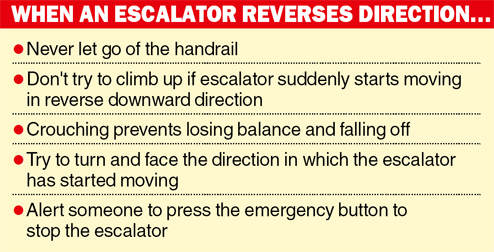

A loose bolt coming unstuck has been identified as the cause of the escalator accident at Girish Park Metro station on Thursday evening, although engineers suggested it couldn't have been the only trigger for the motor to suddenly reverse direction.
"The motor of an escalator rests in a chamber at the top with multiple nuts and bolts, one of which came off and caused the machine to halt abruptly and start moving in the reverse direction," a senior Metro Railway official said on Friday.
The reverse ride with at least 12 commuters still on the escalator landed two persons in hospital and left seven others with cuts and bruises. The incident occurred at 8.33pm on Thursday, moments after a throng of commuters had alighted from a Dum Dum-bound train and taken the escalator to the Central Avenue exit.
The three-member committee that has nailed a loose bolt as the cause of the accident will submit its report in a day or two, the Metro official said.
Several mechanical and electrical engineers said a bolt coming off inside the chamber housing the escalator motor couldn't be the only factor. "Even if a bolt comes out, escalators have a built-in braking mechanism that automatically stops the motor and the movement of the stairs. Hence, just a screw loosening cannot be the reason behind the accident," said a professor of electrical engineering at IIT Kharagpur.
He pointed to the possibility of "a serious fault" in the escalator's motor triggering the reverse ride. "The same escalator can be made to move either way by changing the supply phase. At Girish Park station, the supply phase may have been altered, which led to the reversal of direction."
Samir Saha, professor of mechanical engineering at Jadavpur University, said screws and bolts on escalators should be regularly checked and replaced before they start showing signs of wear and tear. "Two types of maintenance protocols are practised to ensure the safety of electrical equipment for public use - preventive and repairs. In this case, the authorities should have opted for preventive maintenance and replaced screws and bolts before they showed signs of wear and tear."
Lawyers dealing with consumer grievances said Metro Railway was liable to pay compensation for deficiency of service since the injured commuters had paid for a safe journey and ended up being injured in an accident caused by negligence. "The commuters suffered both mental and physical trauma. Also, they would lose wages since at least two of them have been medically advised rest till they recover," said Prabir Basu, a member of the state consumer protection council.
Metro Railway insisted that all 75 escalators at its stations have a regular maintenance schedule. The annual maintenance contract is executed by a German multinational. Engineers of the firm flew down to Calcutta from Mumbai on Friday for an inspection of the escalator at Girish Park station.
"Escalators go through an overhaul once a year. Routine maintenance takes 10 days on an average. A monthly safety inspection is also done for all escalators," said Indrani Banerjee, the spokesperson for Metro Railway.
She said the escalator that malfunctioned had gone through a periodic overhaul in April. The last safety inspection was on November 30.
On Friday, an escalator each at Dum Dum and Kalighat stations was shut after officials heard "unusual sounds", a source said.